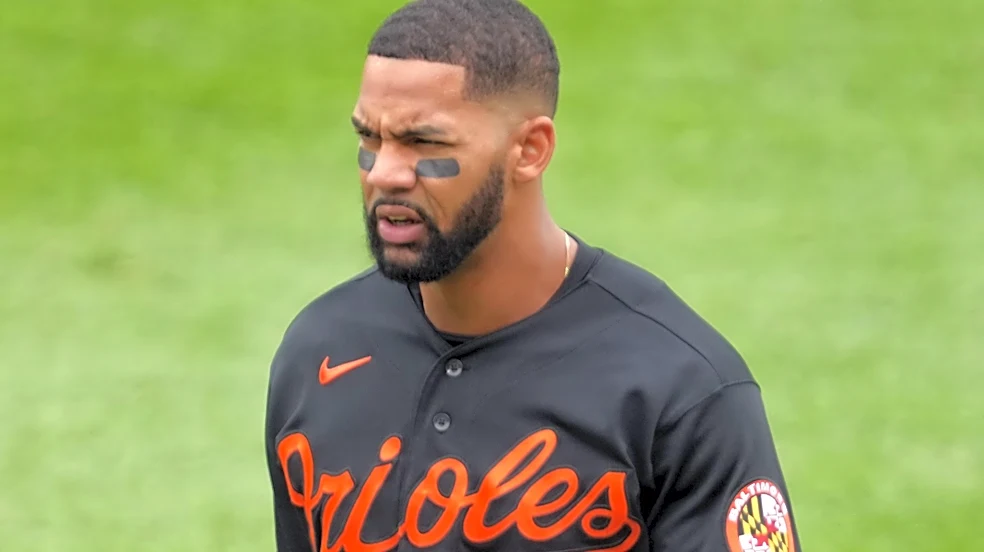



One of the real hallmarks of the 2026 Orioles is how many things happened where, if you were told in March that they were going to happen, you would know that meant the season went poorly. Not all of these things were bad. “Brandon Young is the team’s starting pitcher ERA leader” would have seemed apocalyptic, for example. That was good! Most that would have sounded bad in March did in fact turn out to be bad for a successful Orioles team, including this one: Leody Taveras led Orioles outfielders
in innings played this season.
The Orioles signed Taveras very early on last offseason, inking him to a one-year contract worth about $2 million for the 2026 campaign. That was less than fourth outfielder money for a guy who is kind of a classic fourth outfielder, in that he’s hit badly but not so badly as to be unplayable, he’s decent enough as a defender that he should be able to play any of the outfield positions, and he’s modestly fast, such that you could even maybe deploy him as a pinch runner sometimes.
There was nothing exciting at all about that signing. That was especially true since Taveras was coming off of a 2025 season where he had been horrible, getting dumped by the Rangers – where Taveras was once a top 50 prospect who debuted for his age 21 season – after just a month and then getting dropped by the Mariners, who claimed him off waivers, after about six weeks. He ended up batting .205/.226/.304 for 58 games of the 2025 season; that’s why the Orioles could sign him for the price they did. Taveras was hitting badly enough to be unplayable in 2025. It wasn’t a bad cheap bet to guess he’d be better than that this year. Overall, he was better than that.
The path to more regular playing time for Taveras opened up a couple of weeks into the season, when Tyler O’Neill fell ill and ultimately landed on the concussion injured list due to passing out during an off day at home and hitting his head on the way down. The Orioles shifted Colton Cowser out of center field to a corner spot and had Taveras as their every day guy while O’Neill was out.
Taveras seized the opportunity. By the end of April, he was batting .288/.397/.455. Of the younger players who we might have expected to play over Taveras, Cowser had a .489 OPS and Dylan Beavers was better but still not good at a .645 OPS. The Orioles responded to who was actually playing well and this meant more playing time for Taveras. He played most games in center field through early June. The main problem is he stopped hitting; he had a .630 OPS from the end of April until he relinquished the every day center field job back to Cowser.
The chaos kept on continuing for Orioles outfielders. Beavers suffered an oblique strain. Cowser batted like a guy who needs to never take an at-bat against a lefty starting pitcher. Taylor Ward was traded at the deadline. O’Neill got hurt again toward the end of the season.
What all of this meant was that Taveras stayed in the lineup even after he started hitting more like the guy who was ditched by two teams in 2025; he posted a .591 OPS from May 1 to the end of the season. That is unplayable, except if you’re on the 2026 Orioles and the other outfielders either keep getting hurt, or keep proving to be terrible defenders, or can’t hit a changeup, or whatever other problems were going on.
Taveras is the only reason the Orioles didn’t start turning to Christian Franklin- or Rece Hinds-level players earlier than they did. Never mind that Taveras himself probably would have been shuffled out of any semi-functional team’s outfield mix. That’s just not what the Orioles were in 2026.
Even so, Taveras ended the season at exactly 0.0 bWAR, so he was the definition of a replacement-level player. There is a whole lot of blue on the Statcast page. Blue is bad. There were, unfortunately, multiple below-replacement Orioles outfielders as the season went along, including Beavers. I think if you had gone back a year ago and told Mike Elias that his fourth outfielder signing was going to start 115 games, he would have probably signed a better guy than Taveras.
Or at least, I hope he would have. I don’t know. Elias is a weird guy who galaxy brains himself into stupid decisions sometimes. This wouldn’t be the first time and if that’s what it was, it won’t be the last either. He might have still thought he nailed it with signing Taveras, believing he had the secret to get Taveras to hit like it was 2023 (.733 OPS in a 2.9 bWAR season) again. This did not turn out to be the case. His defense was worse than past years as well, at least as measured by Statcast’s Outs Above Average. Taveras was a 34th percentile range defender.
It’s not exactly Taveras’s fault that every other part of Mike Elias’s outfield plan went haywire. You can’t expect a guy to be something that he’s not. Though in baseball, sometimes for a month or two, a guy can be something that he’s not, which Taveras managed to pull off in April.
There is no contractual obligation to the Orioles for Taveras next year. The deal was for one season and at the end of the World Series, that season is done. Something is going to have to be done about the outfield situation that was a complete disaster for the 2026 O’s. Hopefully, part of that is signing a better bench outfielder than Taveras, so that even if he is needed as much as Taveras was, that won’t be as much of a downgrade for the Orioles.