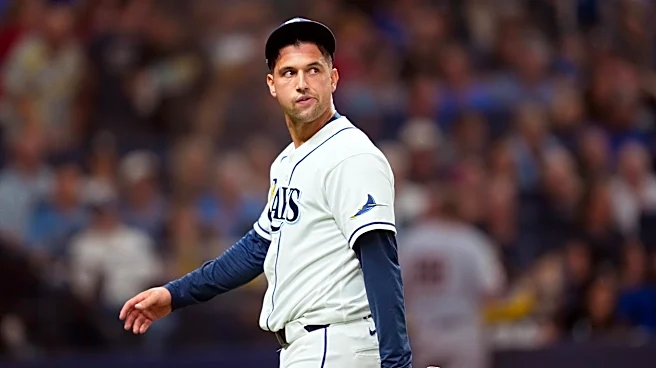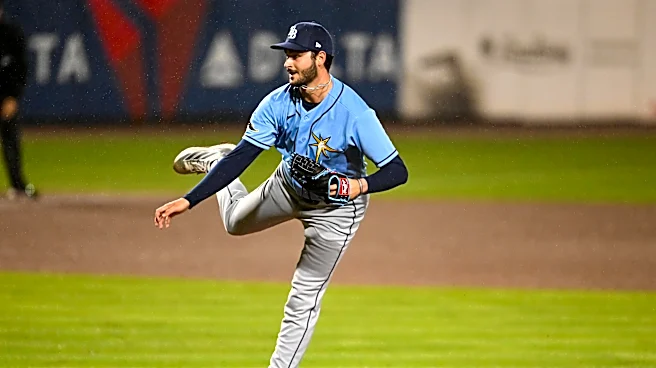


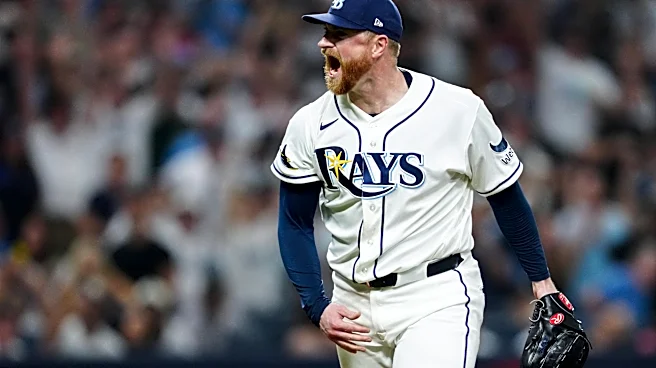
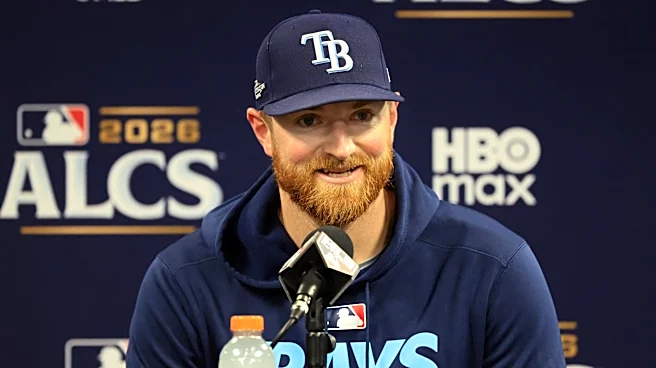
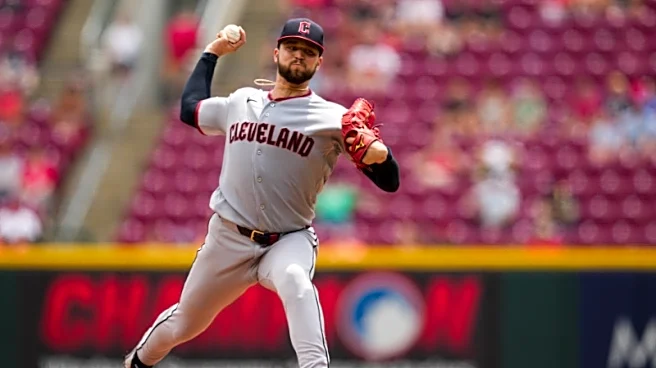
Michael Forret isn’t just a pitching prospect. He’s also a potentially fascinating science experiment.
You’ve heard of Rays Pitching Magic, right? The Tampa Bay organization, currently battling for the American League pennant, has a reputation for sprinkling metaphorical pixie dust on their pitchers to suddenly transform them into unhittable behemoths. The Rays have worked their magic both on journeyman major leaguers — witness Bryan Baker morphing from an unreliable middle reliever into the best
closer in baseball — and also on prospects, refining flawed youngsters into MLB-quality hurlers.
So that brings up a question. What happens when the Rays get hold of a new prospect from another organization, bolster him with their sorcery for a few months, and then send him back from whence he came? Can their pitching magic hold strong once the player returns to his original organization, or will he inevitably backslide without the Rays’ instructors to help him?
Michael Forret is the case study for that very scenario. The 22-year-old Oriole-turned-Ray-turned-Oriole-again spent just under eight months soaking up Tampa Bay’s wisdom and know-how. Now he’ll hope to bring what he learned back to the Birds, with an eye on potentially making his major league debut next year.
Forret (pronounced for-ETT) has become a sought-after prospect since his humble pro beginnings as the Orioles’ 14th round draft pick in 2023. The North Carolina native was a junior college pick from State College of Florida, a school whose most successful MLB player in history was — and you’re not going to like this — Glenn Davis (19.7 WAR).
Almost immediately in the O’s minors, Forret showed the kind of success that belied his late-round draft status. In 2024, he posted a 3.88 ERA and 11.2 K/9 for Low-A Delmarva and then-High-A Aberdeen, flashing increased velocity from his junior college days. But it was 2025 when he really broke onto the scene. At age 21, Forret dominated High-A to the tune of a 1.51 ERA in 16 games (15 starts) with a sparkling 11.5 K/9 and 0.804 WHIP. He slashed his walk rate dramatically from the previous year, from 4.0 BB/9 to 2.6. He earned a promotion to Double-A Chesapeake and made three excellent starts there as well.
Forret’s 2025 dominance saw him rocket up the Orioles’ prospect chart. He rose to #11 in MLB Pipeline’s O’s prospect rankings, one of the organization’s highest-regarded young pitchers. A year later, he’s #10. “He’s not your typical overpowering starter,” Pipeline writes. “The 6-foot-3 right-hander beats hitters with deception, a deep arsenal and command. There’s some crossfire action in his delivery, making him tough on right-handed hitters.”
The Rays are among the teams who took notice of Forret. And when the Orioles were looking to strike a deal last winter for cost-controlled starter Shane Baz, they ultimately agreed to include Forret as part of the five-player return package on Dec. 19. And so began the youngster’s journey with the developmental wizards in Tampa Bay.
Forret hit the ground running with the Rays, dominating with Double-A Montgomery. In 10 starts with the Biscuits, he was 6-0 with a 2.15 ERA, 1.049 WHIP, and 9.3 K/9. Even with a fastball that averages only 92 mph, Forret continued to demonstrate quality command and deception to get batters out. Writes FanGraphs’ Eric Longenhagen: “He attacks righties around their hands with the fastball and then dots sliders on the black away from them, while he jams lefties around theirs with cutters and sliders, and then forces them to choose between covering elevated fastballs or his sinking cambio (changeup).”
In June, Forret moved up to Triple-A for the first time, and the adjustment wasn’t exactly smooth. In two of his first three starts with Durham, he was battered for five runs. But he adapted quickly. He posted a 2.89 ERA in his next six starts, holding batters to a .645 OPS, and might have been in the Rays’ plans for a big league promotion late in the season.
And that’s when the Orioles came into the picture again.
At the trade deadline, the Rays were in the market for a setup man, and the Birds’ Tyler Wells was in their sights. The Orioles targeted a familiar face as their return piece. And voila, Michael Forret was back in the O’s organization in a one-for-one swap on Aug. 3.
“Getting the call that I was coming back to Baltimore was kind of a surreal experience,” Forret said in a MASN interview. “I obviously wasn’t expecting that, but I’m super excited to be back.”
So did Forret bring the Rays’ fairy dust back with him to the O’s organization? Well…the early returns aren’t great.
The O’s assigned Forret to Triple-A Norfolk, where he made five starts before the season ended. The results: a 6.35 ERA, 10.3 H/9, and 5.6 BB/9. Batters tagged him for an .804 OPS. Still, in such a small sample size, it’s hard to read too much into those lousy numbers. Forret had one particularly rough outing — an eight-run, 10-hit debacle against Gwinnett — but didn’t give up more than two runs in any other start.
Was Forret getting drastically different instruction from the Orioles’ coaches than he did in Tampa Bay? Not really, according to him.
“Now that I’m back, I’m seeing there’s more similarities than differences,” Forret said. “I think that a lot of what Tampa did was just pitch to your strengths, which was a very similar process to what we do over here. Be in the zone and understand the importance of getting ahead in counts, winning your 1-1 counts. [That] has become a big shift over here and they’re doing the same thing over here now, too.”
But Forret did learn at least one thing during his stint with Tampa Bay.
“I picked up a cutter with the Rays,” he said. “That’s a big pitch for the Rays organization. They want their pitchers throwing cutters. So I tried picking it up after I got traded. Starting getting the hang of it, and then in spring training finally fine-tuned it and everything. And that’s been a nice pitch for me to have this season, just to kind of bridge in between my fastballs and my sweeper [and] my changeup.”
Forret will start the 2027 season at Norfolk (assuming he’s added to the 40-man roster this offseason, and isn’t traded back to the Rays), where he’ll need to prove that his stuff will play against higher-level hitters. The 22-year-old righty has his flaws, and he might not have the highest upside of the Orioles’ stable of pitching prospects. But if the O’s need to dip into the minors for pitching help in 2027, they should make sure they don’t miss the Forret for the trees.