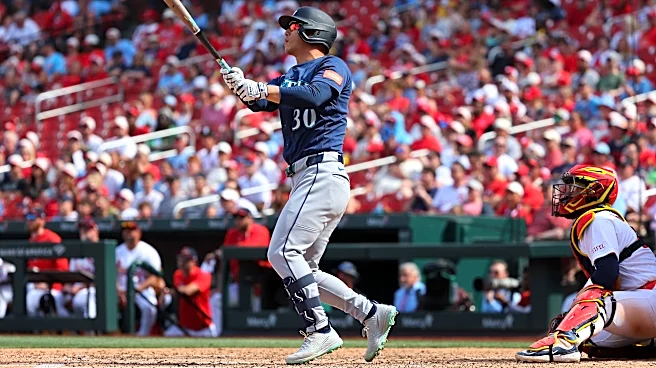








This discussion comes off the heels of the Mariners win on Sonday night over the Cardinals. The game was noteworthy for Rob Refsnyder’s big pinch-hit home run in the top of the ninth, and the manner in which it came about. Refsnyder watched a pitch about three inches off the plate called for strike 2, and then one even further outside – this one about six inches off the zone. Refsnyder challenged the call, got his second chance and put the next pitch into the bleachers. The challenge was the furthest
miss on a strikeout call so far this season.
Refsnyder’s challenge was far from the only use of the ABS system in this game, though. The teams went a combined 8-for-9 on ABS challenges, a rough night for Triple-A call-up John Bacon.
ABS has been a hot topic this season like instant-replay review was when it rolled out in 2014. It’s sparked BIG FEELINGS from seemingly everyone – players, umpires, managers, media, Lookout Landing commenters, etc. The writers met to discuss the impact of ABS this season and a proposed “grey zone,” described below. –Nick Vitalis-Troupe
Eric: Like, it’s no exaggeration that the Mariners lose yesterday without ABS, right? It wouldn’t have even gotten to Ref’s AB being the turning point as there were already 7 (!!!) overturned calls that would have changed the trajectory of the game.
Zach G: I would guess that the cumulative WPA swing was -0.3, if you don’t count the home run.
Anders: Well, the game might have gone to extras so you probably have to account for that. If not for the home run it becomes a 50/50 game, broadly.
Grant: The other consequential challenge I remember is JP’s 8th inning AB, where a 3-2 pitch went from a walk from a strikeout. MLB.com said there was a 31.7% increase in WPA from the home run, wow.
Evan: Shannon Drayer was just talking about this and she had some spicy things to say. I was surprised to hear her agreeing with Mike Salk about a “Grey Zone” after consulting with the players, which I strongly disagree with.
Matthew Roberson: What is a grey zone?
Evan: They want an area around the strike zone that’s essentially immune from challenges. A “close enough, call on the field stands” type of deal. Now, have they any clarifying details? No. But if Matt Brash spots one of his insane pitches and one of the laces nicks the strike zone? That’s a strike, not a ball. I feel very strongly about this.
John: Yeah, I get people being kinda in on the grey zone in concept, but what that actually is is expanding the strike zone, and any way to tilt the scales away from pitcher dominance is worthwhile.
Evan: Exactly. I would go so far as to say pitchers not liking it is, if anything, a reason to keep ABS exactly as is. It appears to be an inherently fair system that is currently benefitting the offense on a preceptory but measurable basis. ABS accidentally benefitted the offense, which MLB has wanted for years. No way they change it now.
John: I don’t think it was an accident. Or at the very least, they studied it enough in the minors to expect it would have at least a narrow positive impact on offense.

Evan: Personally, I still think the best argument in favor of ABS is that it isn’t for the players, it’s for the viewers. I’m not really interested in how the players feel about it. They get millions of dollars either way. We might as well get calls right, have definitive balls and strikes, because it makes logical sense and we have every ability to do so, and we shouldn’t not do it because it occasionally annoys millionaire athletes.
I am biased about ABS (clearly); I love it so far. I genuinely think it’s a semi-revolutionary change to the watching experience, even relative to the other changes baseball has made recently. I think the 2026 season is the best video product baseball has ever produced. I might be in the minority, there, but to be clear, I believe ABS is an overwhelmingly positive change.
Ryan: I actually like the grey zone personally but it creates two separate strike zones and I get why it’s not a popular idea. I’d still prefer full ABS to either.
Anders: Idk man, if players are actually irritated about it, this is just one of those things where the human mind takes a loss a lot harder than it savors a win. Batters are getting benefits out of this too. But they will whine about the instances where it hurts them. If it feels too “pedantic,” idk what to tell them. It’s a strike.
John: I agree. It’s boundaries. People will always complain about boundaries, but if they moved them they’d complain about them in the new place. A thing being clearly yes or no is better than arguing over “well, they got it wrong, but not too wrong so we’ll leave it wrong.”
Kate: I started out liking this grey zone because I feel like missing a call by the seam of a baseball sucks and should be what the umpire originally called so the ump doesn’t take an accuracy hit – kind of like the “call upheld but not confirmed” thing when there isn’t enough evidence to overturn it. But as it was explained to me, this is one of those things where you could just go on forever and gradually just expand the zone and now that I’ve typed this out I actually think no, I was correct originally. I think within a one-inch buffer zone, it should go back to what the umpire called originally.
Ryan: I just don’t like the super tight margin of error calls. If an ump makes a call, and ABS changes the call within <.01 inches, then we haven’t really improved the accuracy of the call, we’ve just kind of flipped a coin.
To me, the spirit of the challenge system should be for middle-middle pitches where the umpire blinks and calls it a ball. If we actually wanted better accuracy and symmetry, we would just go full ABS.
Evan: If the spirit of using ABS is to get more calls right, having a zone that you have designated where it’s okay to get calls specifically wrong (and not just wrong but ABS challenged and still wrong), that’s very silly.
Anders: Right, so then does the team lose a challenge if they were “correct” but the call wasn’t wrong enough to overturn it? This is just getting so messy.
Gotty: Ryan, I guess I feel that the line has to be drawn somewhere. The answer clearly is full ABS, but for now, if you create a gray zone of .25 inches, aren’t you now creating the same issue if a ball is off by 0.251 inches? This would feel absurd if we extended this to tennis, because the ball is either in or it’s out. Likewise, a pitch is either a ball or it’s a strike.
Ryan: Yeah, absolutely.
Ders: I think people are searching for a perfect system. There is no perfect system. There are hundreds of people affected by this change, and millions if you extend it to fans. Some of them will be mad no matter what you do.
Gotty: Everything until we get true ABS will be a temporary band-aid that we’ll all try to forget eventually.