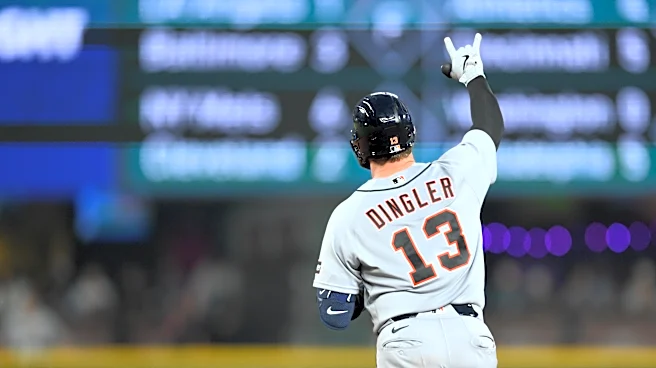

On Tuesday, the Detroit Tigers announced that starting catcher Dillon Dingler was the recipient of the team’s 2026 Heart and Hustle award. There couldn’t be a more deserving candidate. Dingler put the team on his back for months in the middle of the season, playing everyday and producing as the best catcher in baseball on both sides of the ball. His defense, his leadership, his bat, and the extra workload he shouldered are all to his credit. He ran out of gas in mid-August and it’s been really rough
ever since, but it was still a very successful season for the Tigers primary backstop.
The problem is how to project him going forward. Clearly he hasn’t fully unlocked some new level at the plate where we should expect greatness like we saw in June and July. He’s likely going to end up with basically the same run production he had in 2025 when he posted a 108 wRC+. Currently, he’s at 109 wRC+ for 2026, and that’s despite posting back-to-back months below a 50 wRC+ mark to close out the season. After hitting a 4.1 fWAR mark last year, he’s currently at 5.0 fWAR even in 2026, ranking him the 14th most valuable position player in baseball. Per Baseball Reference, those marks are lower at 3.2 rWAR for 2025, and 4.2 rWAR this season, but B-Ref doesn’t use Statcast’s detailed catching metrics and weighs catcher defense a little lighter as a result.
Either way, the key to Dingler was always his defensive ability. He grades out as the most valuable defensive catcher, and one of most valuable defenders at any position in baseball. Per Statcast, Dingler is fifth in blocks above average with 11. He and the Blue Jays’ Brandon Valenzuela are tied for the lead in framing with eight runs saved. In throwing and pop time he remains near the top of the leaderboard firmly in plus territory. He draws good to elite grades in all elements of the catching position.
This was the reputation when Dingler made his way slowly through the minor leagues before debuting in August of 2024, four years after he was drafted out of Ohio State in 2020 with the first pick in the second round of the amateur draft. Dingler was always an elite catcher in the minor leagues. His offensive production was the more difficult part of the equation. He spent parts of three seasons stuck in Double-A Erie, slowly cutting down his strikeouts, and finally in 2024 at the Triple-A level, he posted a strikeout rate of 20.3 percent with a walk rate of 10 percent, and finally looked ready to go. He didn’t hit the ground running after taking over from Carson Kelly, who was traded to the Texas Rangers at the 2024 trade deadline, but his two full seasons at the major league level now show him as an above average hitting catcher who is one of the top defenders in the league.
In 2026, he started out with pretty typical production, but in June and July, he went nuts, and he did it by massively improving his production against sliders. Sliders in particular have always given him trouble, while he’s feasted more on sinkers and north-south offspeed pitches like splitters or straight changeups. This year it was offspeed stuff that really gave him trouble. Left-handers with good changeups were a problem for him all year long.
What’s particularly notable about this, is that improvement against the slider, and struggles with changeups and splitters, meant that his production was a lot better against right-handed pitching. Dingler currently holds a 129 wRC+ against right-handed pitchers, which is outstanding, but just a meager 66 wRC+ against left-handed pitching this season. Lefties who can spot sinkers away and occasionally back foot a breaking ball, can otherwise lean on their offspeed pitch and tie him up this season. That’s a complete reversal of his splits from 2025, when he mauled lefties for a 169 wRC+ and managed just an 89 wRC+ mark against right-handed pitching.
Dingler made some adjustments to his setup that might explain the increased production against right-handed pitching, particularly against sliders. He started setting up in an open stance, and then using his leg kick, which is basically the same both seasons, to get himself back into a more neutral position with his shoulders and hips square. He also stopped laying off his barrel over his shoulder, and is getting the bat into a more vertical position right before he starts to load his hands. The stance changed helped him keep from flying open against right-handers, which always had left him pretty vulnerable to their sliders. Instead, he preset himself open in his initial stance, and then used his leg kick to rotate back into a fully loaded but more neutral, squared off position at pitch release.
The change to his barrel angle wasn’t major, but presumably by keeping the bat more vertical rather than laid off over his right shoulder, he was able to get the barrel down to the zone earlier and catch more balls with loft, producing the huge surge in power we saw for much of the season. That might explain his improved ability to hammer sliders and the occasional changeup even when they were below the zone. In fact, during his red hot stretch in June and July, he often appeared to be hunting sliders down, knowing he was crushing those pitches with good loft and doing a ton of damage.
So what went wrong? There really isn’t a simple answer other than fatigue, but while that might explain a month long slump, by now you’d expect things to be coming around. Still he has played a lot. Even with AJ Hinch giving him more rest as Eduardo Valencia has settled in, Dingler is still going to finish with 143 or 144 games played this year, assuming one day off in the final series against Pittsburgh. He appeared in 126 games in 2025. He currently has 594 plate appearances compared to 469 in 2025. And yet, he’ll actually finish the season having caught less games than in 2025. His bat was so needed in their lineup after their collapse in May, that Dingler picked up a lot of extra shifts as the designated hitter on days off from behind the plate. Of course, there’s still plenty of work on a DH day, and that lack of full days off certainly could have caught up to him in August.
Take a look at Dingler’s pitch chart for his extra base hits this season. Below, you’ll see the same chart from 2025. He was clearly emphasizing hunting pitches down this year and doing a lot more damage on them, whereas he had a little more neutral bias in his pitch chart in 2025. The stance and barrel angle adjustments played a part as well, but the results indicate clear intent to hunt the ball down in the zone or even below it if necessary, while letting the high fastballs go by. This worked until August, and perhaps by then his legs were just gassed. Tired legs are stiff legs, and that ability to sink into his legs and leverage these lower pitches into the air likely suffered for it.


So, should we just expect that a better rested Dingler will get back to destroying the baseball in 2027?
Well, I think we can expect above average production again, but the fact is that Dingler is a pretty streaky hitter and will remain so without some amazing improvement in his plate discipline. He’ll need to readjust to the adjustments pitchers made to him after months of getting torched. Beyond that, players who chase a lot and don’t walk much just tend to be more erratic in their production, and plate discipline has always been a bit of a problem for Dingler. His walk rate in 2024 was a miserable 3.9 percent. In 2025 it was 4.9 percent, and in 2026 he raised it a bit further to 5.6 percent, but this is still roughly two percent lower than league average. At least he’s trending in the right direction.
Here’s his production by month. Obviously the highs and lows are somewhat BABIP dependent. It’s not as though he’s starting striking out a crazy amount either, though those numbers have certainly trended the wrong way. A combination of bad luck and fewer hard hit balls in the air is to blame for his production crumbling in early August, and it hasn’t come around in September despite playing a little less.
As the low walk rates after May indicates, Dingler’s chase rates, or O-Swing percentage, remain on the high side. In 2024, he chased 36.7 percent of the time. In 2025 he cut that to a more palatable 30.2 percent, but then reverted back somewhat in 2026 to 33.7 percent. League average this year was 32.9 percent, so he’s not a disaster in this regard, but he strikes out more than average, and walks less than average, so there is certainly room for improvement. We’re probably not going to see that though. Instead, recently having turned 28 years old, this is just who Dillon Dingler is as a hitter. He’s going to have stretches where he’s chasing too much and caught between hard and soft stuff, and he’ll have runs where he’s a dominant hitter doing a lot of damage because he does make plenty of hard contact despite the strikeouts. There’s no need for more, because Dingler is more than enough already.
Dingler’s value is tied directly to his skills behind the plate, and the Tigers need to put themselves in positions where they aren’t riding an elite defensive catcher into the ground because they need maximum offensive production out of him too. That’s only going to become more relevant as he nears 30.
His work ethic, intelligence, and leadership all draw rave reviews from his coaches and teammates, leading to Dingler being voted the Tigers’ Heart and Hustle award winner this season. He’s going to give them everything he’s got, and this year they may have just drained the tank long before the season neared its endpoint. Pushing for more, especially as he’s into his late 20’s, is a bad idea. The Tigers have a lot of bats without a real defensive home. Sorting out that group and getting the most offense possible out of them is a necessity so that Dingler can just do what he does best, and catch as many games as possible.
Despite the collapse in August and September, it’s been an outstanding overall season for Dillon Dingler. He’ll finish the season as one of the top 20 position players in the game. Between him, Kevin McGonigle, Riley Greene, and now Max Clark, the Tigers look like they’ve got more than enough high end talent to get back to contention next year from an offensive perspective. The problem is getting enough out of the other positions on the field to balance out the lineup and the team’s defensive needs. Sort the rest of the roster out, and just let Dillon Dingler be Dillon Dingler next year. The Tigers, and his longer term career outlook, will be better for it.