






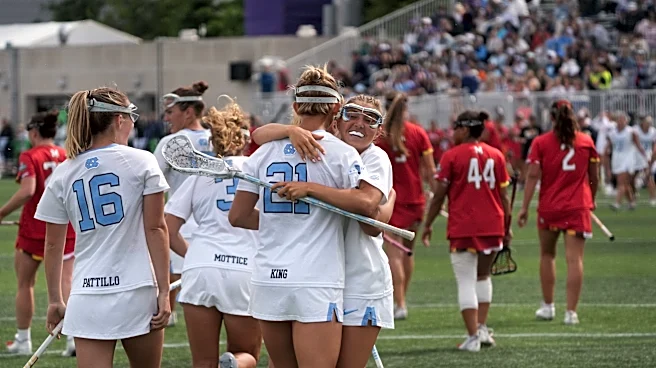

The ball was still in the air when Madison Taylor knew.
Not the result. Not the final score. Something else.
Something that had nothing to do with lacrosse and everything to do with why she was playing the sport.
She had just assisted on her sixth goal of the afternoon: a feed to Gabriella McCollester, a first-year from Colorado who had spent most of this national championship game making herself a start. As Northwestern went up two on North Carolina with six minutes left, the lake wind cut through
Martin Stadium and 8,316 people roared so loud that you could feel in your ribs.
But that was not what Taylor felt.
What she felt was Lucy Munro — her best friend. The senior who had gone down in agony earlier that game, whose afternoon ended on the Martin Stadium turf in the first half. Munro had looked up at Taylor from the ground and said through pain, tears and the cruel mathematics of an unforgiving sport: “Maddy, you got this.”
Taylor remembered that in every huddle. In every timeout. When the Tar Heels led. When the lead changed. When the fourth quarter arrived and everything was still in doubt.
“We knew it was going to be hard,” Taylor said. “Even when we were down, there was ups and downs, and when we were at a low point we just stuck together every single second.”
So they did.
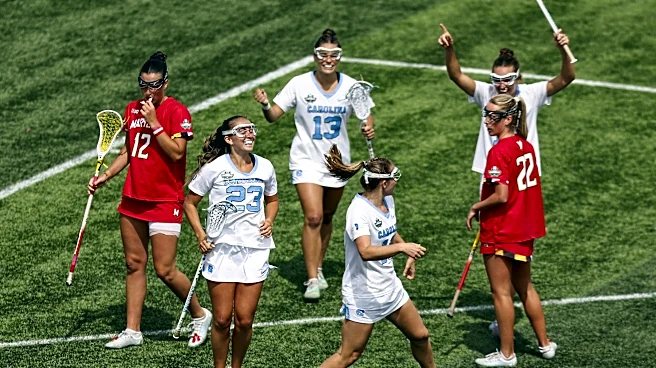
Northwestern 14, North Carolina 11.
The No. 1-seeded Wildcats did not just win their ninth national championship under Kelly Amonte Hiller on Sunday afternoon at Northwestern Medicine Field at Martin Stadium. They did not just become the first team since Maryland in 1986 to win a title on its home field. They did not just hand Amonte Hiller more championship hardware than any Division I lacrosse coach, men’s or women’s, in history.
It’s deeper than that.
This team lost on senior day in mid-March and had to decide what it wanted to become.
This was a program that had been to three straight national championship games and lost two in a row, including last year’s final to these same Tar Heels.
This was a team that just barely outlasted Colorado two rounds ago in double overtime.
This was a senior class that had played in four title games and knew exactly how it felt to walk off a field as their opponents celebrated…two years in a row.
And this was a team that when its back was against the wall, knew exactly where to turn because of their past encounters with those bumps in the road.
“Those adversities at the beginning of the season were such a gift to us,” Amonte Hiller said afterward.
To understand why, you have to go back to a moment when none of this felt possible, when the only thing anyone could talk about was what Northwestern was not.
The losses came in clusters.
Colorado on Feb. 9, a 10-9 heartbreaker at home. Syracuse on March 12, a 9-6 slog where the offense never found its rhythm. Then Ohio State on March 15, a 16-15 loss that felt like a season tipping over.
Three losses in five weeks. For a program built on championships and for a national audience that measures success in May trophies, the noise was deafening:
What is wrong with Northwestern? Too much turnover from last year. Too many close games slipping away. The dynasty is falling.
That was the story. That was all anyone could see.
These losses were evidence, or so the narrative went, that something had been broken. A program that had once seemed invincible was suddenly vulnerable. The questions followed the team everywhere: on the bus, in the locker room, even in the quiet moments before practice when doubt has nowhere to hide.
Inside the Northwestern locker room, Amonte Hiller saw something else, as she recounted in the postgame press conference. After the Ohio State loss, she gathered her team and offered them a choice: they can look at this as “poor us,” she said, or they can look at this as a gift. An opportunity to reflect. To love each other more. To grow stronger, individually and collectively.
The team chose the gift.
“That’s not an easy thing to do,” Amonte Hiller said, “to have self reflection and to really look deep. That’s why I say this team is coachable, because I pushed them on that. That’s one of my strengths. And they did. They looked deep. They never stopped believing.”
“Don’t Stop Believin'” is her personal motto. The song by Journey is quite literally her ringtone.
On Sunday, it was the quiet engine underneath every goal, every save and every challenge initiated from the sideline.
The tale of two seasons could not be more stark. After the Ohio State loss, the Wildcats were 5-3 and lost in a dark tunnel, searching for a beacon of hope. That was the last game they’d lose in 2026. A 14-game winning streak closed the season— one that encompassed a Big Ten regular season title, a conference tournament title and a national championship win on their NU’s own field.
The same team. The same players. The only difference was what they decided to believe about themselves.
Midway through the third quarter, with Northwestern trailing 9-7, the national title game threatened to get away from the ‘Cats. North Carolina’s Reese King appeared to have scored, which would have pushed the Tar Heel lead to three, but Amonte Hiller signaled for a challenge without hesitation. The replay, piped to her tablet by the team’s IT director, confirmed what she suspected: a crease violation. The officials waved off the goal.
That challenge kept the game within reach. Instead of facing a three-goal deficit, Northwestern got the ball back down two.
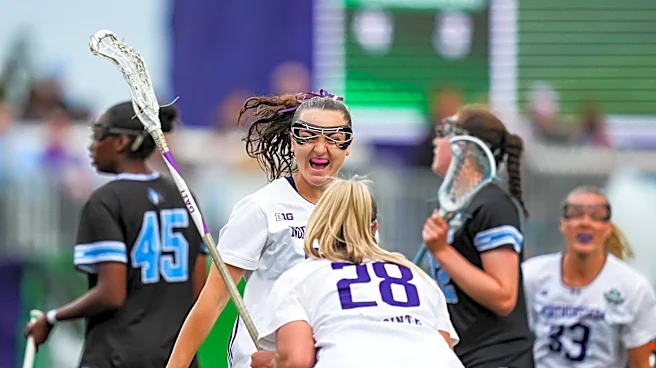
Moments later, Maddie Epke scored to cut the deficit to one. The momentum had shifted.
What followed was a fourth quarter that will live forever in program lore.
Northwestern trailed 11-9 entering the final 15 minutes. The Tar Heels had scored three of the game’s last four goals. The home crowd, so loud for three quarters, was starting to hold its breath. Everything that went wrong in March felt like it was about to repeat itself in May.
It didn’t.
Five unanswered goals in the fourth. The defense denied UNC in the final 15 minutes. And another challenge from Amonte Hiller, this one coming with about 6:30 left, right after Northwestern had reclaimed the lead kept it in the driver’s seat.
Caroline Godine and the Tar Heels thought they tied the game at 12. They erupted upon seeing Godine’s shot meet the net. Amonte Hiller had seen something else on her tablet — a dangerous follow through that made contact with Mary Carroll. The officials saw the same upon review. The goal came off the board, and Godine was sent to the penalty area for a card.
A dagger into the heart of North Carolina.
In a game decided by three goals, those two challenges were the difference between a comeback and a collapse. The first kept Northwestern alive. The second sealed its fate.
“I was very confident in both of the challenges because I had the review,” Amonte Hiller said afterward. “I had different angles.”
She gave credit to Eric Winchester, a critical member of Northwestern’s IT department. She gave credit to Kiera Shanley, the director of operations for Northwestern Lacrosse, who made sure she could see what she needed to see.
This is what nine national championships takes. It is not just the stars. It’s what goes on behind the scenes. It’s the guts to challenge. It’s a coach who never stopped believing and a team that followed.
When Munro went down in the first half, the Wildcats needed someone to fill the void. Enter McCollester: a rookie had spent most of the season waiting for a moment like this. S
he had scored six goals all year entering Sunday and had never scored more than two in a game. But she had stayed ready, as she put it, because her teammates kept telling her to.
“Everyone around me and the team believed in myself and just kept telling me to stay ready,” McCollester said. “And I stayed ready.”
She netted four in the national championship game, two of them in that fourth-quarter run. The final goal came on the man-up advantage created by Amonte Hiller’s second challenge. Nearly half of her scoring output in the 2026 season came on the sport’s largest stage.
“I just can’t believe it,” she said in retrospect. “It’s amazing.”
The story of this team is not about Xs and Os. It is about who stepped up when someone else could not.
Munro’s afternoon ended in the first half. The exact nature of the injury was unclear in the moment, but the sight of her on the turf, unable to continue, said enough: a senior who had waited four years for this moment, who had earned the right to play on championship weekend, was robbed of the rest of her final game.
There is no fairness in sports. There is only what happens next.
And what happened next was McCollester stepping into the void.
What happened next was a team deciding that Munro’s game would not end in the first half. They would carry her the rest of the way.
Taylor, the three-time Tewaaraton finalist who entered the day needing seven points to tie Izzy Scane’s program record of 483, did not spend the afternoon hunting history. She spent it feeding everyone else. She finished with six assists and one goal, a performance that looked from the outside like a superstar deferring. From the inside, it looked like a senior who had learned something over four years and four national title games.
“We just wanted to attack, attack, attack,” Taylor said. “Play really fast.”
But also: play for Lucy. Play for the people who could not. Play like this might be the last time you ever share a field with these specific humans, because it was.
“That was, like, an ending that you would see in a movie,” Taylor said. “I don’t know, and it just happened in real life.”
She finished her career tied with Scane at 483 points, a fact she did not know until a reporter told her after the game. Her reaction was not a number. It was a name.
“I got to learn from her throughout my first two years here,” Taylor said of Scane. “I feel like I was able to take what I learned from her to the underclassmen now. That’s crazy. I can’t believe that. I mean, nothing better than that.”
When Amonte Hiller was asked to describe what Taylor has meant to the program, her answer was not about points or records.
“I just feel so blessed to have been able to mentor her,” the coach said. “She is a really special person. When we first recruited her, both her parents are teachers from Long Island, and we just sold her that this experience could really change your life, not just the lacrosse experience, but getting a degree at Northwestern. And to see what she’s done, not just in the games, but every single day at practice, she’s a great teammate. Everybody loves her. And hardest worker in practice every day, just so coachable. It’s just been a great honor to be a part of her life.”
On the other side, Jenika Cuocco made 11 saves. The defense held North Carolina, the nation’s most prolific offense at 17.85 goals per game, to just 11. Mary Carroll drew the assignment of containing reigning Tewaaraton winner Chloe Humphrey and silenced her down the stretch.
“She’s a beast. She’s a dog,” Cuocco said about her partner in crime in the defensive zone.
Cuocco, a graduate transfer from Drexel who finished her career with a single-season program-record 191 saves, anchored a unit that refused to break. After the win, Amonte Hiller mentioned that Madison Smith had been throwing up the night before, but unwilling to sit out the next da:. “that kid is the heart of toughness,” she said.
A national championship won by a team that refused to make excuses, that played through illness, injury and the weight of expectation, reframing every obstacle as a gift.
The weather had been a character in this story all afternoon. At the opening draw, grey skies and cold rain — the kind of damp that seeps into your bones and makes every seat uncomfortable. The lakeside wind did not help. It never does.
For the first three quarters, the conditions matched the tension on the field: unsettled, unpredictable and hard to read.
But somewhere in the fourth quarter, as Northwestern mounted its comeback, something shifted.
The rain stopped. The clouds broke. By the time the final whistle blew and the Wildcats stormed the field, the sun was out. Rain poured down on 8,316 people who had trooped through the gloom, who kept believing when seemingly impossible. At day’s end, they stood in the light — the same light that Northwestern was searching for after losing to Ohio State in March. That reality brought jubilation to that crowd.
You could not have scripted it better. The weather, like the team, had turned.
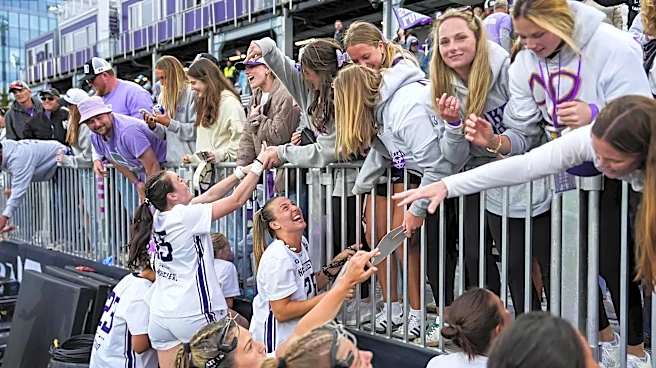
The stadium emptied. The field, torn up from 60 minutes of a national title game, would soon go quiet. The crowd had slowly spilled onto the grass after the final whistle, had screamed and hugged and taken photos and slowly filtered back toward their parked cars with lifelong memories.
And somewhere in the aftermath, Lucy Munro existed in a space that no headline could capture. You could only imagine what she felt in that moment: the relief that her team had finished what she could not, a feeling that followed the ache of helplessly watching from the trainer’s room.
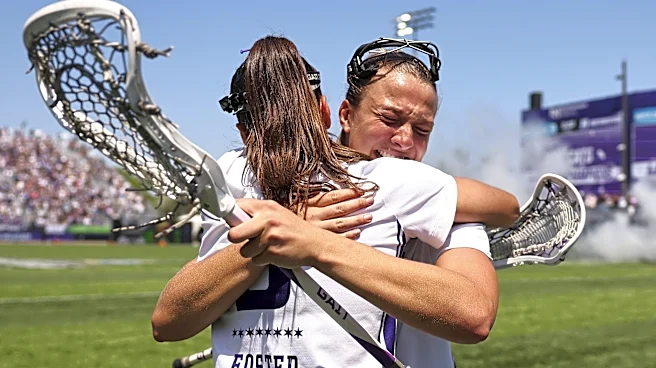
She had been robbed of playing the rest of her final game, but she had not been robbed of the title of national champion. The trophy belonged to her, too. The words of “Maddie, you got this” propelled a masterful performance from her best friend.
Taylor was asked, after the game, to compare this title to the one she won as a first year in 2023. Four years apart. Two different versions of herself.
“I feel like this is a really full circle moment,” she said. “That was literally me four years ago,” gesturing to McCollester, who took center stage when NU needed a spark, “and now I’m sitting up here four years later. I’ve just learned so much about myself and this team and everything about this program. It fits me so well.”
In the end, nobody could conclusively describe it better than Taylor herself.
“Last game, best game,” Taylor said.
She meant it.