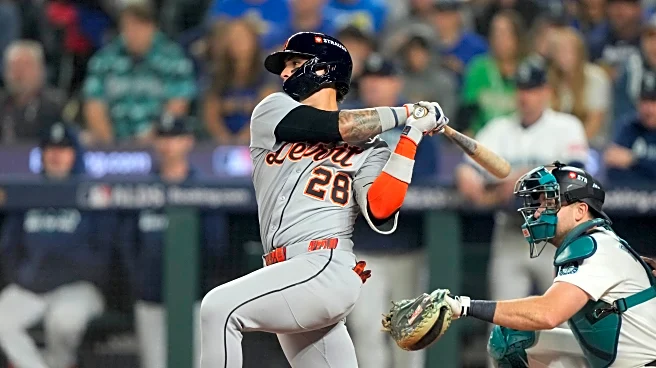

Now that the 2025 Major League Baseball season is well behind us, and the sting from the Detroit Tigers’ final-game marathon against the Seattle Mariners has begun to subside, I thought it would be a fine
idea to look back at some Tigers statistics from, as the saying goes, a “thirty-thousand-feet-up view.” Stats are from Baseball Reference and Baseball Savant.
You can go deep down the rabbit hole unpacking each one, following the trail from wOBA, to xwOBA, to the magical xwOBACON. What is xwOBACON? And can we get eggs and hash browns with that?
(Expected Weighted On-Base Average on Contact) is a measure from Statcast that considers a player’s offensive production only when they make contact, removing strikeouts, walks, and hit-by-pitches to assess the quality of batted balls, indicating how well a player should have performed on contact alone, not what they actually got.
We’re not serving xWOBACON right here though. There’s something to be said for stepping back and just considering the basics relative to the rest of the league.
Batting and Baserunning
These statistics will only be within the 15-team American League. What happens over there in the National League, anyway? Are there dragons on the field? Nobody knows. That’s just a strange parallel universe that only crosses into “real” baseball now and again, and frankly, I wish we didn’t have to have any interleague play at all. What’s this? They’ve had the DH for years now? Ok, well good for them. But, I digress; I’ll be selecting some statistics which I find interesting, surprising, important, silly, or all four of those.
OPS: .730 (6th place, league average .719)
This one was a little surprising, given how often it seemed like the Tigers struck out. However, you’d expect roughly seven or eight teams above the league average, and seven or eight below, but the average was skewed upwards by the Yankees (.787) and Blue Jays (.761) far ahead of the third-place A’s (.749). Last place in the league? Your AL Central-champion Guardians (.670), which makes me irrationally mad.
Strikeouts: 1454 (4th place, league average 1371)
Ah, there are the whiffs. Again, the average was skewed upwards by one team in particular: the Angels (1627), who were single-handedly trying to cool southern California with all those swings. We like to complain about our free-swingers, but holy mackerel, they had six people in triple-digits, led by Mike Trout who only played in 130 games.
Home runs: 198 (5th place, league average 196)
Again, some serious skewing by the Yankees (274); indeed, the Tigers were in fifth place in the entire league, but only two home runs above league average. Still, for all the strikeouts and the second half collapse, the Tigers hit their share of home runs and it’s a big reason they can overcome their strikeout rates, at least in the regular season.
Stolen bases: 61 (15th place, league average 114)
The Tigers were last by a longshot, sixteen behind the Blue Jays. But hey, the Jays took the Dodgers to extras in Game Seven, so I guess it’s not that important, right?
Runner runs: 8.0 (1st place, league average –0.1)
Essentially, this is the number of runs created on the basepaths by advancing extra bases and not getting thrown out. The Tigers led all thirty MLB teams in Advance Attempt Percentage, which means they were the most aggressive team on the basepaths; they tried to advance 40% of the time in all situations where the average expected percentage would have been 36% for a generic runner. Now, they did get thrown out fifteen times on the bases, highest in the Major Leagues, but life’s about taking chances.
It’s an interesting mix between stolen bases and overall baserunning. The Tigers aren’t exactly stacked with speed, but even considering that they really don’t try to steal much. You’d like to see them at least present a threat to steal more often to keep opposing pitchers and catchers on their toes. That they managed to make up for it by taking the extra base to such a degree that they were the best baserunning team in the American League is pretty impressive.
Pitching
Team shutouts: 17 (1st place, league average 11)
Sure, one of those was a complete-game masterpiece by Tarik Skubal, but the other sixteen were, by definition, a team effort. When you can throw a boatload of fresh, reliable bullpen arms in there for one inning each from the sixth onward, that’s going to smother the other team’s chances pretty nicely. Remember the Royals’ World Series three-headed bullpen monster that helped them to a World Series title in 2015? Yeah, even more like that, please.
Intentional walks: 14 (12th place, league average 21)
It appears that AJ Hinch generally isn’t a fan of the intentional walk, which is fine by me. Like cologne, it should be used sparingly, and only when it would give you a huge advantage and/or scare away dangerous wildlife, and then Jose Ramirez. The Angels, though? Their hitters strike out, and their pitchers intentionally walked the most in the league (44). Maybe that’s partly why the Angels had the worst ERA in the American League.
BAbip against: .288 (7th place tie, league average .288)
Batting Average on Balls in Play (BAbip) generally shows how lucky or unlucky a given hitter is. A batter goes on a hot streak out of nowhere, but his BAbip is .450? That’s not gonna last. But this statistic shows that Tigers pitchers were tied with the Mariners for exactly-average luck (measured in this particular way at least). There weren’t an unusually large numbers of “ground balls with eyes” or easy fly balls that just weren’t caught. Then again, individually, Chris Bassitt of the Blue Jays led the league with a .315 BAbip-against, and he had a decent year on the mound; last year he had a similarly-solid year but was incredibly unlucky at .335.
Run Value on a particular pitch: Tarik Skubal’s changeup, 25 (1st place)
Alright, so this isn’t surprising: Skubal’s changeup may well be put on trial for murder. Cleveland’s Joey Cantillo actually gets a higher swing-and-miss percentage on his changeup (49.4% to Skubal’s 46.8%), but when hitters make contact with both those changeups, Skubal’s slugging percentage-against is .227 to Cantillo’s .270. Those are both great, but Skubal’s is the lowest in the Major Leagues on that particular pitch. (The three worst Run Values belong to Rockies four-seam fastballs. Gotta love that thin mountain air.)
Fielding
Outfield assists: 16 (14th place, league average 22)
Perhaps this also isn’t terribly surprising: Tigers outfielders generally don’t gun guys out on the bases: the less said about Riley Greene’s arm the better, and with Akil Baddoo signing with Milwaukee, at least we won’t have to watch him try to heave a baseball into the infield in a Tiger uniform again. The only team below Detroit was the Yankees; Aaron Judge had an arm injury for a good part of the year, but they’d sure rather have him out there than Giancarlo Stanton these days.
Catcher framing runs: Dillon Dingler, 7 (6th place)
Assuming that 0.125 runs are generated for every extra expertly-framed strike, that’s pretty nice. The leader in the American League was Toronto’s Alejandro Kirk with 17, but the runaway winner overall was the Giants’ Patrick Bailey with 25. That Dingler fellow, he’s a keeper.
Double Plays turned by pitchers: 14 (1st place, league average 8)
When I saw this I had a hunch: “I bet a bunch of those were by Skubal on weak comebackers.” Nope! Skubal was involved in exactly zero double plays this year. Keider Montero and Will Vest each turned a pair, and even Dylan Smith got one in his brief cup of coffee, on June 25 against the A’s.
As the old saying goes, “There are lies, damn lies, and statistics.” Well, make of these statistics what you will, but none of the stats here told any lies. Some might be fairly meaningless, some might be telling, but in the end, counting things is fun: just ask Count von Count from Sesame Street, he’ll tell ya. Do you have any surprising, important or strange stats? Feel free to share them with us, and everyone else, in the comments.