

I thought today I’d take a break from posting trade and free agent target articles and instead delve into a topic that I’ve been interested in ever since MLB changed from the unbalanced schedule to a balanced one in 2023.
In September, I posted this article citing the balanced schedule as a possible reason MLB batting averages are down. The reasoning behind that is:
Now, with the balanced schedule, every team plays all 29 other teams and there are 48 interleague contests per team. What that means,
of course, is that teams are playing nine clubs that they didn’t used to see, and fewer games against divisional opponents, down from 19 to 13.
This, obviously, means that players would see many more different pitchers. In 2022, 523 different men pitched for MLB teams. Now, this includes position players pitching, though that was done far less even that recently — only 30 different position players that year, compared to the ridiculous number of 11o this year. We can’t really take an “average” per team because some of these pitchers pitched for multiple teams.
You ready for this? There have been 856 different players throwing at least one pitch for an MLB team this year. Even if you take out the position players for both years, that’s still a 48 percent increase.
There are other possible reasons, of course, but if MLB returned to the unbalanced schedule where divisional foes played each other 19 times a year instead of 13, hitters would see the same pitchers more often and perhaps be able to develop ways of hitting them
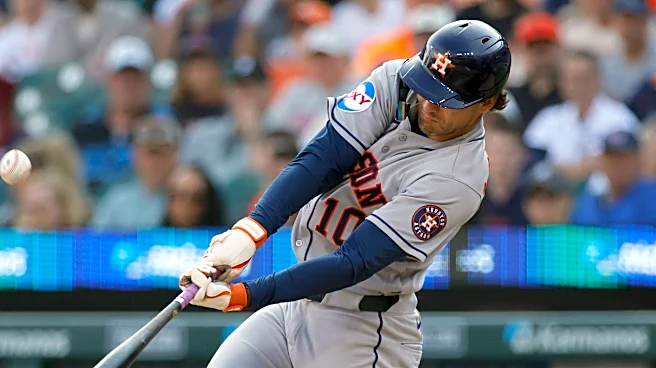
One other unintended consequence of the balanced schedule is the fact that there was a division winner in 2026 with a .500 record, the AL West champion Houston Astros at 81-81. (And they had to win their last two games to get there!)
This happened despite the fact that division had two of the three worst records in MLB — the 64-98 A’s and 62-100 Angels. Incidentally, in their 65-year history before this year, the Angels had never lost 100 in a season. They were the only current MLB franchise with that distinction, until 2026.
If there were more divisional play, it seems likely that one or both of the Rangers or Astros would have beat up more on the A’s and Angels and would be in the mid-to-high 80’s in wins, at least, or maybe closer to 90, although the 2026 results didn’t reflect that — the Astros went just 14-12 against those two teams.
Generally, though, you’d expect that if teams played 76 intradivisional games (19 vs. each team) instead of 52 (13 vs. each team), that someone would take charge and win more games.
The most extreme example of this came in a season that didn’t get finished — 1994. When the strike came, the Rangers led the AL West despite a record 10 games under .500 at 52-62, and had that season been completed we would have had a division champion with a losing record — there’s no chance those Rangers would have gone 30-18 to finish over .500. (The A’s were second in that division at 51-63; they’d have had a losing record, too, even if they had caught the Rangers.)
MLB switched from that balanced schedule back to an unbalanced one in 2001. Between 1995 and 2000, two teams with mediocre records — the 1997 Indians, 86-75, and the 2000 Yankees, 87-75, were division champions who wound up getting to the World Series, and those Yankees won it.
With more teams in the postseason, clearly MLB is going to have some teams near .500 as wild cards — last year’s Reds, for example, made it at 83-79, and the 2023 Diamondbacks made it to the World Series with an 84-78 regular season record.
An unbalanced schedule wouldn’t necessarily solve all these problems. But I strongly believe it would make things better. I hope MLB considers doing this with the new CBA, along with the 154-game proposal they’ve made to players (though the latter shouldn’t be contingent on a salary cap, as currently proposed).