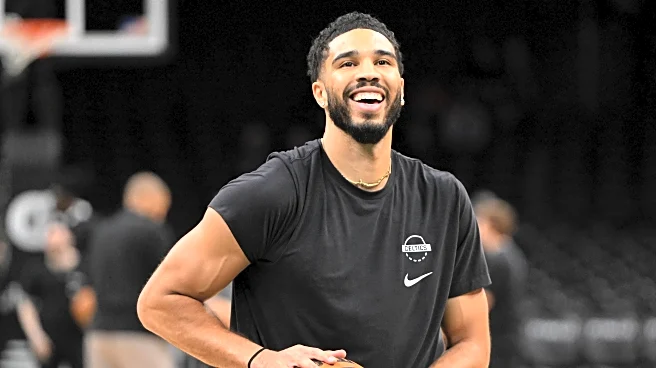


BOSTON — For months, whether Jayson Tatum was going to return to the court was one of the biggest questions in basketball.
We saw glimpses of his on-court workouts and heard nothing but positive things about how he looked to his teammates, but the door was left open — and discourse intensified — when he went on the Pivot Podcast in January and expressed reluctance about whether he should come back.
Tatum pointed to the Celtics’ success without him — they held the Eastern Conference’s second seed for
most of the year — and candidly reflected on the fact that a return wouldn’t be seamless.
“There is a thought in my head, like, how does that work? Or how does that look with me integrating myself off the injury … 50, 60 games into a season? There obviously could be some challenges. And it is a thought: Do I come back? Should I wait? It’s something that I honestly, recently, in the last two weeks or so just kind of contemplate every single day.”
By now, we all know where Tatum landed: he ultimately decided to come back, less than 10 months after rupturing his Achilles. In three weeks since his return, he’s played in all but one game, averaging 19.8 points, 9.5 rebounds, and 3.8 assists per game.
Of late, the minutes restriction has seemingly lifted — Tatum logged 37 minutes on Friday night against the Hawks — and his rebounding has shown no drop-off.
Still, as he’s routinely told reporters, he’s rusty and still trying to regain his rhythm and flow on the court. Even his handle has felt off at times, an aspect of his game that is unrelated to his Achilles injury.
Earlier this week, I penned a column about how I believed fans should think about Jayson Tatum’s return. Much of the discourse centered on his shooting woes rather than on his improbable on-court impact.
(Tatum is shooting 38.3% from the field and 30.3% from three in 10 games this season).
In effect, I concluded, that mere weeks after his debut, we had already lost sight of the big picture.
The big picture is this: Tatum tore his Achilles tendon last May and returned to the floor less than 10 months after suffering the injury. He’s been back on the court for less than three weeks. The choice to re-acclimate (and, unavoidably, struggle) in the public eye was a brave one, and, though it’s not unheard of to do so, it’s also very uncommon for a player of his caliber to return as quickly as he did.
Take a look at three other former NBA All-Stars who suffered the same injury in 2025: Dejounte Murray (injured in January), Damian Lillard (injured in April), and Tyrese Haliburton (injured in June). Lillard and Haliburton were immediately ruled out of the 2025-2026 season, while Murray rehabbed for 13 months — nearly four more than Tatum — before returning to the floor.
Tatum did not give himself that same grace; he opted to work tirelessly to lace up for the Celtics this season, knowing that a playoff run was ahead.
One of the many fun aspects of being a reporter is that you’re able to ask players (and coaches) to weigh in on any proposition you’ve formed in your head.
So, after the Celtics’ 109-102 win over the Atlanta Hawks, I asked Tatum if the idea of getting to fully shake off the rust and take another 4-to-5 months to rehab in private was ever tempting.
It was a decision, after all, that most of his NBA peers made, and one that would have taken lots of the pressure off — every misstep could have occurred in private, at the Celtics’ practice facility, rather than on national television. There’s a world where he returned to NBA action after months and months of full-speed 5-on-5 scrimmages, rather than weeks.
“That’s a loaded response,” Tatum said, with a smile. “It was a range of emotions, of things I was dealing with and contemplating and thinking about.”
Then, he addressed a reality he’d rarely touched upon since his return: this Celtics team was a championship contender.
Could he really pass up the opportunity to be a part of that?
“A lot of it had to do with where the team was at, and never wanting to take moments in a season for granted, just thinking like, ‘Oh, we’ll be good next year,’” Tatum said. “It’s like, I’ve been in the league [a long time], I’ve been fortunate to be on a lot of really good teams. And, you never want to take for granted the opportunity to be on the team that’s contending for a championship.”
The Celtics, however you want to slice it, are championship contenders. They have the East’s second-best record at 49-24 (and the fourth-best overall record, trailing only the Detroit Pistons, Oklahoma City Thunder, and San Antonio Spurs). They have the league’s second-best offense and fourth-best defense. They’re the favorite to come out of the East despite the Pistons’ excellent regular season, and Tatum quickly recognized that reality.
This week alone, they’ve beaten a Thunder team that had won 15 of their last 16 games, and a Hawks team that had won 15 of their last 17.
Jayson Tatum could have watched that all pay out from the sidelines, or he could have chosen to be a part of it.
He, unsurprisingly, chose the ladder.
And he did so knowing that it might — at times — be ugly.
“It was a lot of people I talked to to make the decision, knowing that I wasn’t going to be perfect when I first came on the floor,” Tatum said. “But, showing my teammates that I was willing to fight through it, and give it my all, even though I wouldn’t be as in-rhythm or in-condition at first. I knew it was going to take some time, but I wanted to be out there with them. I was gonna do whatever it took.”