

There were glimpses of it during the Golden State Warriors’ first matchup with the Suns in Phoenix, in which they lost their third-straight game. But in their rematch at Chase Center, it was on full display for everyone to see, with intentionality that was as clear as day.
In the first quarter of their first matchup, the Suns briefly experimented with putting 7-foot-1 center Mark Williams on Butler, the rationale being that Butler isn’t a threat out on the perimeter and, therefore, Williams could
roam off of the Warriors’ second option and act as a rim and paint deterrent. Besides the risky proposition of someone screening Williams — a big who is unaccustomed to the nuances of screen navigation — the Suns were comfortable with seeing how that configuration worked.
After a missed shot in transition by Royce O’Neale, Draymond Green finds Butler on the other side of the floor. After a failed attempt to run empty-corner ball-screen action for Moses Moody — an attempt to involved Williams as a pick-and-roll defender via Butler screening for Moody — the possession flows into a Butler cleared-side isolation against Williams.
Butler doesn’t dilly-dally upon catching the ball. He fakes a drive to his left in order to coax Williams to lean to his right, before dashing the other way, past Williams, and finishing at the hoop with a reverse layup, with a foul to boot:
(Note the spacing: Devin Booker as the low man not even thinking about leaving Quinten Post alone in the corner. Dillon Brooks tries to slide into the paint, off of Draymond Green on the wing, but the distance is long and even he hesitates before settling for a slight stunt. As a result, Williams is left all alone on the Butler drive.)
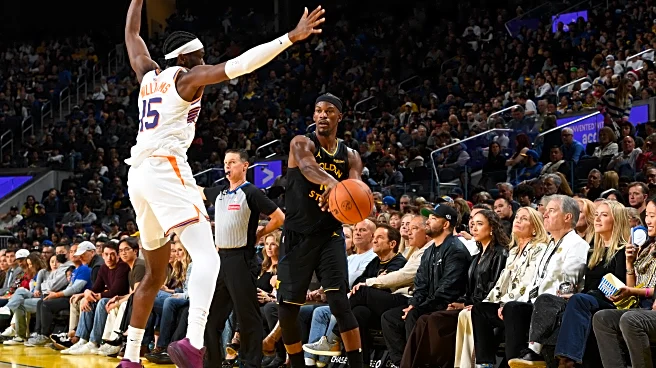
That was a matchup the Suns were willing to commit more to during their rematch with the Warriors in San Francisco. Again, no time was wasted in putting Williams on Butler — perhaps, daring him to demand the ball, demand more touches, and create, instead of the alternative: Steph Curry doing all the creating and getting most of the touches.
The intentionality was more apparent in the rematch. At the 9:45 mark of the first quarter, the Warriors run “thumb up,” or Steve Kerr’s play call for a spread ball-screen. Curry brings the ball down, with Butler — guarded by Williams — setting the screen approximately at a level commensurate to the edge of the center logo. The high screen forces Williams to have to play somewhat of a high “drop” coverage, almost but not quite at the level of the screen (sometimes referred to as “centerfield” coverage).
With Collin Gillespie caught up in the screen and attempting to recover toward Curry, Williams has no choice but to step up toward Curry around the screen. This frees Butler up for a roll, drawing Royce O’Neale away from the corner in order to “tag” the roll. Immediately upon getting the ball from Curry, Butler sprays the pass to Post in the corner, who gets a wide-open corner look after getting Gillespie (“X-ing out” toward the corner) up in the air with a fake and escape-dribble combination:
(And yes, if you’re wondering, Curry’s shot off the offensive board ended up going in.)
Never mind that Post missed an open look created by the advantage-creation tandem of Curry and Butler — the prevailing point is the intentionality with which Butler and the Warriors pinpointed the Williams-on-Butler matchup, went straight to that particular pressure point, and generated efficient offense. There were several more instances of it peppered throughout the game, with each instance almost always resulting in either a good Butler shot or a good shot for every other Warrior.
The next instance didn’t take too long to manifest, courtesy of another Curry-Butler pick-and-roll. Butler sets the screen at the wing, with the Suns opting to switch this time around: Williams jumping out toward Curry, with Gillespie taking Butler. However, Butler’s screen forces Gillespie into a tough position — that is, being on Butler’s top side and leaving Gillespie vulnerable to a Butler cut toward the basket:
Upon closer inspection as to how Butler got a clear lane to the rim, it is, once again, a matter of spacing, with a little bit of help from Moody “lifting” from the corner to the wing:

This particular theme of Butler screening for someone else in order to draw Williams out into a disadvantageous position was as apparent on the ball as it was for someone off the ball. On the sideline out-of-bounds (SLOB) set below, Butler forces Williams to have to defend the Warriors’ bread-and-butter split action. Taking the role typically played by whoever the five-man is (hence the Warriors’ term for split action: “5 Out), Butler screens for Pat Spencer, who comes off of the screen and pulls up after the catch, with Williams in drop coverage and in no position to greatly affect Spencer’s shot:
The flip side of that equation — Butler scoring when someone else sets a screen on Williams — also rang true. Who better to set the screen, then, than Curry, whose willingness to set hard picks as a 6-foot-3 guard is arguably unmatched?
The SLOB play above (called “WTF”) was expedited. Post seeks out Brandin Podziemski, to whom the ball is typically supposed to go to. However, Podziemski points out the action happening between Curry and Butler. The screen by Curry catches Williams unawares, while Gillespie is unwilling to detach himself from the greatest off-ball threat in basketball history. There is no weak-side help to be had (Booker stuck in no-man’s land with his noncommittal help off of Moody, while Brooks stays glued to Podziemski on the wing), resulting in a lob for Butler.
Of course, like Butler’s first foray against the Williams matchup, these relatively tactical approaches to taking advantage of the Suns’ center existed in harmony with Butler’s plain on-court disdain over the Suns choosing to guard him with a center, as if to say that Butler mattered little in the grand scheme of the Warriors’ offense. He must’ve thought that, like several Warriors’ fans in the social media sphere, his opponents didn’t think him to be as aggressive and domineering as his reputation said he was supposed to be.
To that, Butler responded in assertive fashion:
This insistence on attacking a matchup, with perhaps a tinge of offense taken from the Suns’ decision to match him up with Williams, was a significant factor behind Butler’s 25-point night on a 56 percent true shooting mark. It may not have been one of Butler’s most efficient scoring nights, but it fueled an aggressive attack built upon the matchup that he and the Warriors targeted with merciless intent.
It’s a no-brainer statement that the more Butler is involved with the offense and its outcomes, the better the team will be for it. Around 23.8 percent of the Warriors’ offensive possessions against the Suns ended with Butler shooting the ball, shooting free throws, or turning the ball over — a usage rate that matches exactly his mark for the season. He is second only to Curry in that regard, a dynamic that isn’t all too surprising given their standing on the team.
For them to recover from this early season quagmire of mediocrity, that dynamic will need to be maintained, along with the understanding that the offense will need to pick at pressure points (e.g., Butler attacking the Williams matchup, which is the premise of this piece) as they are presented to them. A team that has been offensively challenged won’t be given such opportunities on a silver platter; it’s on them to lure it out from opponents and take it with aggression and, to use a term Steve Kerr has been highly fond of, force.