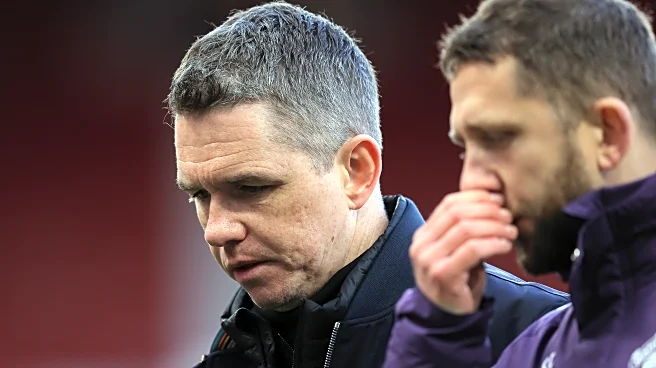



Manchester United Women have been under the leadership of manager Marc Skinner for nearly five seasons now.
Skinner’s time at United arguably peaked in 2022-23, when the Reds pushed for the WSL title until the final day of the season and reached the FA Cup Final, falling short against Emma Hayes’ Chelsea in both pursuits. The following year, the club recorded its only win over Chelsea to advance to the FA Cup Final, where they beat Tottenham Hotspur 4-0 to secure the club’s first, and so far only,
major trophy.
It was an exciting achievement that helped outweigh the negatives from the club’s most difficult WSL campaign to date, managing just 10 wins in a fifth-place finish after letting two key players walk for free in the summer. Goalkeeper Mary Earps would follow Ona Batlle and Alessia Russo out the door in 2024, along with forward Lucia Garcia, and new arrival Geyse would quickly seek an exit just a year after her arrival, going on loan to Gotham FC in 2025 before securing a permanent move to Club America in 2026.
The squad overhaul under Skinner continued, but despite the arrival of talented young players and veterans from the top level, the football did not evolve. The results followed in kind.
The Reds managed just five WSL wins from 12 matches as they limped to a fifth-place finish in 2024, including two losses to Liverpool, and defeats at the hands of Manchester City, Arsenal, and Chelsea twice, with a 6-0 embarrassment at Old Trafford on the final day of the season.
In 2025, the Reds managed to cling on to a third place finish despite winning just two of the final seven matches of the season, once again losing to Chelsea in the FA Cup Final, this time to the tune of 3-0.
And now, in the midst of a season of opportunity on all fronts, the Reds have once again capitulated. In the span of six matches, United have been knocked out of the FA Cup and League Cup by Chelsea, dropped two points at West Ham and suffered an embarrassment at Old Trafford at the hands of Manchester City, and are on the verge of elimination in the Champions League after a sloppy 3-2 loss to Bayern Munich.
The common thread through all of those key losses was the tactical setup. In nearly every meeting with a Top 3 rival in the English game, the Reds have approached the matchup with a willingness to give up ground. In some cases, there is a hunger to attack space in behind, and in many, that is the strategy. The idea of playing through some of the best midfielders in the game isn’t entertained.
Whatever hunger and enthusiasm there is, however, often does not survive the opponent scoring. It’s been most evident against Chelsea, a team that still has United’s number without Emma Hayes, without Sam Kerr (for some of the time), and without the aura of invincibility that radiated for five years.
The strategy came up in Europe as well. Perhaps it was a way to remedy playing midweek matches across the continent with a squad that isn’t deep at most positions, but the willingness to sit back and defend a lead or hold on for a result was good enough to get through the group phase.
And perhaps that’s the biggest issue. Under Skinner, United have been good enough to be the best of the rest. What they have not been is bold enough to test their nerve in a push for more.
The football is stale, and the footballers have become a reflection of that.
The urgency is not there, the hunger is not there. Despite the talent in the team, the team’s play is pushed to the fringes rather than fighting for space. Jess Park, arguably the signing of the season in English women’s football, is now asked to push wide while the team cedes control in the middle.
Five years in, we know what Marc Skinner football looks like, and it’s not good enough. His crowning achievements came with a team he inherited that has since been dismantled and rebuilt, and the results have not changed.
The unfortunate truth for United is that change feels unlikely, not only because of a manager set in his ways, but because of club leadership that has expressed at best disinterest in women’s football, and at worst willful ignorance towards it. Skinner was handed a contract extension until 2027 by INEOS after their worst-ever league finish, and have largely left the team on autopilot since then with Director of Women’s Football Matt Johnson at the wheel.
The club continues to sign good players and operates in the green financially, and there is no evidence to suggest Jim Ratcliffe cares about much more than that from the women’s side. Qualifying for Europe hasn’t yet been a standard asked of managers, or Skinner would have been gone long ago, and it’s unclear at the moment whether the latest downturn in results will have any impact on decision makers.
Sully from Centre Devils wrote a brief over the weekend indicating that Skinner is under “serious review” from club officials because of the poor form at yet another crucial point in the season. There was no indication that a decision would fall down on Skinner’s employment yet, with a Top 3 and Champions League comeback still a possibility, but it’s not looking likely for either scenario. Arsenal can pass United into the Top 3 by winning their games in hand, and Chelsea has already taken advantage of five dropped points to overtake the Reds.
Should there be a decision to move on, it will come with plenty of evidence in support. Skinner’s time at United never got off on the right foot because of the manner in which Casey Stoney left after exposing the lack of support, and that observation has only expanded after five years of stagnation and a breadcrumb trail of unhappiness with club hierarchy and Skinner himself.
At some point, enough is enough. For fans, it has been enough. For the club, it may finally be enough.