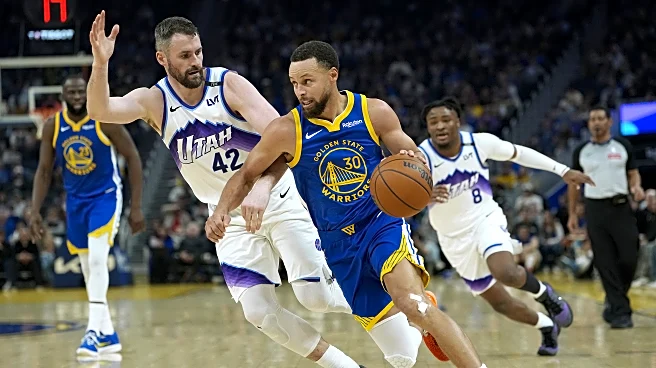

Steph Curry scored 20 of his 31 points in the third quarter against the Utah Jazz, in what was the third instance of Curry scoring 20 or more points in a quarter this season. For his career, this was the 45th
time he has had a 20-plus-point quarter — seven more than Kobe Bryant’s 38. To compound this incredible feat, think of the fact that for the typical NBA player, scoring 20 points is generally considered a good day’s work. To score 20 points in a quarter 45 times in one’s career is a feat that solidifies one’s legendary status.
More than that fact, it was further evidence to add to the pile of Curry still being one of this league’s preeminent offensive fulcrums. There has been a somewhat minor but occasionally loud contingent (especially on this site) that has considered the Warriors continuing to revolve their world around Curry as a failing strategy, without redirecting their critical eye toward the apparent lack of urgency to remedy Curry’s supporting cast (and, by extension, Jimmy Butler’s supporting cast).
Curry’s 31 points on 70.6 percent True Shooting to lead the Warriors past the Jazz is a performance worth of admiration in a vacuum. How can one see Curry perform feat after feat and think that the team must go another way? One does not simply find another generational superstar one after the other, as if switching from an old smartphone model to the latest and trendiest edition. In this case, the old model still does the work efficiently and its battery is still going strong, albeit requiring a bit of power management.
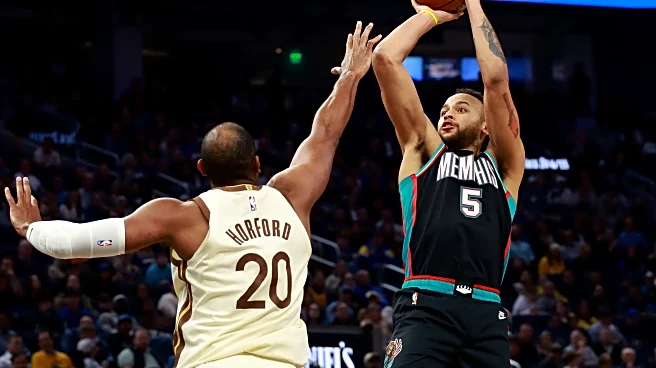
But fully charged, Curry is as capable as the best of them in this age:
The maneuver Curry performs to create separation above deserves a closer look. A left-foot-gather step back requires Curry to rotate mid-air in order to square his shot to the rim, made tougher by having to use his right-foot plant to generate power behind his upward motion. For most people in the league, this shot has little-to-no chance of going in. For Curry, it’s another day at the office.
The spark behind Curry’s 20-point third quarter was a more conventional step-back three against the Jazz’s Keyonte George:
From then on, the Jazz (who, I might add, are geared toward another lottery season and have plenty of leeway to experiment) experimented with all sorts of coverages against Curry. The quintessential two-to-the-ball coverage was, as expected, deployed:
Off of the Warriors’ “C” sideline out-of-bounds (SLOB) set, the Quinten Post rescreen allows Curry to dish the ball to the open Post, who stays beyond the arc and drills one of his three total makes from beyond the arc.
On a more conventional setup out of their flow offense, Moses Moody twirls the screen Curry sets for him, before Curry comes off of Post’s away screen — creating a virtual empty-corner action with George falling behind on his chase around the screen, with Kevin Love having to step up against Curry as a consequence. This opens the pass to the rolling Post:
On a set called “Dive Roll” that involves one screen to get Lauri Markkanen switched onto Curry, before another screen to involve Kevin Love in the action — essentially, making both of the Jazz’s frontcourt players defend a pick-and-roll — the Jazz opt to send two to the ball against Curry, releasing Post in the short roll against a four-on-three numbers advantage. He finds the cutting Gary Payton II on the lob:
The dangers of switching screens for Curry is precisely why teams such as the Jazz go with the relatively “simpler” decision of sending two defenders around him on screens. If switches are subpar in their execution, Curry promptly punishes them without mercy:
The Warriors run their split-action variant that has an initial screen for a curling player, with Curry curling inside. The Jazz attempt to switch, but Brice Sensabaugh — perhaps expecting Curry to come off of Trayce Jackson-Davis — jumps out to switch, and in the process allows Curry to cut inside for the open layup.
In a similar vein — with Curry being the one setting the screen this time for the curling player, off of the Warriors’ “22” baseline set — the Jazz switch the curling action, with Sensabaugh once again finding himself having to chase Curry around the screen by Jackson-Davis. Curry draws two around the screen, allowing the big man to dive to the rim unimpeded:
On another staple Warriors set called “Head Tap,” Curry has the option of coming off a cross screen underneath the rim or lifting up to use Jackson-Davis’ “zipper” screen. More often than not, Curry’s defender positions himself in such a way that the cross-screen option is denied Curry, which means he mostly chooses the zipper option, as what happens in the possession below:
Markkanen switches onto Curry around the zipper action, followed by Curry drawing two to the ball when Payton comes over to screen. Once again, an advantage is created off of Curry attracting an extra defender on the ball, with Payton as the rolling passer who finds Jackson-Davis on the lob.
What do all of these possessions mean? It’s quite simple: Curry still warps the geometry of the floor in ways defenses find difficult to compensate for. In their attempt to cover every base, there will almost always be one or few that will be left open; such is the nature of an offensive possession that involves the greatest shooter of all time.
The Jazz didn’t have much choice but to funnel the on-ball playmaking toward Curry’s teammates and out of his hands. Previous instances of Curry being left alone to do his thing informed such decisions:
Granted, not every defense will be like the Jazz, who profile as the worst defensive unit in the league in terms of points given up per 100 possessions (121.6). But nevertheless, the evergreen advantage-creating nature of Curry persists, no matter what quality of team the Warriors face. That makes it paramount that the Warriors’ decision makers squeeze every possible juice out of Curry’s remaining years at the top of the league — however long that lasts.