




The Colorado Rockies are a team in the midst of a rebuild. With this in mind, the staff at Purple Row thought it would be useful to revisit the “State of the Position” series that we ran in March to see where things stand. We’ve asked authors of the spring articles to re-evaluate their earlier remarks with an eye toward the August 3 trade deadline.
Entering the season, it seemed like Willi Castro would be the latest veteran to try to be the Rockies second baseman. Hoping for a resurgence, Castro,
a former All-Star with good baserunning and utility skills, signed a two-year, $12.8 million deal with the Rockies in January.
I had Castro pegged as the starter with Edouard Julien, Ryan Ritter and Adael Amador rotating as the backups. Instead, Castro has turned out to be the true utility player the Rockies love, especially under the new front office. He’s made 38 starts at second base, but that comes in second to Julien’s 48. Together, they have started 87.8% of Colorado’s games at second base.
They have added speed and production with mixed results defensively. But so far, the additions have translated to an upgrade at the position. In 2025, Colorado’s second basemen combined to rank No. 29 in on-base percentage (.267) and OPS (.550), No. 28 in batting average (.213) and slugging percentage (.283) and tied for No. 26 in homers (eight) and RBI (53).
This year, at the All-Star break, the Rockies second basemen have combined to climb up 20 spots to No. 9 in on-base percentage (.332), and improved to No. 14 in RBI (38), No. 16 in batting average (. 246) and homers (16), No. 17 in OPS (.690) and No. 22 in slugging percentage (.358).
While a true comparison will have to wait until the end of the season, the improvement in the power and ability to get on base is remarkable.
The 2B duo
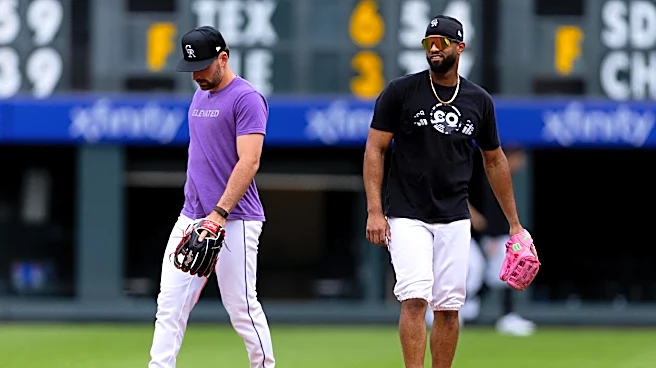
Castro has out-performed Julien at the plate this season, while also making 35 starts at four other positions (shortstop, third base, first base and left field), in addition to spending a little time in center field. On any given day, he’s got around 10 gloves with him and prides himself on being “prepared for anything.”
Castro is hitting .260/.251/.378 with a .709 OPS, seven homers, 13 doubles, 37 RBI and 40 runs scored. He is just one homer away from tying the total of all eight players who played second base for the Rockies last season. His most recent homer came in the form of a two-run shot vs. the Giants on July 9
His sprint speed is in the 77th percentile at 28.3, even if it doesn’t show up tremendously in his stolen base total of six. While his arm strength also ranks in the 77th percentile at 88.5, his range (OAA) is -3 (20th percentile).
Julien doesn’t have the power, the versatility, the speed, or the defense that Castro does, but he does own an effective plate approach with an 18.9% chase rate, which is one of the best in MLB. Whereas Castro has a 27.8% strikeout rate and an 8.8% walk rate, Julien walks at a 13.8% rate and strikes out 25.9% of the time.
Unfortunately for Julien, whom the Rockies acquired in a trade with the Twins in January, it doesn’t always translate to production. He is hitting .222/.335/.366 with three homers, seven doubles, one triple, 33 runs scored and 20 RBI. He lacks the sprint speed at 26.7 (32nd percentile) and his defense leaves much to be desired with a -4 OAA (11th percentile) and 77.3 arm strength.
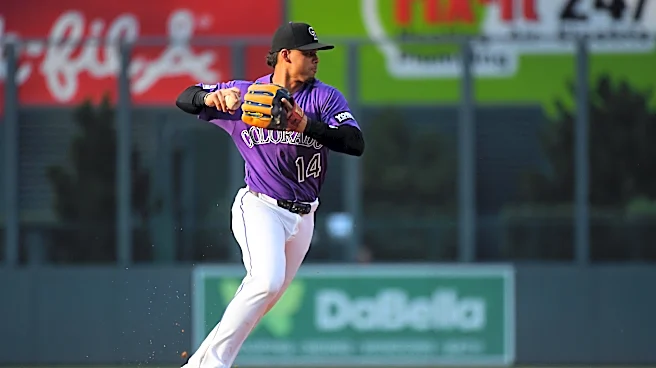
That being said, he’s still capable of some highlight-reel plays.
Julien had a short stretch where he was hot in the leadoff spot, but has dropped down in the lineup. Meanwhile, Castro has worked out nicely as the leadoff bat when the Rockies face lefties.
The backups and future
Three other Rockies have slotted in at second base so far this season. Chad Stevens was called up for a few weeks in May and June, making seven starts. Utilityman Tyler Freeman has made four starts, and Ritter made one start in March. None have done enough, or had sufficient opportunities, to make a mark.
Ritter and Amador have both struggled with injuries and bounced around the farm system in their rehab assignments. Amador, who missed some time with a leg injury, has put up good stats in Triple-A (.257/.363/.393), but he has yet to prove they can hold up at the MLB level. Ritter has only played 27 games with the Isotopes, joining them after recovering from an ankle injury on June 16. He has also played a bit of left field in an effort to diversify his fielding profile.
Barring trades, the Rockies second base crew is set. Castro, 29, has one more year on his contract. Still pre-arbitration eligible, Julien, who is 27 and making $792,750 this season, will remain under team control until at least 2029.
Depending on how the season plays out, and if the Rockies mantra of versatility sticks around, the Rockies could have the kinds of players they want in Castro and Julien. Of course, the second base bar is low considering the struggles of the past few seasons. Julien and Castro, or a player yet to be determined, could continue to raise that bar even higher as the team fights to become a contender. For now, the Julien-Castro duo is part of the reason why the Rockies are playing better baseball in 2026 than they did in 2025.
Join the conversation!
Sign up for a user account and get:
- Fewer ads
- Create community posts
- Comment on articles, community posts
- Rec comments, community posts
- New, improved notifications system!
Please keep in mind our Purple Row Community Guidelines when you’re commenting. Thanks!