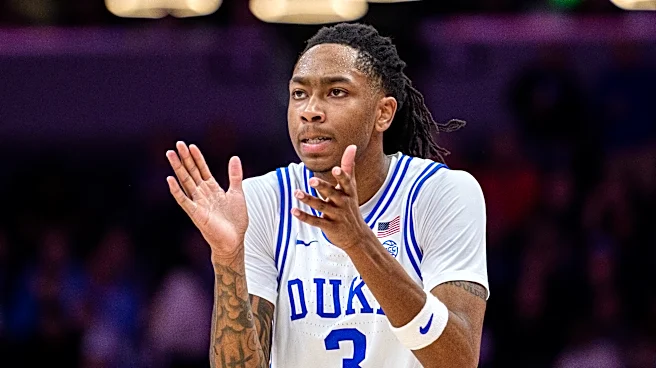








Just a few days into the offseason, Duke has already seen two rotation pieces—Nik Khamenia and Darren Harris—enter the transfer portal. What the Blue Devils haven’t heard yet are any decisions regarding the NBA Draft.
Cam Boozer is surely off to be a Top 3 pick. Dame Sarr and Pat Ngongba have challenging stay-or-go decisions to make. But interestingly, most reporters with inside knowledge of the Duke program, including The Athletic’s Brendan Marks, are operating under the assumption that Isaiah Evans
will join Boozer in the draft.
Even a couple of years ago this would be a no-brainer decision for Evans, who is consistently projected as a first-round pick and tested the draft waters last season. But things have changed drastically. Case in point: recent reporting from Jeff Goodman stating that top wings in the portal could demand around $3 million dollars this offseason.
Even that number could be low, with some reports stating that John Blackwell—one of the top scoring guards in the portal and a potential Duke target—could fetch closer to $5 million.
Goodman’s reporting, coming directly from coaches, is likely more realistic than the reported number for Blackwell (potentially put out by his agent to drive up his asking price). Still, if you split the difference and say a player of Evans’ caliber would demand $4 million in NIL, you’re faced with a fascinating thought experiment.
That sum would exceed the first year of a Rookie Scale NBA contract for any player drafted below 15 overall. By the time you reach the mid 20s—where Evans is most consistently projected—a $4 million NIL payday would dwarf the first year of an NBA contract by more than $1 million dollars.
There are, of course, other factors to consider than the raw dollars. Many players enter the NBA as early as possible so that their second contract—the first chance to get a 9 figure payday—comes in their prime. But many players drafted in Evans’ range don’t even reach that second deal, with a 2018 study finding that the average career for players drafted in the 20s in the first round is much closer to 5 (the maximum length of a Rookie contract) than 10 years. A player like Evans certainly maximizes his career earning potential by entering the NBA as early as possible, but very few hit that ceiling.
There’s also a unique confounding factor to making a draft decision this year—the 2026 Draft is universally viewed as one of the best in recent memory, while the 2027 is seen as much weaker. Were Evans to return to Duke, likely making more money in the 2026-27 season than he would in the NBA, he might also jump up in the 2027 Draft. Moving up from the 25th pick to the 15th pick would be worth millions more over the length of a rookie contract.
Finally, there’s this: college players are now getting paid more than some of their NBA counterparts to play less than half of the games. At Duke, you play those games consistently in front of a national television audience, rather than the local sports networks of your average NBA contest. That’s less wear and tear on your body and an increased potential to build a brand that will yield lucrative endorsements now and into the future.
It’s highly likely this is nothing more than an interesting thought experiment given the various reports on Evans’ status. But more Duke players will face similar decisions like this as the college game continues to change. For college stars, it may soon be the case that—with the notable exception of surefire lottery picks—the best purely financial decision will be to forego the draft as long as possible.
Go to the DBR Boards to find Blue Healer Auctions || Drop us a line