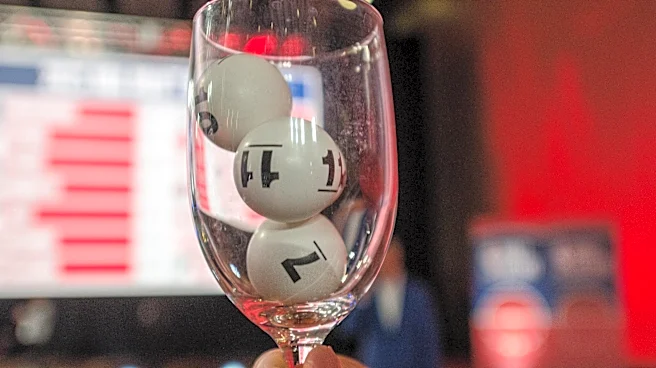





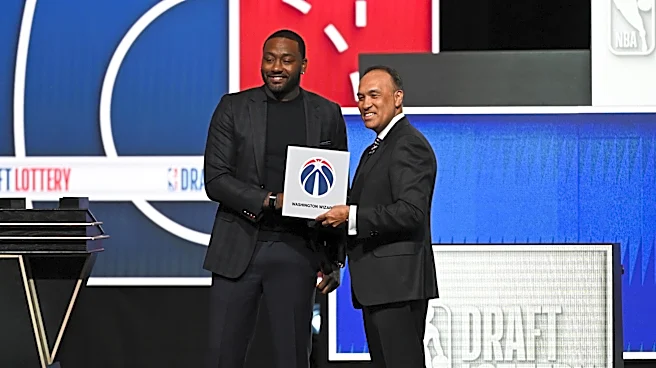


In just a few days the NBA will crown its eighth new champion in eight years. That’s a long streak of parity after a couple of generations rules by dynastic franchises. In the coming year the league will also introduce its new 3-2-1 lottery system with more participants, flattened odds, and drawings for all 16 lottery picks instead of just 4.
In today’s Blazer’s Edge Mailbag, a reader tries to connect those two things. Is his argument successful? Let’s find out.
Dave,
I can’t believe that you’re taking
a stand against the new 321 lottery system. I won’t mention the antitanking benefits because lots of people have already. This can be amazing for the Blazers too. It’s exactly the chance we need to get a higher pick even if our record isn’t bad or the Bucks’ isn’t. It’s also good for parity. I think a fan of a small market team like the Blazers would love mixing up picks because it gives everybody a shot. No more big market dynasties! Everybody’s winning championships now anyway. It’s got to be our turn soon lol! Why wouldn’t you support this fully?
Lucas
You’re confusing parity and randomness. They’re not the same.
First, as we mentioned in yesterday’s Mailbag, randomness has a negative effect on sports when taken to an extreme. Even bad causation is worse than no causation at all. If the Lakers win six titles because they can sign the best free agents, that’s a bad development, but at least there’s a concrete why and how. Other teams can either duplicate it or, if that’s impossible, the league can regulate it. More importantly, winning the championship means something. The Lakers had to do a tangible, concrete thing to achieve it. They can be admired or hated for hitting that mark.
None of these things apply if championships and good records are just distributed randomly. Sure, L.A. won’t win it every year, but there’s no reason to admire, emulate, or hate whoever does. “Winning it all” just happens to somebody, for some reason, each year. Next year it’ll be someone else. There’s no achievement, no honor, no growth or change.
Second, random odds do not automatically indicate that everybody involved will get a chance at winning. That would only happen if teams lined up in a queue to get their titles one after another. Unsurprisingly, random odds just mean that random things happen.
It’s true that, over time, with enough repetition, odds will settle out into a predictable distribution. If you flip a coin a million times, chances are you’re going to get somewhere in the vicinity of 500,000 heads and 500,000 tails. Flip it infinite times and it should turn out exactly that, I suppose. But drafts and championships happen once a year. There are 30 teams in the NBA (maybe soon 32). We don’t have a million years to see each of them win 33,333 trophies. Over the shorter run, random distribution will yield wacky results. And the 70-80 years we’re alive on this planet and aware of professional basketball is a very short run, statistically.
Finally, and most importantly, we’re just counting the effect of a singular event: getting promoted in the lottery and receiving a high pick. We’re not accounting for the ramifications of that event. They’re quite different, team to team.
Let’s say a 10-win, 20-win, 30-win, 40-win, and 60-win team all have a shot at a generational superstar in a given, randomly-drawn draft. The odds are relatively equal for all of them. That seems fair. You might even argue it as a type of parity. But the aftermath of those results will not be anything near equal.
If the 10- or 20-win team gets the superstar, chances are they have jumpstarted their rebuild. With a few smart moves in the coming years, they could become a team on the rise, maybe a playoffs contender.
If the 30- or 40-win team gets the superstar, they’re going to make the playoffs and perhaps, if they don’t blow it and things go well, become a championship hopeful soon.
If the 60-win team gets the superstar, not only have they increased their current dominance over the rest of the league, there’s a very good chance they’ve just cemented a generational dynasty that nobody will be able to break until the current cycle of players has retired.
Even though they’re all equally likely by chance, these outcomes are not at all the same by implication. The first two potential events feed the cyclical ecosystem of the league, contributing to parity by opening up chances for more franchises. The third event does the opposite, raising the winning team above the ecosystem, smashing apart any pretense at parity. In this case, randomness has destroyed parity rather than bringing it.
The new 3-2-1 system with its relatively equal odds and its ridiculous policy of drawing for all 16 lottery spots is far closer to that third event than the first two. It carries a serious threat of messing up the league for a generation or more. This is especially bad when you consider:
- Throwing up draft order to random chance means that at some point, the bad side of random chance IS going to happen. It’s just a matter of which draw it happens in: sooner or later.
- The NBA is pretty reactionary. They don’t anticipate problems as much as they sweep up behind them. Anyone could have told you that, given a lottery, some team was eventually going to get back-to-back #1 picks like the Orlando Magic did in 1992 and 1993, or that a team could get super lucky in an extended draft run like the San Antonio Spurs over the last three years. The league waited until Orlando actually broke the draft before instituting weighted odds. They also waited until San Antonio bounced into their next randomly-drawn dynasty before putting in limits around the number of times a team could get promoted consecutively. If history holds, they’ll wait until an awful result happens again before changing it. “Oklahoma City, here’s your #1 pick! San Antonio, here’s #2! Enjoy, guys!” The problem is, once it happens, it’s too late. We can’t break up Wembanyama, Castle, and Harper like they were a phone company monopoly and redistribute them to other teams. The rest of the league will have to live with the lack of foresight for the next decade, probably.
If you truly want parity in the NBA, it comes through enough randomness to keep people from gaming the system followed by open opportunity for everyone to access the same power and benefits. The latter part is the opposite of the first. Random access is not equal access. It’s simply a way to disguise that you don’t have it.
Thanks for the question! You can always send yours to blazersub@gmail.com and we’ll try to answer as many as possible!