
In 2025, Michael Harris II completed his first 20/20 season after spending the first three seasons of his big league career knocking on the door of that particular club. If we just left it at that, then
you’d think that Harris had himself a fairly straightforward and perfectly fine season out there in center field for our Atlanta Braves. However, the path that Harris took to getting there was about as rugged and rough as you could imagine. 2025 was anything but straightforward for Money Mike, and now it’s time to take a look into why this was such a wild season for him.
How acquired
The Braves initially drafted Michael Harris II in the third round of the 2019 MLB Draft. After hitting the ground running in successful fashion for his big league career, Money Mike cashed in during 2022, his debut MLB season, with an eight-year, $72 million contract extension that includes team options for two years at the end of the initial eight-year contract length.
What were the expectations?
Expectations for Harris have always been a bit wacky, going all the way back to when prospect evaluators thought he may not be a good defender. Though he had a phenomenal rookie season that culminated in a Rookie of the Year award, putting up 4.7 fWAR in 441 PAs, that came with him outhitting his xwOBA a fair bit. As a result, he seemed worse the following year, despite making huge strides offensively, because he underhit his xwOBA and thus finished with “just” 3.9 fWAR. In 2024, his xwOBA ended up right in the middle of his 2022 and 2023 marks, but he underhit it massively, finishing with a 99 wRC+ and just 2.0 fWAR in 470 PAs. Given all that, it looks like Harris peaked and has been backsliding since, but that’s not really the case. He just got super-lucky the first year and has been paying the price in both the vagaries of ball-in-play stuff and perceptions since.
Harris came into 2025 with gaudy projections. ZiPS’ point estimate for him ahead of the season was about 5 WAR, and that rate suggested he could get close to 6 WAR if he actually played a full season. Steamer was similar. Across the full set of MLB, no player had a higher projection relative to his 2024 fWAR total than Harris. A combination of a well-above-average xwOBA, really good defense at a premium position, and a track record of adding a bunch of value with his legs on the bases (in a way that weirdly didn’t happen in 2024) suggested that all he needed was not-terrible ball-in-play fortune to have another awesome season, with a batting line 25 percent-ish better than league average, and his usual strong defense. Boy, that sure would’ve been nice!
2025 results
Unfortunately, reality, and the Braves themselves, apparently had other plans.
Harris had an absolutely calamitous first half of the 2025 season. There’s no other way to put it. He was truly awful at the plate for long stretches before the All-Star Break. From the start of the season up until July 10, Harris hit .205/.229/.310 with a wOBA of .232, a wRC+ of 44 and six home runs over 356 PAs. Again, compare those numbers to what he was projected to do and then you will get a slight taste of the disappointment that surrounded Michael Harris II’s season up until that point.
Did it help that he also had an absurd xwOBA underperformance? Kinda. He wasn’t really performing like a 44 wRC+ guy. But, his xwOBA was just .284, so sure, he wasn’t all-time abysmal for a guy with 350-plus PAs, just run-of-the-mill horrid. Still not great.
July 10 wasn’t just some random date. It’s also a clear line of demarcation because from that point forward, Harris went from being one of the worst everyday players in all of baseball in 2025 to being one of the top outfielders in all of baseball from July 11 onwards. From that date, Harris finished the season hitting .302/.317/.531 with a wOBA of .359, a wRC+ of 131 and 14 home runs over 285 PAs. That is an astonishing in-season turnaround and it honestly makes you wonder what would’ve happened had Harris made the adjustments to his swing as early as it was noticed (allegedly by both hitting coach Tim Hyers and part-time consultant Chipper Jones) that his hitting approach was out of whack at the time. It also makes you wonder why exactly the Braves changed around everything he was doing in the first place, before having to re-adjust him to get things to work. He slightly outhit his xwOBA in this span, but nothing close enough to reverse the horrid fortune he had to deal with earlier.
Either way, it is absolutely wild that Michael Harris II had a first half that saw him woefully underperform those lofty ZiPS projections and then he proceeded to make up for it by slightly exceeding expectations during the second half of the season. Had the second half version of Money Mike showed up for the full season, he may have had a shot at actually nailing those expectations. Instead, 2025 ended up being a topsy-turvy season for Harris where he was able to at least end the season on a high note.
All in all, Harris finished with a career-worst 1.4 fWAR and a career-worst 83 wRC+ in 641 PAs. He once again massively underhit his xwOBA. In 2024, he had the seventh-biggest underperformance across the 250ish players with the most PAs; in 2025, it only “improved” to the 27th-biggest. Over the last two seasons, only 13 players with a combined 400 PAs have a larger wOBA-xwOBA gap; only two of those have more PAs than Harris.
What went right?
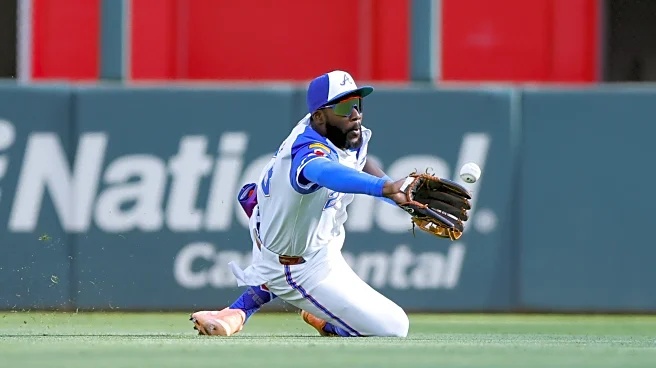
We could probably just compose this section with highlights from the second half of his 2025 season but I suppose y’all would want a bit more information than that, huh? I’d say that no matter what was going on for Harris at the plate, his defense remained extremely solid. Harris finished in the 95th percentile in Outs Above Average, as he finished this season with a career-high OAA of 8. He additionally posted a Fielding Run Value of 7, which placed him in the 87th percentile in that category.

This also brought up the still-largely-unsolved mystery of what exactly is happening when center fielder defensive value from OAA/FRV is translated to FanGraphs’ fWAR values. There’s something weird going on there, and while the general contour of it makes sense (downplaying center fielder value because the peer group they’re competing against in OAA includes corner outfielders), the mechanics of the adjustment seem weird and perhaps overly punishing to Harris.
Even at his lowest point at the plate during the 2025 campaign, Harris was still extremely reliable in the outfield and that was essentially the only thing keeping him in the lineup every day once he reached his nadir. Defense doesn’t slump and Money Mike’s business with the glove was still booming.

We covered this earlier, too, but Harris also had a few amazing games WPA-wise, including an all-timer 4-for-4 with a double, two triples, and a homer that somehow happened in a loss. Top marks for him, though, actually came back on May 8, where he had a go-ahead triple in the fifth, and a game-tying single in the bottom of the ninth, en route to an 11-inning Braves walkoff win (where he struck out with two on and one out before Drake Baldwin brought it home).
Though Harris finished with negative WPA overall, he had the Braves’ two highest single-game WPAs of 2025, which were 41st and 42nd in MLB for the season; he had four of the top 200 such games in MLB on the season.
What went wrong?
We could probably just compose this section with lowlights from the first half of his 2025 season but I suppose y’all would want a bit more information than that, huh?
Fundamentally, Harris came into 2025 with a very different approach. How much this was very directly driven by instruction to do the other stuff the Braves were doing in fits and starts as largely a team at the time — trying not to chase, trying to ‘score runs in different ways,“ trying to draw walks, and so on and so forth — we’ll probably never know, unless we get some juicy insider knowledge dropped on us at some point. But, fundamentally, Harris started the season with incredibly diminished bat speed, a flatter swing, and a wider stance where he set up notably further back in the box. Perhaps the idea was that all of these things would help him not chase — but they really didn’t. All they did was neuter his contact quality. with him posting four consecutive months of below-average exit velocities to begin the season. Eventually, and commensurate with his second half, a bunch of these things turned around. By the end of the season, his exit velocity, bat speed, and barrel rate had ”caught up” to where he was in prior ears, and a bunch of other bat-tracking and contact quality metrics ended up either similar to what they were before, or were far closer to his past performances than it seemed like he’d ever get to given how dramatically different he was as a batter for the first three-plus months of the year. In his career to date, Harris had had 22 calendar months. His xwOBACON was below the league average in just six of those months: the first month of his career (where he had barely any PAs), three in 2023, and two in 2024. In 2025, it happened for three months straight.
Perhaps the biggest issue is not just that this happened, but that whatever aim the Braves were trying to achieve with Harris was just not met at all. The guy rarely takes a walk: from his debut through 2024, only ten players had a lower walk rate. Yet, despite all the maneuvering with his bat speed and the like, his walk rate actually dropped even further, by about half — he was around five percent in each of his past three seasons, and in 2025, it was 2.5 percent, nearly a full percentage point behind Lenyn Sosa and his 3.3 percent rate. That 2.5 percent rate wasn’t just bad for 2025; it would’ve been the worst rate in any full season dating back to 2018, which is when Dee Strange-Gordon managed to get through 588 plate appearances with a walk rate of 1.5 percent. His chase rate exploded upwards to second-highest-in-baseball territory, and he also just swung more in general, finishing sixth in overall swing rate. Combine that with much worse contact quality, including him trading power for contact in the zone, and you can see all the contours of the nightmare.
Notably, when Harris turned his season around-ish in July, his walk rate just further plummeted. In August and September, he chased more than in April and May. If you said that he was emboldened by his July to basically throw all caution to the wind and just go after everything he thought he could mash (which was really, most things he was thrown), it would be hard to argue against it — but the flip side was that he hit the ball so hard when he did make contact that it didn’t seem to matter much down the stretch. (It’s also worth noting that if you look just at outputs, he had a pretty miserable .269 wOBA in September, but his xwOBA that month was .333.)
Will he ever be able to keep that sort of low-walk, high-exit velocity profile going successfully for longer than a few months? Who knows. The even-lower-than-before walk rate could be an aberration rather than a sign of things to come, but it’s not really clear where he’s gonna go given just how much of a roller coaster his 2025 was, and the fact that when he “fixed” things, it was by abandoning the lower-impact, more-patient approach that he completely flubbed earlier in the season.
There are a few other things to nitpick as well. Harris posted his first below-average throwing arm value in 2025, despite no erosion in his arm strength from 2024. The adjustments he made in 2023 and 2024 made him much better at handling breaking balls because he wasn’t falling over the plate to shoot fastballs on the outer portion to left; whatever changes he and the Braves made over the course of the season made him vulnerable to those again, and even when he rebounded, his huge success was largely from obliterating fastballs. And, he was no stranger to horrible games at the plate — like the one-run loss to Arizona on June 4, where he struck out against Justin Martinez twice in two innings: first, with runners on second and third, one out, and down by a run — on a floating 0-2 splitter nowhere near the zone and both off the plate and about neck-high, and then second, with the bases loaded and Martinez already having walked in a run to make it a one-run game again, on four pitches that ended with a splitter nearly in the dirt.
2026 outlook
ZiPS is already out and while its not nearly as bullish as it was on Harris in 2026 as it was ahead of the 2025 season, it still believes that the version of Money Mike that we’ll see in 2026 will look closer to the version that closed out 2025 rather than the one who opened up the season. Basically, ZiPS has Harris as a 4 WAR guy, and Steamer has him in the 3-4 WAR range depending on playing time.
The Braves are going to need his high level of production at his premium position if they’re going to return to Postseason relevancy next season. I don’t think that we’re going to ever see Harris turn into a patient hitter who takes a ton of walks, but as long as he can continue to stay in a position of production where he can make his prior approach of “hit the ball super hard” work for him, then things will be fine and the Braves won’t have to worry about their center field position going forward.
Also, it’s not like there’s any major pressure for Harris to turn it around ASAP (other than helping to improve the team’s chances going forward) — he’ll be entering his age-25 season in 2026 and he’s still got a few years left on a reasonable contract extension. There’s still room for Harris to get better as a player and do so in a Braves uniform, at that. Hopefully we’ll continue to see Harris make strides towards becoming the best version of himself as a baseball player going forward for Atlanta.