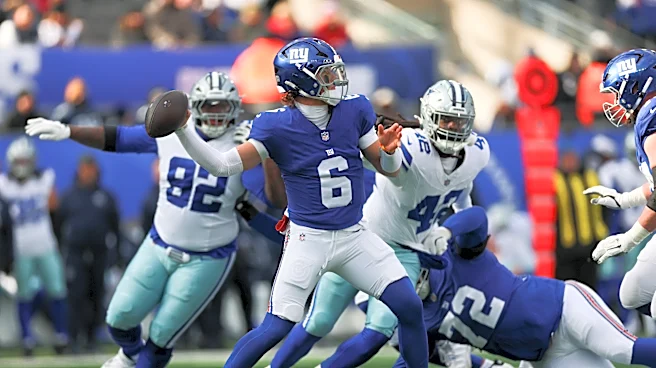


And now for something completely different – a story about Jaxson Dart as a Giants football player.
There is considerable difference of opinion out there among the NFL “cognoscenti” about just how good Dart’s rookie NFL season was and what his future holds. Giants fans (including this one) are mostly thrilled at what he did for them last year – the ability to read defenses, change out of plays, the escapability, the arm talent he showed while on the move to fit throws into narrow windows, and the general
level of confidence that oozes through the rest of the Giants’ offense when he is on the field. Some analysts agree, others see a QB who is overrated and will come back to Earth in his sophomore season.
Dart is an absolute weapon when he takes off with the ball himself, but for this post, let’s just focus on his passing, because you just can’t be an elite quarterback in the NFL if you’re not elite throwing the ball. Part of how you look at Dart, or any other quarterback, is about hard stats, such as touchdown passes and interceptions. In that regard, Dart was ordinary as a rookie: 15 TDs in 12 starts. On the other hand, he only had 5 interceptions. You can interpret those stats in more than one way, because both of them are affected by the players on the other end of each pass – a receiver and a defensive back.
As the old saying goes, I’d rather be lucky than good. The problem is that luck is not sustainable. Mark Chichester of Pro Football Focus has done a study on that. PFF, like every other football statistics organization, of course tracks interceptions. PFF does something else, though, that is just as interesting – it tracks turnover-worthy plays (TWPs), i.e., thrown balls that should reasonably have been intercepted but weren’t. (Turnover-worthy plays can also occur in other ways, e.g., fumbles, but the analysis here is just about passes.)
The flip side of TWPs is another PFF statistic, big-time throws (BTTs), which PFF reserves for passes thrown accurately and with good timing into tight windows, usually well downfield, whether they were caught or not. (Looking at you, Darius Slayton and Theo Johnson.) This post is about the TWPs, but just for perspective, here are the TWPs vs. BTTs for the primary starting quarterbacks in the NFL last season:

The risk-averse QBs are in the lower left quadrant (cough cough, Jared Goff), and the gunslingers in the upper right. Note than no quarterback has a TWP rate (per pass attempt) than 6, i.e., put the ball up for grabs too much and you don’t last as a starter in the NFL. The closest to that is Tua Tagovailoa, whose days as a starter indeed appear to be over. There are though a couple of quarterbacks with BTT rates over six – Matthew Stafford and Joe Burrow, two of the best QBs in the game. Burrow in particular was outstanding last season, with hardly any TWPs despite many BTTs. For what it’s worth, Dart is in fairly good company in this diagram, with a pretty good BTT rate despite a middling at best TWP rate. He’s close to the Super Bowl-winning Sam Darnold. Tyler Shough, who some people claim was better as a rookie than Dart, did indeed have a much smaller TWP rate, but he had about half the BTT rate that Dart had.
As Chichester discusses, TWPs that don’t become interceptions can be as important as actual interceptions. He mentions one well-known example: a should-have-been-intercepted pass by Tom Brady in the Super Bowl against the Atlanta Falcons that ricocheted among four defensive players before remarkably being caught by Julian Edelman before it hit the ground. The Patriots scored four plays later and went on to win the Super Bowl. For Giants fans, a great example is a forgotten play from their thrilling first Super Bowl win over the Patriots. On the final drive, on second down, Eli Manning threw a sideline pass that could have been intercepted by Asante Samuel but wasn’t. It looked like Eli and David Tyree weren’t on the same page, and Eli’s reaction suggested he thought the fault was Tyree’s. The next play was the helmet catch, and we know what happened next.
Manning was charged by PFF with one TWP in that Super Bowl – one of those two plays was it, probably. Between the pass that Samuel wasn’t quite able to bring down and the one that Rodney Harrison couldn’t dislodge from Tyree’s helmet on the next play, you have to say that the Giants were at least a little lucky. Of course while we’re spouting luck cliches, we can say that luck is the residue of design, and that whole drive wouldn’t have even mattered if Steve Spagnuolo and the Giants defense hadn’t confused and terrorized Tom Brady most of the evening.
As Chichester points out:
This is one of the most under-discussed truths in football: the biggest moments in the sport sometimes just come down to luck.
Whether a pass is rated “turnover-worthy” is a matter of judgment by an analyst rather than fact, which is at the very heart of fans’ dissatisfaction with PFF. For this particular stat, though, they seem to do a good job. Here are some sobering statistics on turnover-worthy plays:

It’s about 50-50 whether a turnover-worthy play actually results in an interception, which is what you’d expect if PFF was being fair to both quarterbacks and defenders. Some TWPs are dropped, some knocked out of the defender’s hands, or are just incomplete. A bit fewer than 3% of pass attempts were turnover-worthy. Interceptions are sometimes the fault of the receiver and not the quarterback: Over 3% of receiver drops resulted in an INT. That’s bad luck for the QB. Or sometimes a defensive back just makes a great play on a pretty good throw. Such non-turnover worthy throws were intercepted less than 1% of the time, but bad throws leading to INTs are more frequent. This suggests that the judgement of PFF analysts on this particular metric is fairly reasonable, in a statistical sense at least.
That first stat suggests that luck has a decent bit to do with quarterback success. How much? Glad you asked. Chichester divides interceptions into two classes: Those resulting from TWPs, and those that occurred due to factors outside the quarterback’s control.
From those two classes, he defines a”net luck” parameter:

A positive/negative net luck value means that a quarterback had fewer/more INTs than expected based on the league average given his TWPs and non-TWPs (which are sometimes intercepted even though they’re good throws). Chichester then converts that into a PFF net luck score.
Here are the NFL leaders in net luck for 2025:

The league leader in luck was Matthew Stafford. Interestingly, his luck came mainly on good throws rather than bad throws that weren’t intercepted:

Jaxson Dart came in fifth in the NFL in net luck. That’s pretty high considering that he only started 12 games. Only 3 of Dart’s 11 TWPs were converted into INTs, a pretty low 27.1% rate. On the other hand, he only had 2 INTs on non-turnover-worthy passes – more than Stafford’s extremely lucky 1, but much less than Baker Mayfield, Dak Prescott, and Caleb Williams.
Let’s repeat the Stafford calculation above for Dart, scaling his numbers to a full season. It took me a while to realize, but the numbers above for Stafford are for the playoffs too, not just the regular season, i.e., 20 games. Scaling Dart’s numbers to 20 games, this is how he’d have compared to Stafford:

The first thing to note is that Stafford threw a lot of passes last year. His 716 total passes (695 clean + 21 TWPs) attempted led the NFL by 58 over Bo Nix and Caleb Williams, the next most prolific throwers. Dart threw a measly 339 passes, and even scaled up to 20 games, his 565 would still be a lot less than Stafford’s total. The point, though, is that Dart’s net luck, scaled to 20 games, would have been only a bit lower than Stafford’s and second overall in the NFL. He led a bit of a charmed life in 2025 if the net luck numbers are any guide.
The reason I say “charmed” is that luck does not persist from year to year for most QBs. Chichester finds that the year-over-year correlation in TWP-worthy INT conversion rate is just 0.12. Thus, Dart had better clean up the TWPs in 2026 if he hopes to remain the darling of Giants fans (and John Harbaugh).
That said, some quarterbacks have defied the odds on good luck. The luckiest is Aaron Rodgers, with a career net luck of +24.2 over the 2016-2025 period. The unluckiest? That would be Jameis Winston, with a -14.2 career net luck. Interestingly, the top 10 in career net luck include many of the names we usually consider to be Hall of Fame-worthy QBs: Not just Rodgers, but Stafford, Tom Brady, Drew Brees, Patrick Mahomes, and Ben Roethlisberger. The top 10 unluckiest list only has one quarterback usually considered to be elite: Joe Burrow.
So I ask: Do great quarterbacks make their own luck? Or is our perception of them being great partly a product of the luck they had over their careers? Chichester ends his analysis with some food for thought on that subject as we watch Dart’s career unfold:
The most predictive part of interception analysis is not the interception itself, but how often the quarterback generates turnover-worthy throws in the first place. That’s the stable signal. That’s the part most closely tied to process, decision-making and quarterback play. It’s also the part that is far less visible in public conversation.
Those hidden plays — the turnovers that almost happened and the turnovers that never should have happened at all — shape quarterback narratives just as much as the interceptions we remember.
The difference is that only one side of that equation gets counted.