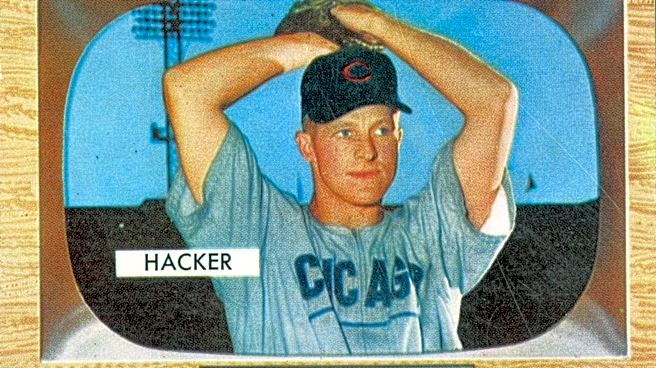



Mostly forgotten today, right-hander Warren Hacker is the kind of guy who epitomized the Cubs in the 1950s. He had one really good year — got downballot MVP votes! — and then either because of injuries, poor coaching, no support or all of the above, he descended into mediocrity and eventually was traded away in a deal where the Cubs basically got nothing.
Hacker, like yesterday’s entry in this series Carl Lundgren, was an Illinois native, from the tiny town of Marissa, which is southeast of St. Louis.
When Hacker was born in 1924 Marissa had about 1,900 residents and it’s about the same size today.
The Cubs acquired him in 1948 in a minor-league deal but he didn’t become a mainstay in the team’s rotation until 1952 — that “one really good year.” In 33 games (20 starts) Hacker produced a 15-9 record, 2.58 ERA, 12 complete games and led MLB in WHIP at 0.958. He finished 22nd in MVP voting that year, in pre-Cy Young days. Cubs outfielder Hank Sauer was NL MVP that year and the team finished 77-77, their only non-losing season between 1947 and 1966. Hacker threw a five-hit complete game June 12 against the Phillies and the Cubs were in third place, only four games behind the league-leading Dodgers, with a 32-19 record.
Despite Hacker’s good pitching and Sauer’s hitting, the team went 45-58 the rest of the way, because, well, those two were about all the team had.
Hacker never again had a year that good. The following year he led MLB with 35 home runs allowed, and in 1955 he served up 38 long balls, which remains the franchise record to this day despite Shōta Imanaga’s best efforts to break it in 2026. (Sorry, Shōta!) Also in 1955, Hacker had a game that might have put him in the history books. He took a no-hitter into the ninth inning against the Braves in Milwaukee, but George Crowe broke it up with a solo homer. The Cubs won the game 2-1.
Hacker was traded to Cincinnati after the 1956 season, along with Don Hoak and Pete Whisenant for Ray Jablonski and Elmer Singleton. Hoak hated playing for the Cubs — one of the few who ever felt that way — and demanded a trade, so the Cubs had little leverage. Jablonski never played for the Cubs and was dealt before the next season began, and Singleton, already 39 when the deal was made, was a spare part.
Hacker didn’t do much, either, after the deal, drifting from Cincinnati to Philadelphia to the White Sox before leaving the majors after 1961. He played in the minors through 1967, then was a minor-league pitching coach int the A’s organization (1967-71) and later in the 1970s in the Padres organization. He died in Lenzburg, Illinois, not far from his hometown of Marissa, on May 22, 2002, aged 77.
Warren Hacker posted 13.5 bWAR in his nine seasons with the Cubs, No. 99 on the all-time list.