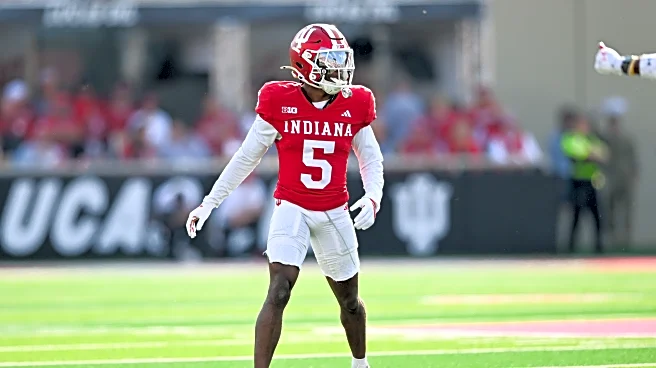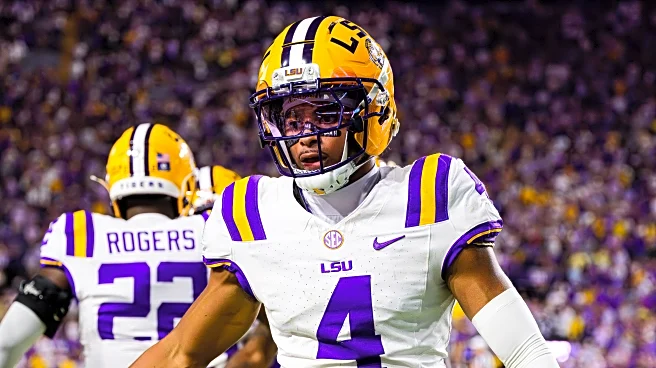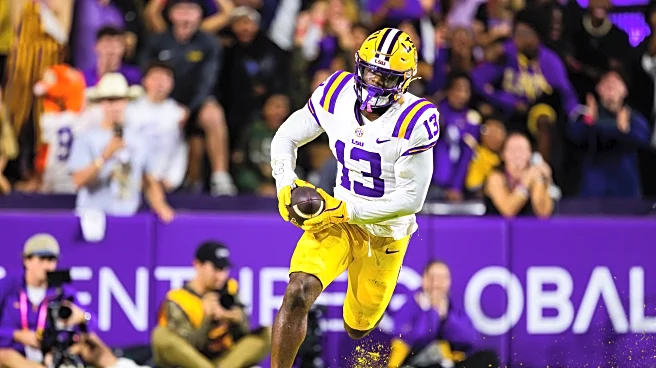

With free agency calming down, free safety is one of the biggest remaining needs on the Las Vegas Raiders’ roster. That will likely push the Raiders to use the 2026 NFL draft to address the position, and former LSU safety A.J. Haulcy should be a strong option for Las Vegas.
As of March 19, NFL Mock Draft Database’s consensus big board has Haulcy ranked as the 58th prospect in the class with a late second-round projection. So, he could be in range for the Silver and Black to use its third-round selection
(No. 67 overall), and the former Tiger has the ball skills the defense could use.
After one season at New Mexico, two at Houston and one more with LSU, Haulcy collected 10 career interceptions and 19 passes defended in college. Additionally, he ranked tied for 10th among qualifying FBS safeties (minimum 111 coverage snaps) with an 88.6 coverage grade from Pro Football Focus last season. He can play the run to, posting a 76.2 mark in that department and finishing tied for seventh among SEC safeties with 12 ‘defensive stops’ as a run defender.
With those numbers in mind, let’s flip on the tape and see what the 2025 All-American could bring to the Raiders.
Part of what makes the 6-foot, 215-pound safety a coveted prospect is that he’s versatile, possessing the size to line up in the box as a strong safety and the speed (4.52-second 40-yard dash) to patrol the back end of the defense as a free safety. He logged nearly 1,400 career snaps at the latter and had over 1,000 at the former, per PFF, and made plays at both positions.
Here, he’s lined up as a strong safety and is on the backside of Texas A&M’s counter run. More than anything, this rep highlights Haulcy’s football IQ and instincts versus the run.
He’s quick to diagnose the play, pointing out the counter run almost immediately after the snap. But notice how he isn’t just flying to the running back and pulls up at about the hash mark. That’s because the Aggies are running a read option where the quarterback can keep the ball, so the safety needs to stay home rather than trying to be a hero and vacating the backside of the play.
Once Haulcy sees the hand-off, that’s when he can be aggressive and insert into the run fit. This is where his speed becomes a factor, getting into a position to make the tackle for a short gain from the backside of the play.
That being said, one area of concern for the LSU product is his tackling. He missed 16 tackles at a 15.8 percent clip last season, via PFF, and a big reason is that he likes to go for the big hit and has a habit of ducking his head on tackle attempts. He gets away with it here, but his technique will need to be cleaned up in the pros.
Building on the section above, Haulcy can also provide run support from the free safety spot, as he’s constantly pursuing to and around the football.
In the play above, Oklahoma dials up a quarterback run where the running back lead blocks on the perimeter to create an extra gap outside of the tight end. However, the inside linebacker shoots the gap and forces the quarterback to bounce outside and into the outside linebacker. Meanwhile, Haulcy reads the play and is quick to trigger downhill.
To be fair, this is a clean-up tackle for the safety since the linebacker already had the quarterback in his grasp, but Haulcy’s speed and instincts allow him to be in a position to come up with the third-down stop had the backer not been there. Regardless, he’s in a great spot to provide run support and make sure the Sooners don’t pick up the first down by delivering a big hit when the situation calls for one.
Haulcy’s speed and physicality also translate to his coverage skills. He has the acceleration to effectively click and close on pass-catchers, and he continues to be a thumper to make impact tackles in the passing game, with the clip above serving as a good example.
Pre-snap, LSU shows a two-high coverage where Haulcy is the boundary safety before having the safeties rotate and blitzing the boundary corner post-snap. Florida has a good answer for the blitz, with the receiver looking back at the quarterback on a hot route, setting up an easy pitch and catch.
Meanwhile, Haulcy rotates toward the sideline to replace the blitzing corner and recognizes the hot route. This is where his speed comes into play. He triggers downhill and makes contact with the receiver right as the ball arrives, laying the wood to prevent any yards after the catch and the first down despite the offense having a good play call for the blitz.
This is where the combination of strong safety size and free safety speed really pays off.
On top of the big hits, the LSU product’s athletic ability allows him to make impressive plays on the ball.
He’s lined up as a single-high safety here, and the Tigers run a simple Cover 3 coverage. They do a good job of taking away all of the quarterback’s options initially, and the left defensive end starts to get some pressure, leading to the scramble.
With the linebackers plastering to the underneath routes, Texas A&M’s tight end is wide open as he works toward the sideline to match the scrambling quarterback. However, Haulcy recognizes that, transitions downhill and has the speed to get into the passing lane. On top of that, he lays out and manages to get in front of the tight end to come up with a PBU.
So, what could have been a touchdown up the sideline ends up being a loss of down that keeps the offense well behind the sticks (second and 20) because of the safety’s efforts and athleticism.
Another key element to Haulcy’s ball skills is that he’s good at reading the quarterback’s eyes and can take advantage when they stare down receivers.
On this play, Florida is trying to hit a backside dig route while LSU is in quarters. At first, Haulcy opens his hips and starts to cheat toward the middle of the field since the passing strength is on the other side of the formation, and the tight end on his side runs a short route. Also, the quarterback looks to the far sideline initially.
However, the quarterback is quick to get to the backside of the read and locks in on the dig route. So, the safety adjusts by getting back to square, takes a peek at the wide receiver to confirm/recognize the dig and drives on it. Combined with his speed and burst, that allows Haulcy to step in the passing lane and come up with the interception.
This is a good example of what happens when instincts/football IQ are paired with athleticism.
This time, the quarterback does a better job of not bird-dogging the throw, as Oklahoma’s John Mateer works through his progressions and tries to quickly rip the seam route. The problem is that he got baited into the throw by Haulcy.
LSU is running Cover 6, where the middle linebacker opens to the wide side of the field and gets depth as the Tampa dropper on the Cover 2 side of the playcall. That’s why Mateer thinks the seam is open. However, Haulcy does a good job of staying deep on the slot receiver instead of driving on the route to make it appear as if the receiver is open. You can tell the safety thought about driving on the route initially, as he took a step toward it initially but pulls up to bait the throw.
Once the ball is in the air, that’s when Haulcy pounces, stepping in front of the seam route and picking off the pass. Again, the combination of instincts, speed and athleticism helps him win the chess match.
Haulcy’s tackling and angles need to improve for him to be a true free safety that the Raiders can rely on. Also, his best fit in the NFL is probably as more of a versatile type of defensive back who spends time on both the second and third levels of the defense, similar to Jeremy Chinn, than someone who is a pure deep defender.
However, Chinn is about to enter a contract year, and the LSU product is capable of playing exclusively as a free safety for at least a year. With that, it wouldn’t be surprising if the Silver and Black target him and make him a high priority in the draft next month.