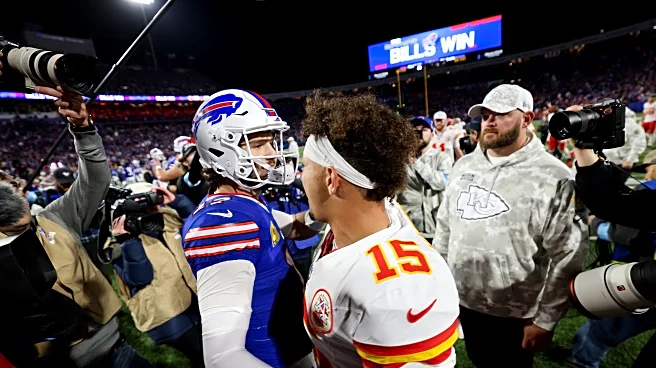



The Kansas City Chiefs have been the dominant team of this era. I understand this isn’t news to anyone, but it needs to be said up front. The two other AFC teams most prominent from 2019-2024 were the Baltimore Ravens and the Buffalo Bills. These three teams combined for nine of the 12 possible AFC Championship Game slots in these six years. They also had — by far — the best records among all AFC teams over this stretch, a combined 135 games over .500. The only other AFC teams to maintain a record above
.500 from 2019-2024 were the Pittsburgh Steelers (58-41-1) and the Miami Dolphins (52-48).
It’s hard to overstate the dominance Kansas City, Buffalo and Baltimore had over this conference for more than half a decade.
That run of dominance came to an abrupt halt this season. The Chiefs and Ravens missed the playoffs entirely. The failure was enough for the Ravens to fire long-time head coach John Harbaugh. The Bills’ dramatic exit from the postseason in the divisional round convinced ownership it was time to move on from head coach Sean McDermott. It’s worth noting that the other AFC teams mentioned did the same.
Andy Reid is the last head coach standing out of the bunch.
The change atop the AFC was a shock to the system, the kind of movement that requires a deeper assessment. The Chiefs, Bills and Ravens enter an uncertain future despite having arguably the three best quarterbacks in the conference.
How did we get here? And what comes next?
Sustaining this level of success is remarkably difficult. It’s what made the New England Patriots’ dynasty so impressive. Opposing teams will poach the coaching staff and front office, and that bleeds into free agency, where players on winning teams are hot commodities.
Winning comes at a cost, both literally and figuratively. These are good problems to have, but it’s something to overcome nonetheless.
The truth is, these issues are easier to overcome while your quarterback is on a rookie contract. Teams can eke out some extra flexibility through the first year or two of a quarterback’s mega-deal, as well. The rookie deal flexibility came to an end for the Chiefs and Ravens in 2021 with Mahomes and Jackson, respectively. The Bills provided themselves with added flexibility in Josh Allen’s deal through the 2023 season.
Cost-controlled young talent is the most valuable commodity when your quarterback accounts for more than 15 percent of the salary cap. Free agency becomes more targeted. Trades are harder to pull off because, again, those draft picks carry their weight in gold. Especially early round selections.
How did the best teams in the AFC fare with those picks in recent years? Let’s take a look.
The Chiefs’ top 40 selections since 2020:
- 2020 – RB Clyde Edwards-Helaire (#32)
- 2021 – N/A
- 2022 – CB Trent McDuffie (#21) & DE George Karlaftis (#30)
- 2023 – DE Felix Anudike-Uzomah (#31)
- 2024 – WR Xavier Worthy (#28)
- 2025 – OT Josh Simmons (#32)
Bills top 40 selections since 2020:
- 2020 – N/A
- 2021 – DE Gregory Rousseau (#30)
- 2022 – CB Kaiir Elam (#23)
- 2023 – TE Dalton Kincaid (#25)
- 2024 – WR Keon Coleman (#33)
- 2025 – CB Maxwell Hairston (#30)
Ravens top 40 selections since 2020:
- 2020 – LB Patrick Queen (#28)
- 2021 – WR Rashod Bateman (#27), DE Odafe Oweh (#31)
- 2022 – S Kyle Hamilton (#14), C Tyler Linderbaum (#25)
- 2023 – WR Zay Flowers (#22)
- 2024 – CB Nate Wiggins (#30)
- 2025 – S Malaki Starks (#27)
There are some solid players on that list. McDuffie and Karlaftis have been foundational pieces of the Chiefs’ defense since they were drafted. Worthy showed flashes as a rookie before injuries took hold in year 2. Simmons looks the part of a franchise left tackle. Rousseau is a solid rotational edge rusher for the Bills. Kincaid’s had his moments. Queen made a Pro Bowl appearance before leaving the Ravens via free agency. Hamilton is a star. Linderbaum might be the top center on the free agent market this offseason. Flowers has been solid. Wiggins can play. Starks is already an established starter.
Moral of the story, these aren’t all busts. But there might be… one star on that list? Maybe you could argue two if you’re willing to list McDuffie into that criteria along with Hamilton? This is the reality of drafting outside of the top 20 annually. It’s remarkably difficult to find blue-chip talent past that range.
I did some digging to find out if this has been unique to these three teams, or if the rest of the league also struggles to find blue-chip talent in this range of the draft:
There were 96 total players picked between the 25th and 40th overall selections in the NFL Draft between 2020 and 2025. Only nine of those 96 players earned a pro bowl nod. Only three (Patrick Queen, Landon Dickerson and Tyler Linderbaum) of those 96 players had multiple Pro Bowl appearances.
Pro Bowl appearances aren’t a foolproof way to judge a player’s career, but the numbers match up well with the reality of these picks. Roughly 10% of the picks in the range where Kansas City, Buffalo and Baltimore have been selecting in the NFL Draft go on to become positive contributors. An even smaller percentage has a chance at becoming a star.
This lack of star talent showed up in a big way when watching all three recent AFC juggernauts this season. The Ravens defense isn’t what it once was. The offense doesn’t feature anyone outside of quarterback Lamar Jackson or running back Derrick Henry, who strikes fear into opposing defenses. The same issues exist for the Bills: the defense got smaller, older and slower in recent years. The offense revolves around quarterback Josh Allen, running back James Cook and wide receiver Khalil Shakir. Shakir would be a nice complementary piece, but he’s miscast as a primary receiver.
Does this sound familiar? Defensive tackle Chris Jones’ decline has exposed the inability of the rest of Kansas City’s defensive line to win one-on-one, and the offense lacks a go-to guy in the twilight of tight end Travis Kelce’s career.
None of this is to absolve front offices for their misses in the draft, but I don’t believe it’s a coincidence we’re witnessing the rise of teams like the Denver Broncos and Patriots in the conference at the same time as we’ve seen the Bills, Ravens and Chiefs level off. The rookie quarterback contract is a real advantage, and the two teams representing the AFC on Championship Weekend this season found ways to weaponize those deals. This will be the 13th time in the past 14 Super Bowls in which at least one of the teams will feature a quarterback on a rookie contract.
That doesn’t feel like correlation; it looks like causation.
The Ravens and Bills fired their coaches in part because they were unable to accomplish what Reid did in Mahomes’ first five seasons — win the big one. The Chiefs came out of Mahomes’ rookie contract with two Super Bowl victories and another appearance. If nothing else, that earned Reid the benefit of the doubt after one down season. Harbaugh and McDermott are left wishing they could be so fortunate.
What comes next is anyone’s guess. It remains to be seen who the Bills and Ravens will hire as their next head coach. The Chiefs will have a top-10 selection for the first time since trading up for Mahomes. That grants them access to the caliber of talent they’ve been lacking in recent years. The Ravens are slated to select 14th overall, the same selection they were able to take Hamilton a few years ago. Buffalo is once again picking 26th, and their cap situation leaves something to be desired. They also have the potential MVP playing in their division.
Reaching the top of the mountain is hard. Sustaining that level of performance might be even harder. The Chiefs, Ravens and Bills lived a charmed life for most of this decade. The rosters aren’t what they once were. Changes are necessary. The offseason will help determine if we look back at 2025 as a one-off or if it’s a sign of things to come.