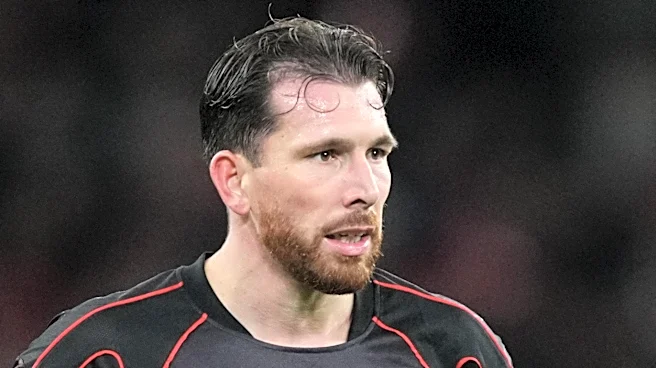


The November international break is the traditional launching point for the winter transfer rumors. Writers desperate for material turn to the mercato, leaning on “sources” or spinning elaborate structures out of speculation. What I’m saying is that we ought to take any stories about Fabio Paratici’s plans to reinforce Fiorentina with some salt. Even so, the spate of articles about an impending swoop for Pierre-Emile Højbjerg worry me.
To be clear, I like Højbjerg a lot as a player even though I can
never type his name correctly on the first try. At 31, he’s got plenty in the tank and has been a mainstay since joining Marseille last January. He’s helped guide L’Om to fourth place this year as the the lungs in the engine room (Is the midfield a cyborg? Adam Hurrey, send help.) He’s steady as they come for club and country, spending a decade playing at a very high level and earning 103 caps for Denmark.
He’d do a job in Florence. His intelligence and work rate make him the sort of midfielder coaches love; I don’t doubt that he’d adapt to life under Paolo Vanoli and make an immediate impact as a starter in a double pivot or as part of a three. He could play next to any configuration of guys currently on the roster, whether that’s partnering Christ Inao Oulaï, Niccolò Fagioli, or even Cher Ndour as part of a two or with any of those alongside Arthur Atta or Marco Brescianini in a 4-3-3. As captain for club and country, he should add the character and grinta et cetera that Fiorentina’s so often lacked in the Commisso era.
Nevertheless, Marseille’s ready to move on from him after just a year in order to bring Frank Zambo Anguissa back to the Vélodrome eight years after selling him. L’Om would make room in the midfield but, more importantly, take a chunk out of the wage bill; Højbjerg’s salary is a whopping €8 million. He’d have to accept a major pay cut to move to Florence, although there are all sorts of financial shenanigans that could have greased those wheels. Fiorentina, of course, has inside information on any such deal through Paratici.
Setting the salary issues aside, my assumption is that buying Højbjerg would mean selling Fagioli. I’m not the biggest Beans fan but won’t deny that he’s got both talent and utility to this team, even if his recent performances and subsequent benching have driven down his value. As an Italy international, he could still garner a decent fee in January. This isn’t about asset management, though, in a financial sense. It’s about vision.
Nobody predicted that Fagioli and Oulaï would be incapable of fitting together thus far. I still believe they could figure it out given time but Vanoli doesn’t seem interested in losing games while they sort out their on-pitch relationship. Given the age profile and value (Fagioli’s book value is probably around €12 million right now), if one of them has to go, it should be the one on whom Fiorentina can turn a larger plusvalenza. So far, so good.
My issue comes with picking a Fagioli replacement. Paratici has spent €76 million on midfielders in less than a year. €23 million of that was on Oulaï. Of the other midfielders he’s brought in, the one currently on the roster who’s best suited to join the Ivorian in a double pivot is Ndour, who was a Pradè signing. That leaves €43 million worth of transfer fees on the bench, which isn’t great, but it also leaves the unanswered question of, “Why spend so much money on players who can’t start for you?”
Vanoli’s move to a midfield pairing instead of a three has tightened the rotation further and, unless he returns to a trio, will leave prominent names out of the XI. These things happen in the course of a season, particularly one so turbulent that it requires firing the manager after three games. Zooming out, though, it’s fair to wonder if Paratici overspent on certain players in an effort to address short-term objectives without including a full range of negative (i.e. bog standard for Fiorentina) outcomes in his forecast.
Paratici’s track record includes significant blemishes, most notably his catastrophic decision to bring Cristiano Ronaldo to Juventus in 2018. The Bianconeri haven’t recovered from that decision, which seemed motivated entirely by an impulsive response to the previous season’s Champions League campaign. The financial fallout of making room for the Portuguese forward’s salary and then figuring out how to pay it put the Juvenuts in financial jail. Some of his moves with Spurs have faced similar criticism, albeit at a much smaller scale.
Running a club means walking a fine line between flexibility and staying the course. It can only be judged from the heights of hindsight. Paratici acknowledging that Fagioli’s lost his spot and reacting quickly to replace him with a player of different characteristics but similar quality could be the sort of agility that Pradè never evinced. It could also be indecision brought on by adversity, a precursor to the type of panic that sets a club back a decade or more. There’s no way to know until a few years after that decision’s been made.
One of Pradè’s greatest sins was his insistence on casting his line into the same few recruitment pools over and over again. Paratici has already brought three of his former players to Florence: Daniele Rugani, Manor Solomon, and Radu Drǎgușin. Højbjerg would be the fourth. Even though he’s a better player and likely to succeed, his age and salary impart at least some risk to a move for him. The narrative path worn by the feet of that previous trio wouldn’t help him either.
This might just be the sort of speed bump that a club starting a new project (albeit for the third time in as many years) encounters as it gets into gear. Until management proves its competence by assembling a sustainable team over multiple seasons, though, fan concern over any personnel move is justifiable in light of Fiorentina’s recent history. Rocco Commisso proved extraordinarily resistant to fan opinion, refusing to fire the likes of Pradè even after he’d lost the supporters’ confidence.
Bringing it back to the original subject, buying Højbjerg isn’t a make-or-break decision. In a vacuum, it’s a good move. If Paratici pulls that lever, though, he’ll begin to erode supporters’ confidence in his long-term vision. It’s harder to trust the planner when the plan has to be heavily amended right out the gate. Joseph Commisso has spoken openly about maintaining his father’s legacy. Will he feel the same if the Curva turns on Paratici and company? Time will tell. Buying or not buying Pierre-Emile Højbjerg won’t be the deciding factor but it could be one entry in a procession of evidence.