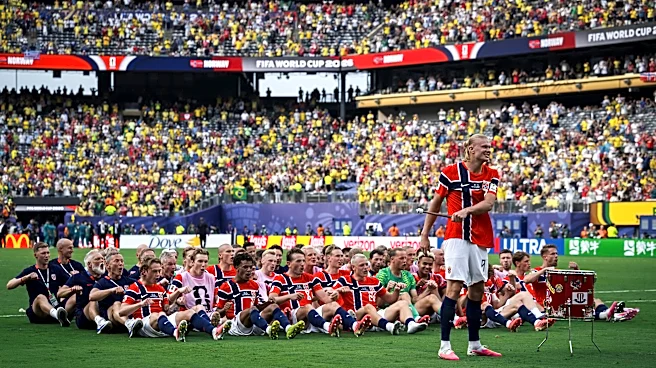







It had to be galling to New York Giants (and Jets) fans when MetLife Stadium was announced as one of the venues for the 2026 World Cup. Not because fans are protective of their beautiful stadium (which MetLife most certainly is not), but because soccer’s governing body FIFA requires that all matches be played on a grass pitch rather than artificial turf.
Giants fans have been pleading for years for the Mara and Tisch families to replace the infamous turf at MetLife, author of Malik Nabers’ season-ending
ACL injury in Game 4 of the 2025 season, with real grass, as so many other NFL stadiums have. It’s fallen on deaf ears…until this year. Money talks, and for several more days, we will see MetLife in all its natural grass glory until the final match between Spain and Argentina is over.
FIFA worries about ACL injuries too, because they are fairly common in soccer. One recent study found that there were 1.7 ACL injuries per 10,000 athlete events. This has led to the “FIFA 11+” injury prevention program. NFL football is different from soccer in the movements and stresses it places on the human body, and unlike the sport-wide FIFA 11+ protocol, injury prevention in the NFL is overseen by individual teams rather than there being a league-wide protocol. A recent study concluded that over a four-year period there were 149 ligament tears in 1213 games played, with the rate being slightly higher on turf (0.132 tears per game) than grass (0.111 tears per game), a statistically insignificant difference. During the World Cup there has been one ACL tear, to Belgium’s Amadou Onana in Belgium’s victory over the US in Seattle. That’s one injury in 102 matches, much lower (0.0098) than the NFL rate. But, small number statistics and different sports.
That said, we now have data on whether two NFL teams sharing the same field can support real grass thanks to FIFA’s experiment. I don’t know if the NFL does this for grass fields, but FIFA requires that sod be grown with a plastic layer underneath, which forces roots to spread horizontally and create a dense grass layer. The grass grown by a local sod farm in British Columbia for Vancouver BC Place World Cup matches received rave reviews from players.
Alas, the same could not be said for the grass grown for MetLife World Cup matches. After the first two matches, The Athletic reported that:
With two matches played there, and six more to come including the final, the condition of the playing surface is already raising concerns. High-profile players such as Brazil star Vinicius Junior and France’s Adrien Rabiot described the pitch as dry and difficult to play on, while Rabiot’s coach Didier Deschamps said it was “special”. (He didn’t mean it in a good way.)
Vinicious Junior said that:
“Because of the weather and the heat, the grass dries out quickly and the game ends up being very slow. We can’t build up a rhythm,” the Real Madrid player told TNT Sports Brazil.
“That makes things difficult because we want to play. We want to move the ball from one side to the other and this disrupts our game. But we have to adapt because I believe it will be like this all tournament.
France head coach Didier Deschamps and player Adrien Rabiot called the grass at MetLife Stadium “a special surface — it’s different.”
“We need to get used to this. There might be some cement below the grass. You have very short shards of grass here. But we do adjust. This does create a change, but we take these technicalities into account.”
Rabiot shared a similar assessment. “Well,” he started, “the pitch was… I don’t know if I’d even call it that. It seemed more like an artificial pitch. It was hard and rigid, but it’s like that for every team. You need to adapt to the conditions.
“I hope we find better pitches in our other games.”
It didn’t pass the eye test either:
The criticism goes back even to last year when Club World Cup matches were held at MetLife. NFL players overwhelmingly advocate for grass fields, not just because of the injury issue but also due to what they see as increased wear and tear on their bodies overall after games on turf relative to grass:
But what is it with MetLife specifically? If BC Place and others can do it, why not here? There are a couple of reasons. One is just the luck of the draw as far as weather goes. There are cool season and warm season grasses. For a tournament played in June and July in New Jersey, of course you’d plant a warm season (Bermuda) grass. Just one problem – Mother Nature didn’t get the memo. May was not as consistently warm as expected, and the Bermuda grass didn’t grow fast enough. Unlike BC Place, which used sod from a local grower, MetLife had to have sod trucked in on a 12-hour drive from North Carolina because the planned usage of a local New Jersey supplier was prevented by the Northeast’s harsh winter.
That said, MetLife will end up hosting eight World Cup matches matches in a month and a half, more than it will host for the Giants and Jets combined over a similar time period.
There’s another factor that is specific to MetLife, though, and this may be the death knell for the hopes of a permanent grass field. Here is the Met Life schedule starting August 1:
- Aug. 1-2: BTS (Korean boy band, in case like me you had to look them up)
- Aug 7-6: Chris Brown and Usher
- Aug. 12: Guns N’ Roses
- Aug. 14: Jets – Tampa Bay preseason game
- Aug, 15: Giants – Vikings preseason game
- Aug, 21, 22, 25, 26: Bruno Mars
- Aug. 28: Jets – Giants preseason game
- Sept. 4-5: Ed Sheeran
- Sept. 11: BigBang (another Korean boy band)
- Sept. 13: Giants – Cowboys season opener
- Sept. 17-18: Karol G (Colombian singer, had to look her up, too)
- Sept. 20: Jets – Packers
- Sept. 25: AC/DC
- Sept. 25: Giants – Titans
You get the idea. For the next two months, MetLife is going to be packed with events, presumably with tons of people on the field. This, in addition to the cost, may be the real reason that the Giants and Jets are so resistant to going to grass. And regarding that latter point, remember that moving to grass permanently is something that Jets owner Woody Johnson would have to agree to and split the cost for, not just the Maras and Tisches.
Perhaps the World Cup was a turning point, though. Maybe some day the owners will finally listen to the players on this issue, and we’ll hear the players shout in unison: “Go-o-o-o-o-o-al!”
In the short term, though, don’t expect anything but a yellow card.