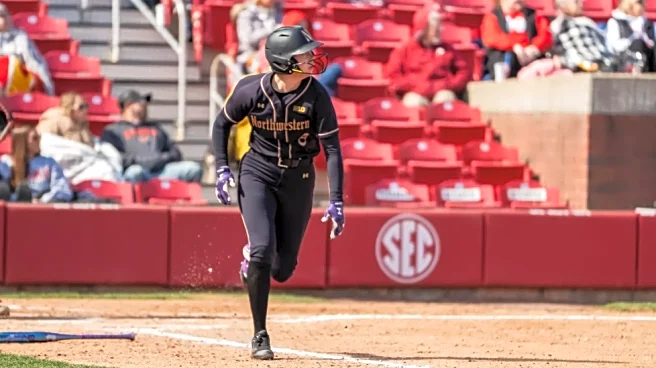


Fifth-year Grace Nieto told me that win or lose, this weekend’s games in Fayetteville would make the team better as long as they learned from the opportunities they had.
I hope she’s right.
After dropping the series to then-ranked No. 8 Arkansas and getting no-hit in one of them, Northwestern struggled to establish a fight. The first contest against SEMO ended with only six hits in six innings, unfortunate numbers against a team that had given up 95 hits on the season. The only convincing performance
came in the second game against the Redhawks (which NU won 12-1).
It’s clear that consistency is the main issue thus far.
Come break it down with me. Grab your favorite snack and let’s dive in.
The Checked Boxes.
Taking a spin
Pitching has been an up-and-down rollercoaster for Northwestern, but I find there’s not much to complain about compared to the current state of the team. Here are the current standings in BB% and K% for all teams in the Big Ten through Feb. 23.

Interestingly, as a team, Northwestern sits exactly in the middle of the Big Ten in K% and BB% — what I would call “truly mid.” It isn’t necessarily struggling, but it isn’t excelling either. You may ask, why would I put this in the good category if it isn’t mid? The answer, dear reader, is because I think this pitching rotation is doing great, considering the fielding and hitting situation on the other side of the coin (which I have and will continue to talk about). This isn’t a staff built to overpower every lineup; instead, it’s built to limit damage.
With a team that had a lot of concern revolving around its star pitcher graduating, I find expectations have currently been met for the Northwestern squad. There is plenty of room to grow, yes, but there is plenty of ground already covered.
I’ve calculated individual metrics below, and I’ve highlighted the leaders of each stat. The rows represent strikeout percentage (K%), walk percentage (BB%), strike percentage (SK%), groundball percentage (G%) and pop-up percentage (P%). Note: I defined pop-ups as anything in the infield.

As a team, Northwestern recorded a ground-ball percentage that’s relatively high — something you definitely want to see, especially if the K% isn’t as high. In this game, it’s extremely important to keep the ball on the ground as it gives your defense a better chance to make outs. Whenever a player has the chance to lift one, shots to the gap and home runs often ensue. Groundballs are consistent, fly balls are not.
Head Coach Kate Drohan has placed considerable trust in Marina Mason, who leads the staff in innings (41.6) and starts (six). This decision is smart. This weekend, she recorded 13 strikeouts, forced 11 ground balls and allowed only five runs — the lowest total among the three starters. She had a K/BB ratio of 4.3 this weekend and overall sits at 2.5. Once she develops that off-speed pitch, she has the tools to be lethal in the circle.
Dohse has quickly emerged as a second option for Drohan, already throwing roughly half the innings she logged all of last season and boasting a 0.62 ERA (tied for first in the country). She has the second-lowest BB% on the staff, the highest K% and she currently sits at a K/BB ratio of 2. It’s great to see the redshirt-sophomore doing so well, especially given that her first collegiate outing as a pitcher was only a year ago (Feb. 14 against LSU).
And yet, Northwestern sits at 6-9 on the season.
But never fear: through the first three weeks last year, Northwestern was sitting similarly at 6-8. What this indicates is that early-season volatility is real, and this is especially true with a reshaped roster. These pitchers are not the end-all, be-all of this Wildcat squad, and I argue that if you need a graduate pitcher to hold together your entire team, then you have some internal adjustments to do.
You can’t always have a pitcher like Jordy Frahm or Karlyn Pickens. By continuing to limit walks, keeping the ball on the ground and cutting down extra-base hits, this pitching staff will keep taking shape.
What’s Still in Play?
A soft underbelly
These past three weeks have been aggravating from a defensive standpoint.
Last season, there were 59 errors in 14 weeks. This year, there have already been 25 in three weeks. That’s 42% of last season’s total in roughly one-fifth of the time; at this pace, Northwestern will eclipse 100 by season’s end (I’m mostly kidding, but this early defensive regression is significant).
Even beyond the error column, plays are not being made and opponents have recorded 87 hits on the season. It would be easy to blame this on the pitching, but as I stated before, this squad does not carry the entire team on its back, and if they have to, then there is clearly something wrong. Roughly 50% of balls in play were on the ground; these are plays that need to be made.
Rtaher than turning to fielding percentage, I’m calculating a metric called the Defensive Efficiency Ratio. DER measures how often a defense converts balls in play into outs and is calculated as: 1 – ((H + ROE – HR) / (PA – BB – SO – HBP – HR))

Below is the calculated DER for No. 1 Tennessee and No. 24 Washington alongside Northwestern. Tennessee was chosen as the top-ranked benchmark, while Washington represents a ranked Big Ten team Northwestern should realistically aspire to match.
As you can see, Northwestern is trailing both programs. Week one was the largest deficit, with NU posting a 69.57% DER against Tennessee’s 82.76% and Washington’s 75.82%. The overall totals sit at NU = 69.46%, UT = 82.18 and UW = 71.92.
The margin between the ‘Cats and the Lady Vols is substantial, the gap between them and the Huskies is slimmer, but still meaningful, particularly when considering run prevention. A difference of even two percentage points in DER over a sample of balls in play can translate to dozens of additional baserunners across the season.
Ironically, Northwestern’s best defensive stretch came against stronger competition in Clearwater, which does bode well. So maybe this is a focus problem? Or a position one?
Tru Media currently has eight errors at third, and Bridget Donahey has four at short. I give Medina grace, as she told me this is her first time playing third in her career, but at some point, it becomes too much. I argue Drohan moves Donahey back to third and Medina transitions to short — it’s where she’s most comfortable, and Donahey certainly didn’t do terribly at third last year.
You aren’t always scoring 8-10 runs in a game, and when the bats fail to show up in big moments (think back to my LOB statistic and the fact NU has 93 strikeouts), run prevention becomes paramount. Take the Missouri game in Clearwater, Northwestern scored only three runs, but it still shut out the Tigers and won. The DER for that game was 85.71% — only two hits were allowed.
If the offense can’t generate runs, the defense needs to generate outs. What I’m seeing right now is only one of these, and it’s not the latter.
Weeklies
Best game: I am a firm believer that the best game you play doesn’t have to be one you win. Going into this weekend, Northwestern’s wins against SEMO were pretty much guaranteed. Arkansas was a different story.
The first two games against the Razorbacks ended in shutouts, and through two innings of the third game, it seemed likely it would happen again.
But things shifted in the top of the third. After scoring five and adding one more in the fourth, the Wildcats finally looked like themselves. It was unfortunate the fire had to be extinguished so soon and as NU tried to claw its way back in the seventh, it was not enough to notch a win.
Still, this game mattered. Avoiding another shutout might not go in the win column, but it showed resilience and small bits of growth against elite competition.
Best play: One Razorback had already crossed the plate, and two more stood in scoring position. The ball was chopped to second, but with Nieto shifted so far up the middle, it seemed impossible that this play was going anywhere.
Cue Kansas Robinson!
After a backhand that made the senior fall over, Robinson secured the web gem, popped to her feet and dove to first in dramatic fashion — beating the runner by a step to end the inning. In a moment where things could have unraveled quickly, Robinson’s athleticism and determination shone through.
The Bounce Back
For the final weekend before Big Ten play, Northwestern travels to Durham, NC to face No. 20 Duke, Boston University and Ohio State.
The Blue Devils are realistically the only ranked team Northwestern has left with a clear opportunity to beat (besides Oregon if it stays in the rankings). Sitting at 9-7, in 100 innings, they’ve allowed 159 hits and 58 with a 5.35 ERA (their best pitcher has a 4.81 ERA).
Similarly, Boston University sits at 6.68 ERA and Ohio State at 5.99. The Buckeyes also have the highest BB% in the Big Ten at 13.45.
The numbers suggest this is a winnable weekend, but it hinges on execution. These rosters allow base traffic, but it’s up to Northwestern to capitalize. Am I saying the ‘Cats will go 5-0? No, but if they clean up the defense and stay disciplined at the plate (especially drawing those walks), the margin is there to stack wins before conference play begins.