


Julian Champagnie
2025-26 stats: 82 games, 27.6 MPG, 11.1 points, 5.8 rebounds, 1.5 assists, 38.1 3FG%, 6.2 3PA
Contract Status: 3 years, $45 million remaining (no options)
Age: 25
Julian Champagnie has overcome the odds and contributed at a high level throughout his career with the San Antonio Spurs. He was a diamond-in-the-rough success story, signing a full deal after being picked up off waivers and becoming a consistent starter in 2023. Then, just a year later in 2024, he was relegated to a bench role that carried over into the 2025-26 season. This year was the season Champagnie firmly earned his way into San Antonio’s starting five for a contending team.
Champagnie has
been a consistent fill-in starter during his career with the Spurs. When De’Aaron Fox went down with an injury early in the season, Champagnie was there. When Devin Vassell got hurt in December, Champagnie filled in. Only this time, the Spurs figured something out. Champagnie’s shooting made it much harder for opposing teams to have their center guard a smaller player, leaving a wing to guard Victor Wembanyama. When Vassell returned from injury, the Spurs doubled down on this approach, starting Champagnie at the four to maximize their spacing around Wembanyama. The starting five of Fox, Vassell, Champagnie, Wembanyama, and Stephon Castle became one of the Spurs’ most potent offensive lineups (125.4 net rating).
It was more than just Champagnie knocking down shots that made this work. He had to guard bigger players and rebound for the lineup to succeed. Champagnie’s rebound rate jumped from 8.8 last season to 11.2 this year, as he became a tough rebounder, particularly on the offensive glass. That helped the Spurs compete on the interior while they reaped the benefits of their newfound spacing. Champagnie was San Antonio’s best three-point shooter, hitting 195 three-pointers this year, the most threes in one season in Spurs’ history.
That shooting carried over into the playoffs, where Champagnie hit 39.6% of his threes. He hit a lot of big ones, too, including 6 in Game 7 of the Western Conference Finals against the Oklahoma City Thunder. Not only did Champagnie shoot the ball well in the playoffs, but he showed a greater willingness to attack closeouts and get to the paint, as teams started to run him off the three-point line. He held his own defensively against some tough wings in the postseason. However, he was exposed in the Finals, as the Knicks intentionally tried to get him switched onto Jalen Brunson late in games.
It’s hard to find many Spurs who were at their best in the Finals, so Champagnie shouldn’t get docked too much for failing to guard Brunson (pretty much everyone failed to guard him this postseason). Overall, Champagnie was one of the Spurs’ most consistent performers in both the regular season and playoffs. Not only did he play in literally every game, but he played well in most of them. San Antonio can always count on him to hit threes, bring a lot of energy on the glass, and hold his own defensively. He more than earned his starting spot this season, and should be in position to keep it next year.
Looking ahead
Champagnie’s stellar season earned him a 3-year, $45M contract extension with the Spurs. But just as he locked himself in for the future, San Antonio also signed his competition. They acquired Tobias Harris on a similar 2-year, $30M deal, giving the team a do-it-all scoring forward who has a bit more size and strength than Champagnie, something San Antonio needed desperately in the postseason. He has a legitimate shot to start for San Antonio next year. But should he automatically get the nod over Champagnie?
The Spurs were an NBA Finals-level team with Champagnie in the starting lineup. Removing him for Harris to start the 2026-27 season feels like a classic case of it not being broke… and trying to fix it. Champagnie doesn’t have the offensive bag that Harris has and is a much different defensive player, but his movement shooting works really well with San Antonio’s guards’ and Wembanyama’s game. If the Spurs are playing a team with a bigger, bruising forward, they can go with Harris to close the game. If they need the shooting, Champagnie can close. Ultimately, the added flexibility is good, but it does create questions about which player is starting more games.
Bringing Harris off the bench would also give the Spurs another versatile offensive weapon to improve a second unit that struggled to score at times last year. With Dylan Harper, Harris, and Keldon Johnson, the Spurs would have one of the NBA’s best benches. If Champagnie goes to the bench, he’d more easily fit into bench lineups that are already fairly forward-heavy, with Johnson and Carter Bryant expected to play meaningful minutes at the 3 and four. He’d also provide some needed shooting alongside Harper-led lineups.
Champagnie will be a key part of the Spurs’ rotation regardless of whether he starts. He’ll continue to give them consistent deep shooting. Improving his shooting on the move, perimeter defense, and ability to attack a closeout will take his game to the next level. After everything Champagnie has shown in his four seasons, it’s not unreasonable to think he will do just that.
Top performance
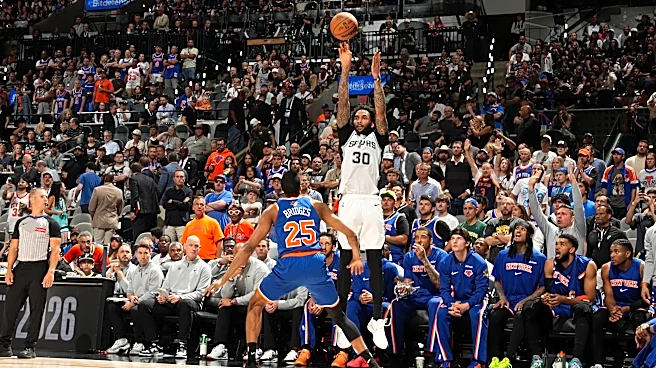
December 31 vs. New York Knicks: 36 points, 6 rebounds, 11-17 3PFG
It was hard to pick between Champagnie’s hot shooting in Game 7 of the WCF or this explosion from the regular season. Hitting 11 threes in a game is incredibly difficult, especially against the eventual NBA champs. This may not have been the pinnacle of the Spurs’ season, but it was certainly Champagnie’s most impressive game.
Final Score: A-
Up next: Stephon Castle
Previous Reviews