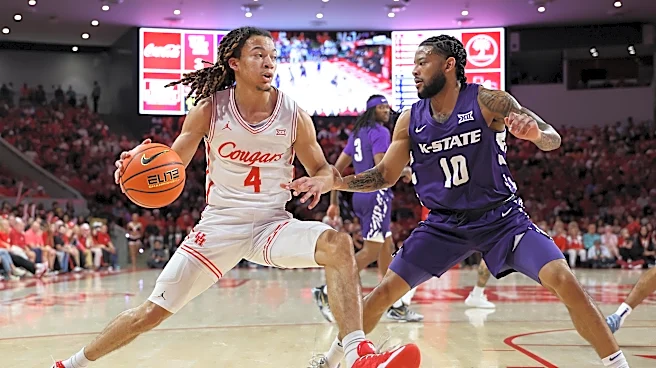







As point guards coming out of a Kelvin Sampson-led program tend to do, Kingston Flemings, of the University of Houston, will come into the NBA with more than one trick in his bag. Playing under Sampson in his only year in the college game is perhaps another advantage he has over the bevy of attractive guard prospects invading the NBA in 2026.
Many recent mock drafts have Flemings going off the board at the seventh pick, to the Sacramento Kings. One recent mock, which should interest Dallas Mavericks
fans, has Flemings falling all the way past Dallas at No. 9 to the Milwaukee Bucks at the 10th overall pick, with Dallas opting to trade the ninth pick and Kyrie Irving to the Charlotte Hornets for LaMelo Ball and the 14th and 18th overall picks. God, speculation is fun, isn’t it?
Flemings showed himself to be effective in the halfcourt, with an ability to dissect the opposing defense, but he’s also an elite downhill driver of the ball, creating space with both physicality and speed. Then there’s the shooting. Flemings shot nearly 39% from 3-point range for Houston as a freshman, but was much better off the catch than he was off the dribble.
The basics
Flemings was born in Newport News, Va., but was raised in San Antonio. He was named the Gatorade Texas Player of the Year during his senior season at Brennan High School, as well as a Naismith All-American. Despite all that, he wasn’t considered a certain one-and-done prospect entering his freshman season at Houston, but he soon proved to be one.
Among the most notable moments in his short college career was a 42-point explosion against Texas Tech, when he set a new high-scoring mark for a freshman at Houston. He shoots. He creates. He defends. You must if Sampson is going to trust you with the ball in your hands as a freshman, and Sampson did trust Flemings, to the tune of a 26% usage rate.
He creates his best offensive possessions when he gets into ball screens. He’s just a whiz at calculating advantageous matchups and executing as soon as the opportunity presents itself. His first step is lethal.
Strengths
That lethal first step is followed by a will to get to the bucket nearly unrivaled in the college game. He did slow down a bit in terms of efficiency at the rim as the season went along and the competition got tighter and tighter, but don’t discount his own explanation of part of his calculus when getting to the rim.
“We wanted to get the ball on the rim,” Flemings told NBA analyst Kevin O’Connor on a recent appearance on his Kevin O’Connor Show podcast. “Some of that is strategic when you have guys crashing. Some of it may have been a slight lack of focus, but part of it was also wanting to get the ball on the rim for those guys to go get it.”
Flemings actually moves the defense with his dribble, rather than simply trying to get past his man. You have to account for his speed at all times, and the advantages it creates can really fuel an NBA offense. It’s his elite athleticism that makes him special. Flemings jumps out of the gym with a 40.5-inch max vertical, and his sprint speed and agility in the lane separate him from the crowd.
Defensively, Flemings has a better foundation than almost every other freshman lead guard in the college game. He generates steals, pressures the ball, and plays with a high degree of competitiveness. The same cannot be said of all guards floating in the 7-10 range of NBA draft boards.
Concerns
Do his measurements from the NBA Draft Combine change his defensive ceiling in the NBA, though?
Flemings measures just 6-foot-2 and 1/2 without shoes, and his wingspan is just shy of 6-foot-4. He’s slight, at 183 pounds. Will he get pushed around in the NBA?
The question on his way to the rack in the NBA will be contact. The guards he’ll be facing are much bigger now. Will his physicality be enough on this level to make him as effective in getting to the bucket as he was in college?
He told O’Connor, to that end, that he was working hard on developing his floater and runner game in his time off after the college season. He realizes there are things he needs to work on, and above all else, this is a 19-year-old kid who hates losing.
Fit with the Mavericks
I’d be surprised if the Mavericks find themselves in a position where drafting Flemings is an option, but stranger things have happened. I believe he’d be a much better fit with the team than, say Darius Acuff Jr., and even a better fit than Mikel Brown Jr.
Flemings has a level of polish to his game at the tender age of 19 that few prospects possess. Thank Sampson and his rocket-launching legs for that. His live-dribble playmaking and his net-positive status on the defensive end would make him a near-perfect fit.
I also think he’s going to be able to inspire a little more confidence from 3-point range in the NBA than he did in college, which doesn’t mean his shooting was a problem with Houston. He just wasn’t a volume guy and he wasn’t that great shooting off the dribble.
“I’ve been working on getting to the same shot pocket [whether shooting off the dribble or off the catch],” Flemings told O’Connor. “I’m kind of shooting it wherever my dribble is [in film from college], so I’m working on getting to same shot pocket and getting more consistent.
“In the NBA, people want to shoot a lot more threes, so I’m going to shoot more threes. In college, we did what we needed to do to win.”
NBA comparison
In the recent conversation with O’Connor, Flemings listed Tyrese Maxey and De’Aaron Fox as two players he emulates. They’re not the biggest dudes either, but they have a nose for the bucket, and their 3-point shot has come along in the professional game, much like Flemings will look to do as more form the perimeter is asked of him starting next season.
Ajay Mitchell and Coby White may also come to mind. Even if he doesn’t become an elite lead guard, he could still be a microwave scoring engine like one of these guys.