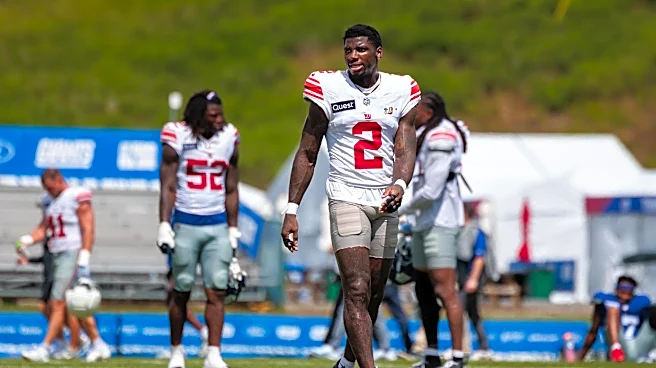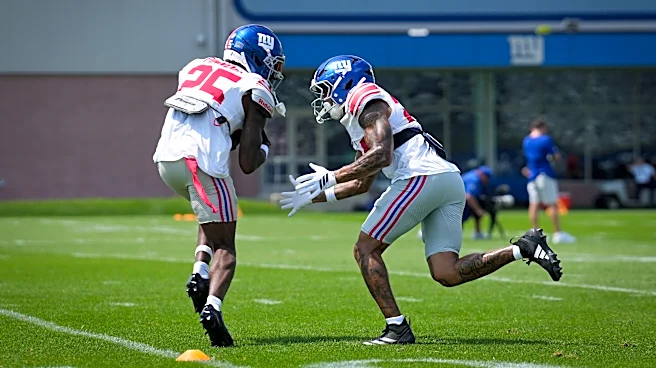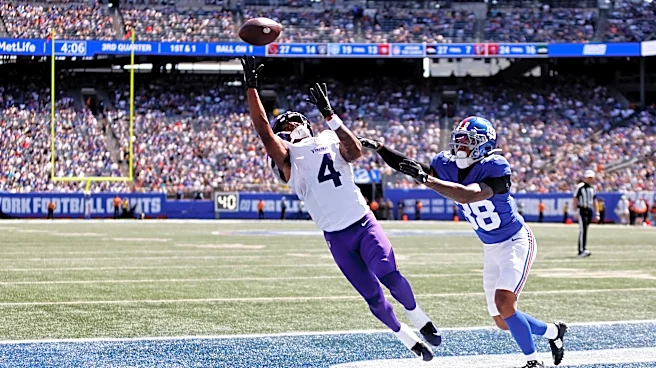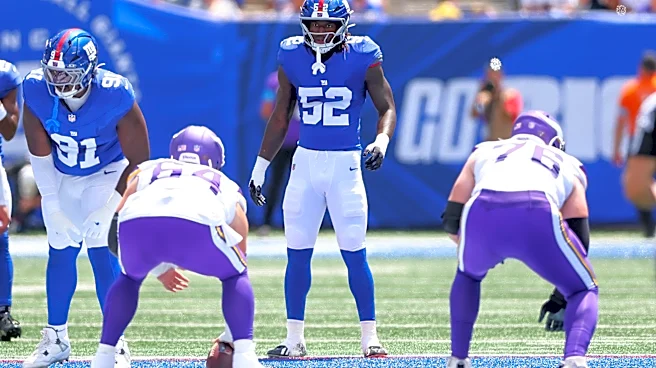


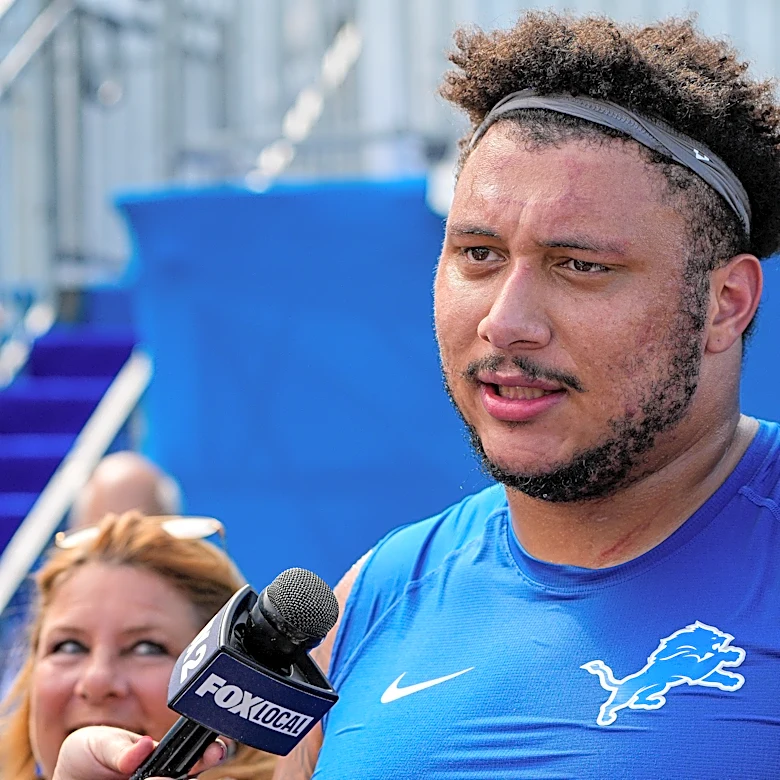
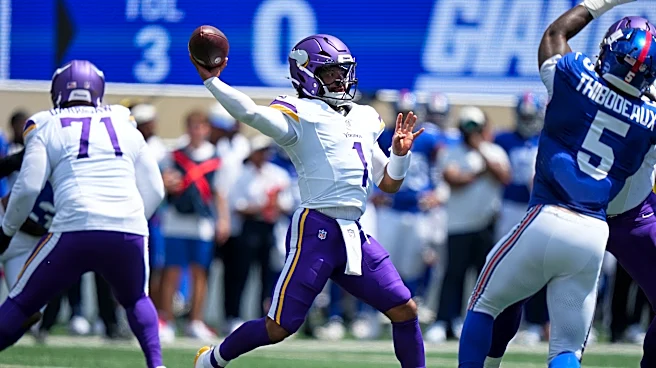
We finally got a look at the New York Giants 2026 draft class in a live game setting. The Giants’ rookies played early and often in their first NFL action, with each of the Giants first four picks starting against the Minnesota Vikings.
The Giants want to build through the draft, so these young men will be their future as well as a big part of their present. And while the Giants lost the game — and go into the next week of practice with plenty of things to work on — there were also plenty of encouraging
signs in their individual play.
Arvell Reese (LB)
The Giants’ first draft pick started the game and played 16 snaps, notching two total tackles. Reese was largely as advertised in the draft and in practice reports. He plays with an impressive downhill trigger, quickly closing on running plays. Reese plays very fast, with an accurate first move as well as his twitchy athleticism allowing him to fly to the ball. He also arrives with bad intentions and hits like an absolute truck.
We’ve seen the clips of his tackle in the run game, but instead I want to highlight Reese taking on the Vikings’ fullback. He quickly diagnoses the play, knifes into the gap, and blows up the lead blocker, forcing the running back to cut back. The run goes for 4 yards, but that isn’t Reese’s fault.

(I’d place the blame on DL Josh Toupu, who doesn’t stay square to his blocker and gives up a massive hole on the right C gap.)
He’s surprisingly fluid in space, which should give Dennard Wilson plenty of options for simulated pressures or zone blitzes. It’s going to be fun to watch Reese develop and see how he’s employed as we see more of Dennard Wilson’s defense.
Francis Mauigoa (G)
Mauigoa got quite a bit of work against the Vikings, playing 32 offensive snaps (as well as 1 special teams on the extra point attempt), or almost half of the offense’s 67 total plays. Mauigoa played with both Jaxson Dart and Jameis Winston.
Mauigoa is clearly a massive, powerful young man. He’s able to distort the line of scrimmage going downhill as a run blocker, both in man-gap and zone schemes. He also clearly understands how to use angles to his advantage, creating creases even when he can’t drive defenders off the ball.
We don’t know for sure if Mauigoa will ever move outside to tackle, he does have very good feet for a guard, easily mirroring interior rushers in pass protection. He lunged a bit on some of his blocks, which he’ll need to clean up to avoid being on the ground too much. However, his hand usage was solid and he’s strong enough to be a problem even without perfect technique.
Mauigoa absolutely looked like he belonged as a guard on an NFL offensive line, though after the game he said that he doesn’t just want to belong, he wants to dominate.
“I do honestly feel like I belong,” he said after the game. “But at the same time, I just don’t want to belong. I want to dominate the league. That’s the mentality that every kid has. As a rookie, you want to come in and you want to earn that trust.”
Colton Hood (CB)
The Giants’ second-round pick started the game opposite Deonte Banks and was on the field for 31 snaps. Hood was credited with 3 tackles and no passes defensed, though he may have gotten one if John Harbaugh had won his challenge. Hood played the left cornerback position, likely putting him in direct competition (or as the planned backup for) Paulson Adebo, who has historically been a LCB.
Hood is a smooth mover in space with quick solid recovery quickness. He did a good job of closing when targeted in zone coverage and gave a good effort to disrupt the catch. Early descriptions of him as a “press man bully” were accurate on the field, and Hood is both very physical with his jams as well as when he’s taking on blocks. He still needs development in the technique department, but the “want to” is there.
Ultimately, Hood was largely invisible and it was a bit of a surprise to see him on the field for 31 snaps (including some special teams work). That’s not a bad outcome for a rookie cornerback.
Malachi Fields (WR)
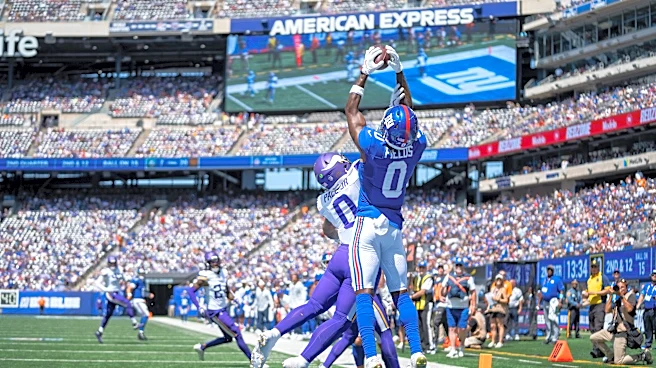
Fields was, in many ways, the star of the offense for the Giants. He was on the field for 21 of the Giant’s 67 offensive plays (as well as five special teams plays), but had some of the most memorable on offense.
Fields plays faster than he timed at the Scouting Combine, however he’s still more of a “quicker than fast” receiver. He’s somewhat plodding unless he can open his stride, but he does have impressive short-area quickness for a big receiver. Fields also clearly understands how to use his massive catch radius, playing with excellent ball skills and strong hands.

Notably, the Giants made an effort to get Fields involved as a blocker. He was occasionally put in motion before the snap and brought to the play-side. He definitely understands how to use his size against defensive backs and blocked with good competitive toughness as well.

That isn’t as flashy as a scramble drill touchdown, but it’s important to the down-to-down operation of the offense.
“He loves the game, he competes through the whistle,” quarterback axson Dart said after the game. “You see that in the way that not only he runs his routes but also the way that he blocks, so I think he’s just been doing what he’s been doing and I have a ton of faith in him.”
Bobby Jamison-Travis (iDL)
Jamison-Travis got on the field pretty early in the game, playing the first of his 27 snaps with 10:21 remaining in the second quarter. That could mean that the coaching staff is eyeing him for a move up the depth chart and wanted to see him against some of the Vikings’ better players.
While Jamison-Travis didn’t record any stats in the box score, he had a good game. He’s stout at the nose tackle position (either at the 1-technique or 0-technique), and consistently created traffic jams in the middle. He’s quicker than expected in a short area, and pretty consistently rocked the center back or stonewalled double teams.

Jamison-Travis also played with an mpressive motor for a big man. He won’t be running many people down, but he consistently disengaged and hustled to the play, even if there was no hope that he’d make the tackle.
J.C. Davis (OT)
Davis didn’t get onto the field with the offense until about halfway through the third quarter (7:57 remaining), playing left tackle with the third team.
The results were decidedly mixed. On the plus side, he does show good play strength once engaged with good pad level, and was able to wall off rushers when they met him head-on. Likewise, he has good power and can move defenders when blocking downhill. He has smooth feet and can move laterally when he needs to.
On the other hand, there were enough snaps where Davis struggled to justify concern about him. He showed a tendency to lunge into contact, as well as pivot too early and get perpendicular to the line of scrimmage instead of staying parallel. In either case, doing so created easy lanes into the backfield. That might be due to the fact that while his feet are smooth, he doesn’t look particularly quick. Davis might have more of a future as an interior lineman than as an offensive tackle.
Jack Kelly (LB)
The Giants’ coaching staff clearly wanted to take a long look at Kelly and had him on the field for 51 total snaps between defense and special teams. He started the game covering the opening kick-off and got on the field the first time with the defense with 13:26 remaining in the second quarter, while some starters were still on the field.
Kelly was extremely active on defense and looked comfortable playing the run as well as dropping into zone coverage. Likewise, he’s explosive coming downhill as a pass rusher and had a couple nice blitzes through the interior gaps. That said, he does need to work on his technique taking on blocks. He wasn’t consistently getting his pads down when taking on offensive linemen and wasn’t really using his hands as a pass rusher.
Kelly might not be as absolutely impressive as Reese, but he had himself a very nice game and played well above expectations for a sixth-round pick.
Ryan Schernecke (OT)
Considering Schernecke’s pedigree as an undrafted free agent from Kutztown University, I wanted to take the time to give him a look. This is a very small sample size, since the UDFA only got on the field for 11 plays at right tackle at the end of the game. That said, there’s some things to like.
To start, Schernecke has quick feet, and not just for a big man. He moves like a much smaller tackle and looks to have the feet to match speed off the edge. He also appears to have enough play strength to slow bull rushes as well as move defenders when run blocking.

Schernecke is a work in progress right now. He needs to improve his pad level and leverage consistency, and also needs to get a lot more accurate blocking in space. However, it seems like he has the tools to work with.