


Editor’s Note: It’s with great pride we introduce Kaden Cho as one of our guest contributors! He’s going to bring some of his fresh perspectives here, and you can follow him at @kady1735.
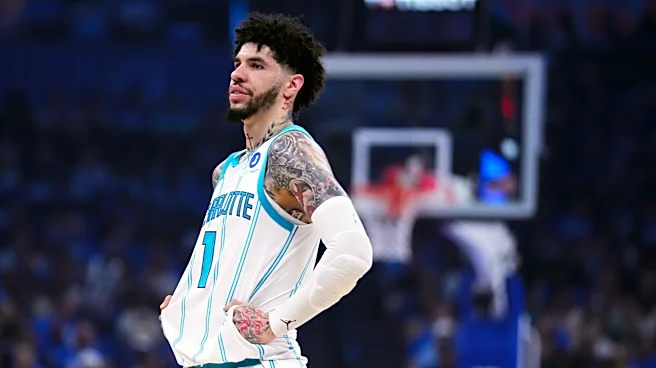
LaMelo Ball is the Timberwolves’ premier addition this offseason, and with that label, discussions have inevitably started about how impactful he really is. The 25-year-old is coming off his first healthy season in years, finally surpassing the 50 game barrier, and leading the best starting lineup in the league in terms of net rating.
This has rightfully garnered Ball praise as one of the best offensive engines in the world, and while some still harbor grievances about his injury struggles, there
remains a camp that believes he is simply not good at all. To them, he’s “reckless,” “inefficient,” and the biggest of his detractors will even call him “stupid”.
This narrative is generally associated with turnover issues, but the Wolves’ new point guard was actually in the 71st percentile among his positional group in creation-adjusted turnover percentage this season. This stat reflects that Ball suppressed turnovers relative to his 94th percentile on-ball load.
Rather, much of the talk about Ball’s playstyle hinges on our perception of his playmaking process, rather than the results of that creation. He is often degraded as being “made for TikTok”, in a way that connotes the idea that he is exclusively a highlight player. The one-legged threes and no-look passes certainly feed into that view, but we must take more than one look at any player that we evaluate.
Why brand LaMelo as “reckless” rather than “innovative”? Ball’s way of playing basketball is groundbreaking and deserving of praise.
Perhaps the way that we talk about him is informed by his off-court shenanigans, with him being brought up as one of the first major social media stars in basketball, which has only continued through his irresponsible driving.
It’s understandable why many use this mental shortcut. The Julian Newmans of the world, who came up around LaMelo’s time, definitely aren’t doing as well, and clips have spread that have only further propagated this idea. LaMelo’s most recognizable highlight from his childhood is his pull-up from half-court, and it’s easy to look at that kid and say he’s an arrogant showboater.
Even in the pre-draft process, LaMelo stood out like a sore thumb. He bounced around internationally, even having a short stint with a start-up league created by his father, LaVar Ball. His interviews were even wackier: He said he wanted to be the President of the United States after he was finished with basketball.
This narrative has also been given life by the numerous clips of LaVar that have gone viral over the years.
It’s easy to look at this and say that LaMelo is not the most put-together person, and I wouldn’t necessarily disagree; I don’t know him personally. But I do find it to be an issue when these categorizations are applied to basketball.
Is it not our job as analysts to separate these issues from his actual play on the court? Why has the collective NBA community dumbed down LaMelo’s ability as a passer?
Basketball has long used terms like “low-IQ” to describe its own aesthetic bias, and it has routinely dipped into anti-blackness. Allen Iverson, Russell Westbrook, Magic Johnson, and so many other extraordinary passers have been demeaned for the same things that Ball faces now.
Magic, who is now widely considered to be the greatest passer to ever step foot on an NBA court, or really any court for that matter, was seen as too careless when he was drafted. Jerry West infamously tried to force him into the post as a power forward instead of as a point guard. And yet, he redefined the game by stretching its boundaries.
These words are usually used as a descriptor for a genuine evaluation of a player, but it’s important to remember that our biases are never fully isolated from stereotypes embedded in our society. There are ways that LaMelo’s shot diet could be more efficient, yes: he was a 58th-percentile point guard in rim attempts per 75 possessions last season, which is very low for his creation duties.
In the same way, LaMelo’s pull-up shooting and passing are indeed unorthodox, but it has lead to historic levels of offense, and even if there are valid criticisms of his game, we must watch what connotations our language has.
Anthony Edwards hasn’t played with a real passing point guard – at least not one who is in their prime – throughout his entire career, and the Timberwolves just went out and got one of the best in the league. Furthermore, it’s a very clear shift by the front office to counter the San Antonio Spurs and Oklahoma City Thunder by leaning very heavily on pull-up shot creation.
Sometimes you have to zag when the league zigs, and that’s what Tim Connelly is known for. It is in moving away from the orthodox that we get some of the biggest Wolves moments of the decade. Coming off Rudy Gobert’s transformative defense and important part in several impressive playoff runs, you’ll never believe that trading for him was largely criticized as mortgaging their future.
Players shouldn’t be assigned personal qualities based on the different decisions they make on the court. Luka Dončić, whose eccentric playmaking style leads to incredible plays but also exasperating turnovers, has been called a playmaking savant, a passing genius, and a true innovator for the sport. But LaMelo “makes bad decisions,” and his passing process is “impaired”.
And even if you think LaMelo is reckless based on the driving, don’t apply it to the game, and vice versa.
These labels have stuck to LaMelo, but in the end, they don’t define who he is as a player. One of the best passers in the NBA is heading to the Timberwolves, and the fans should be excited for what is to come, as their franchise player is.