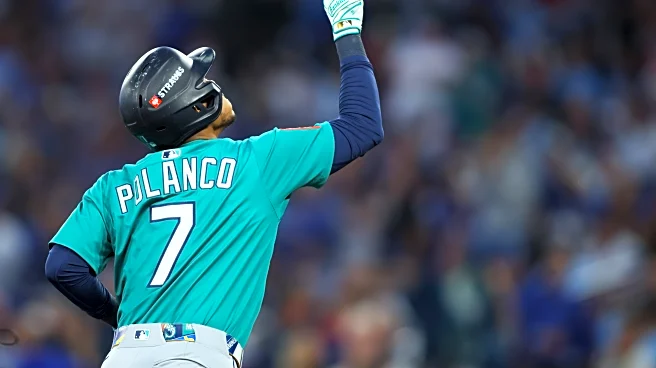




It wasn’t necessarily a splash move, but the Mets made their first foray into the offensive side of free agency over the weekend, signing Jorge Polanco to a two-year, $40M deal.
Originally signed as in IFA by the Twins in 2009 (bet you feel old now huh?), Polanco debuted with Minnesota very briefly in 2014 as a 20-year-old. He didn’t get extended run at the major league level until 2016, but he quickly settled in as a roughly average hitter who spent most of time at shortstop (where he was admittedly
a disaster). Polanco managed to evolve and squeeze more oomph out of his bat after a couple years of regular playing time, gradually adding more power and posting a wRC+ of at least 110 in every season from 2018 to 2023, excluding the COVID-shortened 2020.
Polanco went from Minnesota to Seattle in an offseason trade prior to the 2024 season and promptly had the worst year of his career. His strikeout rate ballooned to nearly 30% (previous career high was 25.7%) and his power pulled back to meager early-career levels. It was revealed after the season that he’d been playing through consistent knee pain, and he underwent surgery on his patellar tendon in October of 2024. Unsurprisingly, the Mariners declined their $12.5M option, sending Polanco back to free agency.
For many, this made him a popular sleeper target last offseason, but Polanco ultimately didn’t go anywhere; the mariners re-signed him to a one-year deal worth $7.75M. He rewarded Seattle’s faith in him thoroughly with the best offensive season of his career. Despite striking out less than 16% of the time, Polanco posted a .229 ISO and 26 HR in the always-pitcher-friendly SafeCo, including both a 9-homer barrage in April and a strong second half.
Under the hood, there are clear changes supporting the offensive jump. Polanco increased his bat speed by more then a full mile per hour and nearly doubled his fast swing rate without lengthening his swing at all. He also flattened his attack angle, a change that did result in more ground balls but which also improved the quality of his pulled air contact. All of this drove significant improvements to Polanco’s Z-contact and exit velocity metrics without harming his approach significantly or batted ball distribution in a meaningful way..
To be clear, Polanco is not a physical freak, nor is he someone who is going to post insane exit velocities. He does, however, appear to have found a set of changes that allow him to make a ton of contact and hit balls hard enough to the right places to maximize damage when he does. Put more simply with a couple of old school metrics, Polanco had a 92nd percentile ISO and a 13th percentile strikeout rate. Here’s a scatter plot showing those figures and highlighting the only players with similar 2025 numbers:

Yes, you’re reading that right. Among players with 100 PA last year, Ketel Marte is the only batter better than Polanco in both of these metrics. Jose Ramirez is the only other player somewhat close. That’s impressive company no matter how you slice it.
So the offensive side makes a lot of sense, but what about the defense? Polanco hasn’t been a shortstop for years and is at this point a poor fielder at both second and third. Fittingly, he seems likely to primarily function as a 1B / DH for the Mets. One problem with that; Polanco has all of one game of experience at the cold corner. Infielders like Polanco typically transition well to the cold corner (tell him Wash) and it’d be tough to be worse than Pete Alonso has been recently, but this does seem to run counter to the Mets’ new emphasis on run prevention.
We also should note that while the term on this deal (only two years) protects the Mets from a lot of downside risk, Polanco’s contract is by no means a bargain. A career-best season at age 32 is always something to be skeptical of, no matter what analysis we do to support it. Both normal regression and plain-old age-related decline are in play here. Couple that with the defensive questions and it’s a good amount of money for an imperfect fit.
The logic becomes more clear when you view this signing through the lens of preserving flexibility. Ideally, the Mets sign another player to be the primary 1B (e.g., Kazuma Okamoto, Munetaka Murakami, Ryan O’Hearn, etc.) and Polanco is the primary DH who functions as an occasional backup around the infield. If the Mets don’t add a clearly better option at 1B, Polanco can play there, and he might even be good; not perfect, but totally viable. If the team decides to trade Baty, Polanco can play there; it’s not ideal, but it’s viable. If a prospect like Ryan Clifford forces the issue and earns 1B/DH at bats, Polanco can split that time while getting additional at bats at 2B or 3B; once again, not ideal, but viable.
So no, this isn’t the perfect deal, but there rarely is such a thing in modern free agency. What Polanco brings is a potentially excellent bat on limited term while preserving the Mets’ flexibility at this relatively early stage of the offseason. It’s a solid B+ move.