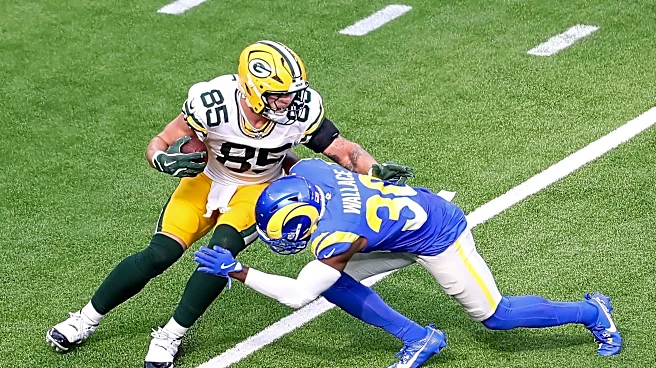



It really is a shame that Tucker Kraft’s 2025 season was cut short. This is not just because the Green Bay Packers might have made a deeper playoff run with him on the field (which is likely) or because he will miss the entire 2026 offseason program while rehabbing his torn ACL. Beyond those concerns for the Packers, Kraft’s injury robbed NFL fans of something special as well: a half-season of highlights from the league’s best receiver after the catch.
While it may seem like hyperbole to say that
Kraft, the 6-foot-5, 259-pound tight end, is a more explosive player after the catch than every other tight end or wide receiver in the NFL, the numbers from the 8 games he did play bear it out.
To begin, it is worth clarifying that running backs are vastly different from the wideout or tight end positions for this analysis. Running backs almost always catch the ball near or behind the line of scrimmage, while tight ends and wide receivers run their routes farther down the field. Offenses rely on running backs to do the vast majority of their damage after the catch point, often helped out by blockers releasing in front of them. For both tight ends and wide receivers, that is the case far less often.
Now on to the numbers, which demonstrate that Kraft was head and shoulders above every other receiver in YAC ability last season. In his 8 games, Kraft caught 32 of 44 targets for 489 yards and six touchdowns. That’s an average of 15.3 yards per catch, which tied him with wide receiver Terry McLaurin for 8th in the entire NFL. But raw yards per reception only tells part of the story, and it does not entirely illustrate his after the catch abilities.
Using Pro Football Reference’s advanced receiving numbers, it’s clear what a unicorn Kraft is in today’s NFL. He averaged 10.8 yards after the catch in 2025 among players with at least 34 pass targets, ranking 3rd in the NFL behind running backs Jaylen Warren and Bijan Robinson. That is impressive company, to be sure. But a scan down the leaderboard reveals that he was the only wide receiver or tight end in the top NINETEEN on the YAC average leaderboard — every one of the other 18 players were running backs. The next-closest receiver or tight end was Kansas City’s Rashee Rice, who came in 20th with an average of 7.8 yards after the catch.
In fact, only twice since 2018 had any wide receiver averaged more than 10 YAC per reception, according to Pro Football Reference. Those two wideouts were Marvin Mims in 2024 (with a rather shocking 12.2, in part due to four touchdowns of 25 yards or more) and Deebo Samuel in 2020 (12.1). And in that span, the only tight ends to even eclipse 9 were George Kittle, who averaged 9.9 in 2018, and — you guessed it — Kraft in 2024 (9.1).
The broken tackle rate that Kraft forced further illustrates this point. PFREF credited him with six broken tackles, giving an average of 5.3 receptions per broken tackle. Only three qualifying players broke tackles more frequently on pass receptions: Jaylen Warren (again), Tyjae Spears, and Michael Carter. You probably know where this is going: they’re all running backs. You have to go through two more running backs before you find a wide receiver, as Terry McLaurin shows up as the first wideout in 7th place after breaking six tackles on 38 catches for a rate of 6.3.
Without question, Kraft was on pace for an All-Pro caliber campaign before his injury, and when comparing only against tight ends, his unique YAC ability is even more startling. He led all qualifying NFL tight ends in overall yards per reception, with his 15.3-yard average beating Buffalo’s Dalton Kincaid by 0.7 yards. But that’s with Kincaid playing primarily a big slot role and serving as more of a downfield weapon than Kraft — Kincaid’s average depth of target was 9.5 yards, which is double Kraft’s (4.7), and he trailed massively in YAC/R with just 6.6.
Overall, had Kraft continued on his first-half pace of 61.1 yards per game, he would have ranked second among all tight ends in the NFL behind only Trey McBride of the Cardinals (72.9). McBride finished second in the NFL in receptions with 126 and in receiving touchdowns with 11, which earned him First-Team All-Pro honors in 2025. But he had nowhere near the efficiency that Kraft did, gaining just 9.8 yards per reception overall. Yes, Kraft averaged more yards after the catch than McBride did in general, and Kraft’s 11.1 yards per target was a top-five number while McBride ranked 97th among qualifiers at just 7.3.
Then, looking again at the broken tackle numbers, Kraft again outshines his fellow tight ends. Sam LaPorta of the Lions was the next-closest in receptions per broken tackle at 8.0 (five on 40 catches). And a look back at 2024 finds only one tight end with a number in that category below 9; obviously, it’s Kraft again at 5.6 (9 broken tackles on 50 catches).
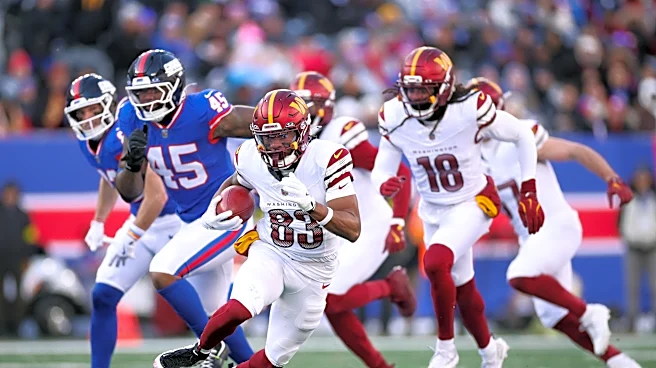
YAC numbers can certainly be influenced by a few big plays here or there. It’s how Mims hit his number in 2024, and it did contribute to Kraft’s YAC explosion in the first half of 2025. Kraft racked up 74 YAC in week two, when he caught 6 passes for 124 yards and a score against Washington, then had an astounding 131 YAC against the Pittsburgh Steelers in week 8 (7 for 143 and two touchdowns). Three of those plays had at least 30 YAC apiece, which had an outsized impact on his average given that he played just half a season.
But a deeper look at those games illustrates how, for Kraft, the ability to generate yardage after the catch isn’t a fluke — it’s a key component of his ability. Those three catches were outliers, but he had an additional three receptions with at least 15 YAC apiece. So in six of his 13 catches in those two games, he was generating at least 15 yards after the catch.
This is something Kraft does better than any other tight end in recent memory, and it’s something he did better than any other receiver overall in 2025. Don’t be surprised if that part of Kraft’s game takes a bit to come back in 2026; after all, he should be ready to resume full activity in or around training camp, with only a bit of ramp-up time before the regular season. But when he truly returns to full strength, the Packers will get back a truly one-of-a-kind player at his position, and one who should be in the All-Pro conversation for years to come.