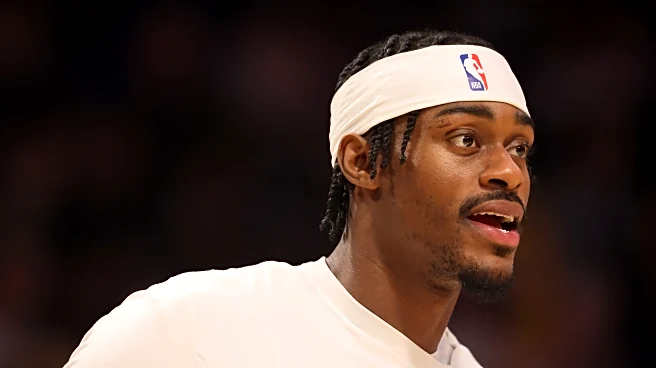

After playing just three minutes in a single appearance in the Lakers previous 10 games, Jarred Vanderbilt played 15 minutes against the Phoenix Suns on Sunday and was a critical figure in his team getting
the victory. Vanderbilt scored seven points and grabbed seven rebounds — six offensive — while swiping two steals and swatting one shot.
He finished the game with a plus-minus of +7 in a game the team won by a single point, indicative of the energy, hustle, and defensive mindset he brought to the team in his minutes. After the game, head coach JJ Redick acknowledged that Vando “helped win this game, full stop,” contextualizing some of the recent communication he’s had with his player who had been on the outside of the rotation looking in but, with Austin Reaves out and the team needing a spark defensively, got the chance he’d been waiting for.
That Vanderbilt had not been playing before the Suns game is a story that is both straightforward and understandable, but also one that I hope is in the process of being reversed.
On the former point, Vanderbilt had not been helping the team as much as might be expected even though there is a clear synergy between areas where the team has a deficit and what his skill set is and how much of a defense-first player he is.
In many of Vando’s appearances earlier in the season, the Lakers were switching a lot one through four, often allowing teams to easily get Vando off his primary defensive assignment and onto a less impactful offensive player.
This resulted in Vanderbilt standing in the corner or out of the action entirely, rendered a spectator or an off-ball worker when, to be optimized, you’d much rather have him at the point of attack defending the other team’s primary ball handler or highest volume shot creator. Sure, he could still help on the boards or, if in a low man position, be a weak side rim protector, but that sort of involvement still doesn’t allow him to impact the game in the ways he’s best suited.
And then, of course, there’s the challenges offensively. We don’t need to hover on this point for too long, but needless to say, the offseason work on his jumper that was the talk of training camp did not carry over into the season. And when the Lakers tried to use him in situations beyond just spotting up in the corner, those attempts weren’t generating much success either.

Most notably, when trying to use Vanderbilt in dribble-handoffs or as the screener in the pick-and-roll, defenses did not respect his gravity as a dive man or in keeper actions, leading to more situations where the Lakers ball-handlers would get trapped hard or see two defenders on the ball.
And when that would happen, it was not always clear that Vando and the team’s guards were on the same page, with him sometimes rolling through the “pocket” area, which would then lead to turnovers at worst or needing to reset the entire play at best instead of the types of four-on-three advantages those sorts of coverages should lead to.
So, with Vanderbilt not necessarily having the sort of expected impact on defense and his offensive limitations still compromising the Lakers on the other side of the ball, Redick pulled him from the rotation. And, honestly, I’d be lying if I said I didn’t understand it or that I had substantive pushback against it. Because I didn’t.
That said, as the Lakers began to lose the games the same way in recent weeks, I’d also be lying if I didn’t start to wonder if Vanderbilt should get another chance. The team’s defense was floundering in the same ways, and with Marcus Smart missing games, I wondered if Vando should get a chance.
And then the Suns game came and with that performance, a bit of a renewed faith in what could be a positive producing role for Vanderbilt emerged in me for a few reasons.
First, Smart also returned in the Suns game which, along with Jake LaRavia — and, to a bit of a lesser, but still meaningful degree, Gabe — gave Vanderbilt partners in crime defensively in some of these Lakers lineups where there was enough defensive talent on the floor where switching wouldn’t automatically allow teams to gain advantage while simultaneously banishing Vando to the corner.
Here, for example, Vanderbilt starts the possession on Collin Gillespie, who is attempting to clear the side and take Vando with him. But there is Smart, who tells Vando to shift to the ball handler, Devin Booker, while taking Gillespie for himself.
Then, when the Suns try to run a pick and roll, Smart cheats up into Booker’s driving lane, baiting a pass to Gillespie, who has sunk to the corner. Smart then recovers, and when Gillespie tries to get the ball back to Booker, Vando pounces into the passing lane to get a deflection and a steal.
Then, on the ensuing offensive possession, with all the cross-matching in transition, Vando grabs an offensive rebound that leads to a LeBron three that pushes the Lakers lead back up to 18.
This is the type of teamwork that allowed the Lakers to go on a 24-0 run fueled by their playmaking on defense and is most possible when you have multiple defensive playmakers on the court at the same time. In other words, don’t allow opposing offenses to sideline Vando by singling him out as the one defender they have to account for.
Instead, make him part of a unit that can collectively pressure the ball, jump passing lanes, and protect the rim. The team doesn’t have enough defensive personnel to play this way for extended stretches, but they can do so for certain parts of the game.
Which brings me to another key figure in Vando lineups: LeBron James.
Vando shared the floor with LeBron for 11 of his 15 minutes and, in that time, the Lakers outscored the Suns by 13 points for a whopping +50.7 net rating. While this sort of success is extreme, it’s not entirely out of the norm. LeBron and Vanderbilt have now been teammates for parts of four seasons and in every one of those years, the Lakers have had a positive net rating when they’ve shared the floor:
- 2025-26: +50.7 net rating (yes, the Suns game was the first time they’ve played together all year)
- 2024-25: +6.4 net rating in 281 minutes
- 2023-24: +4.5 net rating in 303 minutes
- 2022-23: +11.7 net rating in 164 minutes
That’s now 759 minutes of the Lakers posting a positive point differential when Vando shares the floor with LeBron. And, when you drill down, it makes sense.
First, the old axiom for building successful lineups around LeBron was him plus four shooters. But, as he’s aged, I’ve argued that what LeBron actually needs most is to be surrounded by defense and athleticism as this helps him leverage his opportunities to create points in transition while sparing him from the most taxing defensive assignments.
Second, in the half court, as LeBron has aged, he’s become less of a perimeter downhill threat and more of a player who thrives as a spot up shooter, a cutter, a screener and then dive man and creating shots out of the post, which I think is the most important point here for finding avenues for Vando to find his niche offensively.
The geometry of floor spacing shifts significantly when posting up, particularly for LeBron, whose size and strength allows him to back down many of the wing-sized players who primarily defend him. And when LeBron goes into backdown mode, the defense often shifts into strong-side zone.
This not only allows the center LeBron plays with to flash into space to catch lobs, but it allows his teammate that is traditionally spaced into the corner to cut into the creases of the defense, roaming into the restricted area or along the baseline to receive passes or simply sealing in that smaller wing covering down in the dunker’s spot to set up for offensive rebounding position as he did several times against the Suns.
Vanderbilt will never be a high-level offensive player, but I don’t think it’s an argument to rather have him serve as a weak-side cutter and pin-in/corner crasher than it is to simply have him spot up and wait for the ball to find him in the corner for a 3-pointer that the defense isn’t going to defend.
I get that this won’t lead to success on every possession and that the Lakers aren’t always going to play through the post just to accommodate Vando. That said, if this sort of approach is part of their offensive diet when LeBron is on the court, I would very much like to see Vanderbilt find some minutes next to him because it’s proven they have some chemistry and the team can be successful when they share the floor.
And ultimately, that’s all we’re really talking about here — some minutes. Vanderbilt played 15 minutes against the Suns. That might very well be near or at the top of the range for him on any given night. It’s clear that, at this point, he’s not a primary or long-term solution for this team as a significant rotation player.
But, on this version of the team, with these personnel issues, he can certainly be a short-term helper who, in the right lineups, can help you more than he hurts. And now that LeBron is back, I’d love to see him get the chance to prove exactly that.
You can follow Darius on BlueSky at @forumbluegold and find more of his Lakers coverage on the Laker Film Room Podcast.