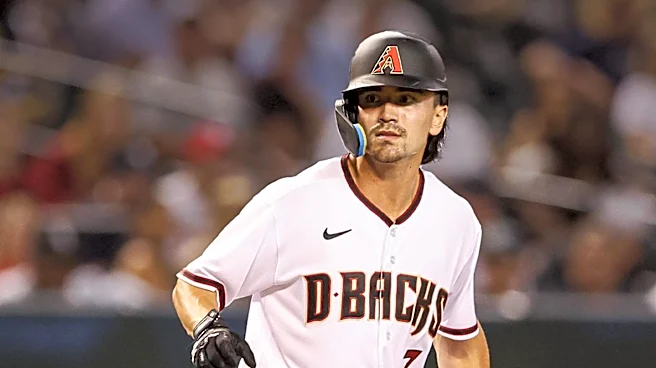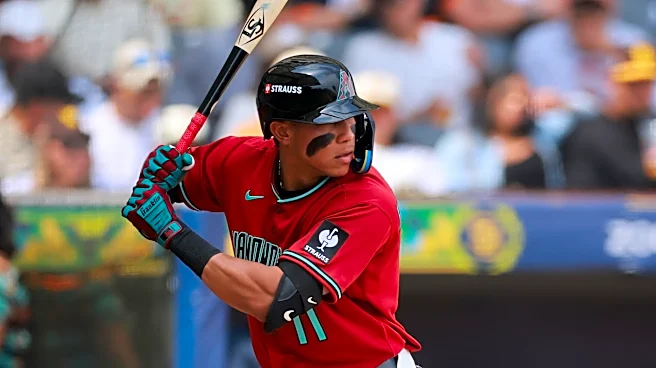


Inspiration.
Many fans have expressed their unhappiness when the Diamondbacks failed to score with runners in scoring position.
In May after 32 games, my batting perspective was that the Diamondbacks batted below league average with RISP.
“While the Diamondbacks’ batting ranked high with men on first base and no runners on base, they batted below league average with men in scoring position (RISP). Batting with RISP was a negative contributing factor.” — Makakilo
In September after 152 games, how are the Diamondbacks
batting with RISP? Recently, Jim McLennan noted that this season the Diamondbacks are scoring a high percentage of their baserunners.
“…Or this season, where we’ve had perpetual complaints about D-backs’ LOBsters. They actually score a higher percentage of baserunners than 23 of the 30 MLB teams….” — Jim McLennan
Let’s look at batting with RISP.
Let’s start with a high-level perspective.
Looking at all runs scored by the Diamondbacks, what percentage were scored with RISP? This season in games through 17 September, 77.3% of Diamondbacks runs happened with RISP (per Baseball Reference Stathead). That percentage is the second highest in MLB (Brewers were highest with 80.7%). Clearly, this is a strength of the Diamondbacks.
Did the Diamondbacks do it with homers? Their .0292 home runs per plate appearance with RISP was only slightly more than the MLB average of .0277 (they ranked 11th). My conclusion is they did it with a fairly balanced mix of homers and non-homers.
My Approach to Address, “How well did Diamondbacks bat with RISP”?
My goal was to compare the Diamondbacks to other teams based on three measures of batting with RISP: OBP, SLG, and wOBA.
Two data splits made the data more relevant to the question:
- (RISP when the tying or go-ahead runs was on base) vs (all RISP PAs).
- (RISP for 1 August to 15 September) vs (RISP for the full season).
Data was courtesy of Baseball Savant.
Torey Lovullo’s Recent Comment.
Slugging (SLG) was one of the three measures that I looked at. Days after my writing was completed, Lovullo made the following comment. His comment appeared to support a conclusion that SLG is perhaps the most important of the three measures. Also, he said that slugging with RISP was worse in the last few weeks. He was correct. From 1 to 19 September, for RISP with the tying or go-ahead run on base, the Diamondbacks’ .390 SLG ranked 20th in MLB. For all RISP, their .405 SLG ranked 18th.
“…And then we hit and slugged with men in scoring position. That’s been something that’s kind of been a missing piece of this puzzle foe a few weeks.” — Torey Lovullo, postgame on 20 September.
The Data to Address, “How well did Diamondbacks bat with RISP”?
In RISP situations, did the Diamondbacks bat better when the tying run or go-ahead run was on base? The data shows that their wOBA and SLG were better, but their OBP was the same. Also, the data shows their SLG ranked very highly, their wOBA was average, and their OBP was below average. The following table shows the comparisons and the ranks compared to other teams:

For the full season, for RISP with the tying or go-ahead run on base (10 relevant PA minimum), Jose Fernandez had the team high .706 SLG (20 PAs).
What about recently? How did they compare from 1 August to 15 September? For RISP situations, when the tying or go-ahead run was on base their SLG was about the same (and was ranked very highly). However, their wOBA and OBP fell, but they continued to be ranked about the same as the entire season. In the last month and a half, for all RISP situations, their SLG and wOBA rose significantly. The following table shows the comparisons and the ranks compared to other teams:

For 1 August to 15 September, for RISP with the tying or go-ahead run on base (10 relevant PA minimum), Corbin Carroll had the team high .800 SLG (18 PAs). Second place was Ryan Waldschmidt with .786 SLG (16 PAs).
Summary.
The Diamondbacks percentage of runs scored in RISP situations was the second highest in MLB.
For the full season, in RISP situations when the tying run or go-ahead run was on base, the Diamondbacks wOBA and SLG were better than all RISP situations. Their SLG ranked very highly compared to other teams. Jose Fernandez had the team-high SLG.
For 1 August to 15 September, in RISP situations when the tying run or go-ahead run was on base, the Diamondbacks SLG was about the same as the full season, and was ranked above average compared to other teams. Corbin Carroll had the team-high SLG, with second place Ryan Waldschmidt.