


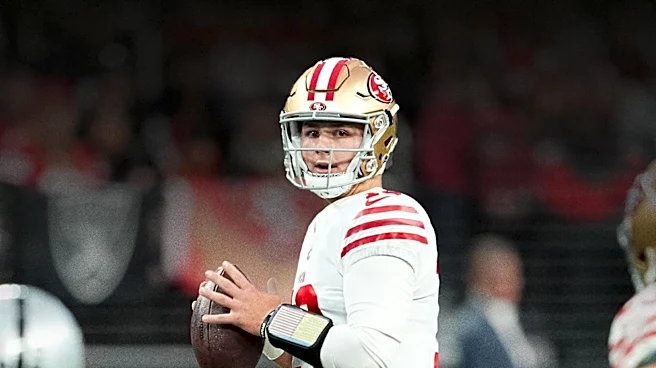
When it comes to the San Francisco 49ers and their secondary, it looks like it’ll be much of the same in 2026, as the 49ers brought back each of their five starters while electing not to make any significant additions in the room.
At cornerback, the 49ers are projected to start Deommodore Lenoir and Renardo Green on the outside again, with Upton Stout in the slot. At safety, the competition is ongoing, but Ji’Ayir Brown, Malik Mustapha, and Marques Sigle figure to be the top options there as well.
San Francisco didn’t get the best results from its secondary last year. A part of it was the tough environment, as the 49ers’ pass rush didn’t do them any favors. But they also didn’t see the growth they had hoped for from Green, who was inconsistent and even benched at times, or the safety room.
Green is a different person than most would imagine a cornerback to be. He’s quieter, rather than brash, and that can play into one’s mentality at the position. But he’s grown this offseason, according to new defensive pass game coordinator Jerry Gray, who came with Raheem Morris from the Atlanta Falcons this offseason.
“Well, to me, I don’t think Renardo looks around in the room and say, ‘okay, I got to raise my game,’” Gray said. “I think Renardo understood that, you know what, I’m going into my 3rd year. What did they expect out of me? The expectation was high. And it’s different when young guys really don’t understand that, hey, you coming into an organization that’s used to winning. You step on this field, they expect you to be the best in the league. And then now I think he understands that. So it really doesn’t matter about Jack [Jones] or anything like that. I think that adds to it.
This offseason, Green did a lot of work on his own, which included talking to former NFL cornerback Xavier Rhodes, who was a first-team All-Pro corner with the Minnesota Vikings and went to Florida State, where Green went to school as well.
“There’s competition there, but I think Renardo had his agenda that, ‘hey, I want to go out there and I’m going to prove to the guys that I can go out there and play at a high level,’” Gray continued. “And then he took it out on himself. To me, he understands guys that I’ve kind of coached. He talked to guys like Xavier Rhodes and stuff like that in the offseason. They went to the same university. What do you get? What information are you going to get? How can Jerry teach you to be better?
“And mostly it’s about the mental part of the game. With Renardo, you got the athletic ability, you got the talent. Hey, take the mental part of the game, put it with your athletic ability, and you’ll be really good. He’s going through rookie stuff right now, you know. It’s like, okay, where do I fit in? What am I supposed to do? He’s really quiet, so he really doesn’t talk a lot. So you have to kind of watch his body language and, you know, bring him in sometimes. We always have a lot of extra stuff, time for rookies, and that helps him a lot because now he can ask the questions that he won’t ask in front of everyone else.”
The defensive back room has a ton of different personalities, which also means that each individual player is receptive to a different style of coaching. Cornerbacks coach Ray Brown has learned that about Green, figuring out the different ways to push him while keeping his confidence up.
“I think it’s one of those things, you have to understand the individual,” Gray said about his cornerback room. “If you understand the individual, you understand what works for each individual person. I can’t say anything to Renardo. I’m gonna let Renardo just go do his thing. But there are ways that I can poke at Demo (Deommodore Lenoir). There are ways I can poke at Stout. But I think every guy is different.
“Like if I said something to Renardo, he’s gonna say, ‘man, that doesn’t work for me.’ And he kind of laughs, but when he laughs, that does keep him loose so he can go play. I think it’s just, as a coach, you have to do a great job of understanding your players. I think you have to understand you can’t coach everybody the same way. So once you get a great understanding of them, you understand how to coach them. One, you have to care. I think that’s a big thing. And I think, I don’t care what level you’re at, I think you have to care. If you don’t care about your players, man, I don’t know why you do it. At the end of the day, life is about relationships.
“In 20 years, those dudes should be able to call me and say, ‘hey, this is what I’m going through, or this is how life is going, you have any advice?’ If they can’t call me, I really didn’t do a great job. And so I think you do have to care. They have to know that you care outside of the football field. But once you get an understanding of them, what works for them, what doesn’t work for them, I think it elevates their play because you understand how to coach them.
“Everybody’s different, just like everybody’s play style is different. If we go out there and we look at their press style, everybody’s going to be a little different because it’s catered to that person. And so once you understand that person, then you can kind of work, you can tweak some things, and you know how to motivate them, which honestly you don’t really have to motivate this group. But we all need to have great self-talk. I think those guys It’s kind of one of the things that Jerry [Gray]’s brought to the room is really the self-talk from each— from themselves, but also we can add in on those things. But as you get to understand a person, you understand kind of what they need in those moments, and you also understand when to leave them alone.”
The results will have to come on the field, but it feels like the process has been a bit different for Green, who is attacking the offseason more as he understands the expectations and importance of having a good Year 3.
He’ll be a vital part of the 49ers secondary as the team looks to get back to being a top 10 defense in the NFL after some mixed results in 2025.