



From now until preseason camp starts in August, Land-Grant Holy Land will be writing articles around a different theme every week. This week is all about Ohio State heroes, from the biggest names in Buckeye athletic history to underappreciated icons to the athletes who will eventually become all-time Buckeye greats.
You can catch up on all of the Theme Week content here and all of our ”Buckeye Heroes” articles here.
You know Jeremiah Smith and Carnell Tate and Emeka Egbuka and Marvin Harrison Jr.,
Jaxon Smith-Njigba and Chris Olave and Garrett Wilson and Terry McLaurin. But do you recall the one that started it all at WRU in the 21st Century?
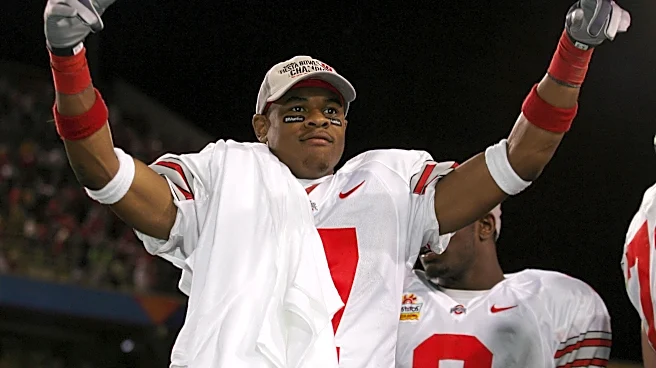
That would be Ted Ginn Jr. After starring at Ohio State and enjoying a 14-year NFL career, Ginn is now back home in Columbus, coaching the United Football League’s newest franchise, the Columbus Aviators.
It’s the full-circle homecoming for a Buckeye who made his name as a game-changing wide receiver and kick and punt returner wearing the Scarlet and Gray.
Born in Cleveland, Ohio, Ginn played for his father, Ted Ginn Sr., at Glenville High School. Glenville is a suburban neighborhood on Cleveland’s east side, and the hometown of Cardale Jones, Troy Smith, Jesse Owens, and Steve Harvey.
Ginn starred at Glenville, earning the 2004 USA Today Defensive Player of the Year and the SuperPrep National Defensive Player of the Year, along with being named a Parade All-American. In addition, Ginn was also named the MVP of the U.S. Army All-American Bowl.
If you’re wondering where Ginn got his all-world speed, here are some numbers from him as a Track runner. The national champion in the 110-meter hurdles, as a Junior, Ginn ran a state championship 200-meter time of 21.51 seconds that same year, then improved that time to 21.16 seconds as a Senior.
In the 100 meters, Ginn ran a 10.5 seconds as a Junior. Ginn’s performances on the track were so outstanding that then-Ohio State track coach Russ Rodgers recruited him to run track at Ohio State with the belief that he could qualify for the 2008 Summer Olympics in Beijing. Although Ginn chose the football route, that speaks to just how much of a freak athlete he was.
In his senior year of high school football, Ginn intercepted eight passes and returned five for touchdowns. Those five touchdowns included a state-record 102 yards, and he also returned one for 98 yards for good measure.
Ginn was the No. 1-ranked cornerback by Scout and Rivals, with Rivals rating him No. 1 in the state of Ohio in the Class of 2004. While he was recruited as a defensive back, Ginn would switch to wide receiver in Columbus… and the rest is history.
In his freshman season at Ohio State in 2004, Ginn exploded onto the scene. He led the country in punt return average at 25.6, running four punts back for touchdowns. Oh, as a wide receiver? He caught 25 passes for 359 yards and two touchdowns, good for 14.4 yards per reception. It only got better from there.
The following season, in 2005, Ginn caught 51 passes for 803 yards and four touchdowns. He averaged 15.7 yards per reception, 10 yards per punt return, and a Big Ten-leading 29.6 yards per kick return, running one back for a touchdown.
Then came 2006, a season remembered by Buckeyes fans everywhere— at least the first 12 games. Ginn, catching passes from Heisman Trophy winner Troy Smith, hauled in an Ohio State-career-high 59 receptions for 781 yards and nine touchdowns.
Don’t worry, he also ran back a punt return for a touchdown and averaged 11.1 yards per return. Ginn also averaged 24.4 yards per kick return, running one back for a touchdown.
That one kick return for a touchdown should be in Buckeyes lore. Instead, it’s a footnote on what turned into a disastrous night in the Desert. After running back a 93-yard kick return for a touchdown, Ginn injured his left foot during the celebration. He tried to give it a go, but he never returned to the game.
Ohio State lost to Florida 41-14. How different would that game have been if Ginn hadn’t gotten injured? We’ll never know.
Ginn opted to forgo his senior season at Ohio State and enter the NFL Draft. The move paid off when Ginn was selected No. 9 overall by the Miami Dolphins. In three seasons with Miami, Ginn caught 128 passes for 1,664 yards and five touchdowns while also returning one punt and two kickoffs for touchdowns.
The Dolphins enjoyed one of the most impressive one-season turnarounds in NFL history in 2008, going from 1-15 to 11-5 and winning the AFC East.
After the 2009 season, Ginn was traded to the San Francisco 49ers. The 49ers were just starting to reposition themselves as a serious player in the NFC West and the NFC. Primarily a kick and punt returner, Ginn averaged 11.8 yards per punt return and 23.5 yards per kick return.
San Francisco went to back-to-back NFC Championships in 2011 and 2012, winning the NFC Championship in the latter year and coming up just short against the Baltimore Ravens in Super Bowl XLVII.
From there, Ginn signed with the Carolina Panthers, joining a young but emerging team led by quarterback Cam Newton, wide receiver Steve Smith, and linebacker Luke Kuechly. Ginn caught 36 passes for 556 yards and five touchdowns in 2013, a key cog in the Panthers’ NFC South title, and earned a first-round bye in the Playoffs.
Following a one-year stint with the Arizona Cardinals in 2014, Ginn rejoined the Panthers for the 2015 and 2016 seasons.
In 2015, a year in which Newton won NFL MVP and the Panthers went to Super Bowl 50, Ginn caught a career-high 10 touchdowns while averaging 16.8 yards per reception. The next season, Ginn caught 54 passes, two off his career-high, and hauled in 752 yards and four touchdowns.
Following his second stint in Carolina, Ginn made the lateral move in the NFC South to sign with the New Orleans Saints, joining an offense led by Drew Brees, Michael Thomas, and Alvin Kamara. Ginn had a really good 2017 season, catching 53 passes for 787 yards and four touchdowns on a team that went 11-5 and won the NFC South.
He played two more seasons with the Saints and was a part of NFC South title-winning teams in both 2018 and 2019. Ginn would finish his career with the Bears in 2020, and he announced his retirement from the NFL on July 16, 2021.
Ginn would take over coaching duties at Glenville High School following his retirement, and he also runs the Ginn Academy, a leadership program for young men in Cleveland. Then, in December 2025, he was named the head coach of the fledgling Columbus Aviators of the United Football League.
Founded just this past October, the Aviators have two wins this season, both of them coming on their home field at Historic Crew Stadium, previously known as Mapfre Stadium.
“Being in a big state of football, being a Buckeye, being a Tarblooder, why not?” Ginn said back in December. “Why not take this opportunity?
“I’m always going to represent my school, the Buckeyes,” said Ginn Jr. “To give another opportunity to those kids who are trying to get to the Bengals and Browns. You can always just stay home and have another opportunity to be somebody in your own city.”
Ginn is back home to finish what he started. He was the first great wide receiver to come through Ohio State and shine in the NFL. Now, he’s paying it forward for those looking for a second shot to make it to the NFL as he did.