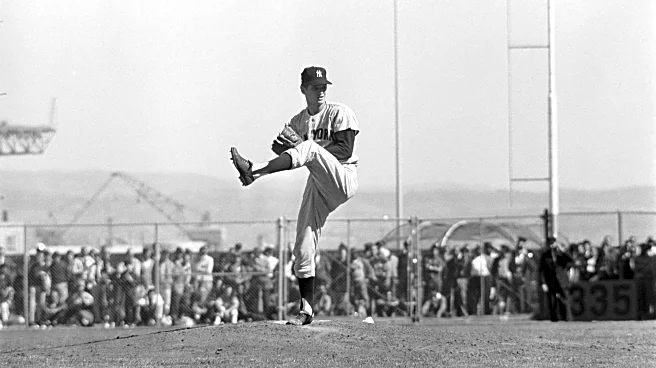


Guys like Ralph Terry are kind of all over the history of baseball, and perhaps more specifically the history of the Yankees. Mickey Mantle, Yogi Berra, and Whitey Ford make all the headlines, but as we’ve seen with recent Yankee teams, the stars always need a supporting cast. Terry was never The Guy on the dynasty of the late 50s-early 60s, but he ended his career with two rings, a World Series MVP, and even became a professional golfer. Despite all that, he might actually be most famous for a mistake
he made on the biggest possible stage.
Terry passed away in 2022; he would have been 90 today.
Ralph Terry
Born: January 9, 1936 (Big Cabin, OK)
Died: March 16, 2022 (Larned, KS)
Yankees Tenure: 1956-57, 1959-64
Feels like we don’t get a lot of people in pro sports from places like Big Cabin anymore. Terry didn’t play baseball until working out an Indy league deal in 1953, preferring football and basketball to America’s Pastime. He played a season in the Ban Johnson League, in the same home stadium future teammate Mickey Mantle cut his teeth in back in 1949, Shulthis Stadium in Independence, Kansas.
Indy ball stats are hard to find on the best of occasions, and 1953 Indy ball even harder. Suffice to say Terry must have impressed, as the Yankees signed him as an amateur that winter and assigned him to the Binghamton Triplets to begin his pro career. It took two seasons for Ralph to crack an MLB roster, and while he initially struggled in New York, a trade the next season to the pseudo-farm-team Kansas City Athletics let him get his feet under himself as an MLB pitcher.
Dealt back to New York in 1959, Terry would have likely his most remarkable moment in the 1960 World Series:
You’ve all seen this highlight dozens of times, it’s on a very short list of the most famous moments in World Series history. Bill Mazeroski walks off the World Series, and indirectly ends the Yankees career of the great Casey Stengel. Ralph Terry threw the fastball that Maz took out of Forbes Field and into baseball history. That fastball stuck with Terry for the rest of his life — the then 24-year-old immediately went to Stengel and apologized, only for the legendary Yankee manager to stress it was a physical mistake, not a mental one. As someone else might say, that’s baseball, Suzyn.
Indeed, Terry became somewhat of a grief ambassador for these most lonely of accomplishments, the guy on the other side of the miracle hit. After Cleveland’s Bryan Shaw gave up two runs in the tenth inning of the 2016 World Series, the two runs that gave the Chicago Cubs their first world championship in 108 years and possibly ripping a hole in the space-time continuum and that’s why everything seems to be so awful now — OK, small bit of editorializing — Terry counseled Shaw in the same way Stengel had 56 years prior: get back on the field next year and play well.
Terry did take home his first World Series ring in 1961, but it really wouldn’t be until ‘62 that he seemed to finally let that Mazeroski home run go, and he did that with a hero’s performance against the San Francisco Giants in the Yankees’ third consecutive World Series appearance. In the leadup to the Fall Classic, Terry enjoyed the best season of his career, making the All Star team and winning 23 games. In modern terms he had a 4.0 fWAR campaign.
Terry actually got scant MVP votes in ‘62, but as the Cy Young Award was still given to the pitcher judged the best across MLB, not split into AL and NL versions, he was shut out of voting for the game’s best hurler. All four vote-getters were National League stars, and indeed a pair of them would end up facing the Yankees in October as members of the Giants.
Come that World Series, Terry got the ball for Game 2 and was the hard-luck loser. Seven innings and two runs allowed would be a dynamo World Series start in 2025, but the Yankee bats were silenced and the Series was evened up at a game apiece. Getting the start again in Game 5, Ralph finally got a win in the Fall Classic with a complete-game victory, a 5-3 final that put the Yankees on the cusp of their 20th title. Just like 1960 though, it would take every bit of all seven games to decide a winner. Weather was on Terry’s side, as terrible rain in San Francisco delayed the series and allowed him to came back for the finale.
Terry threw 8.2 innings of shutout ball in Game 7 before future Hall of Famer Willie McCovey strode to the plate with two men on, in a one-run game. Roger Maris had just made a great play on a Willie Mays double into the right-field corner to hold Matty Alou at third as the tying run. Yankee skipper Ralph Houk gave his starter the choice of walking McCovey to load the bases to face a weaker hitter in Orlando Cepeda (albeit another future Hall of Famer in his own right).
Terry declined, betting on himself to get McCovey, and we all got another one of those most famous World Series moments:
That looks like an overshift to me, I dunno.
Terry would play for the Yankees for two more seasons, and make appearances with Cleveland, back to Kansas City, and end his career with the Mets. But the story of Ralph Terry is that of the Best Supporting Actor, never a player that was going to be on a Hall of Fame track but a player that was needed to deliver more than one championship.
Moreover, the story of Ralph Terry is that of the ultimate peak and ultimate valley. There must be no lower feeling in baseball than giving up the World Series winning home run, and there must be no greater high than a complete game shutout to seal your own Fall Classic victory. It was a baseball life as full as anyone’s could be, even for a guy that was never The Guy. Happy birthday, Ralph.
See more of the “Yankees Birthday of the Day” series here.