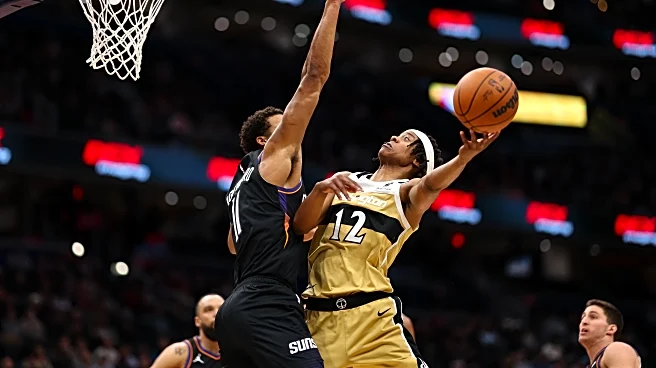

The Wizards’ defensive game plan against the Phoenix Suns was straightforward: make life tough for Devin Booker, and make Someone Else generate offense.
The plan worked — Booker needed 23 shots to score
22 points and produced an offensive rating (individual points produced per possession used x 100) of just 97 (league average is 115.8).

Someone Else turned out to be third-year guard Collin Gillespie, who torched Washington for 25 hyper-efficient points and assists. Gillespie had an ortg of 174 on a 22.9% usage rate.
The Suns also bludgeoned the Wizards on the offensive glass, grabbing 20 offensive boards and outscoring Washington 26-10 in second-chance points.
Where the win over the Memphis Grizzlies was a roller coaster affair with wild swings in scores as both teams went on extended runs, this one was close for a half before the Suns pulled away in the second.
With the loss, the Wizards record dropped to 7-24. The Suns’ record moved to 19-13, and they sit 7th in the competitive West.
Thoughts & Observations
- The Wizards’ defensive scheme for Booker was aggressive. The Suns run wing actions (isos and pick-and-roll) for Booker, and when they did, Washington consistently had an extra defender leave his man at the top of the circle and come all the way to the strong-side elbow to help. That effectively closed driving lanes and forced Booker to pass.
- Phoenix seemed interested in targeting Jamir Watkins in the first quarter, which seemed an odd choice considering Tre Johnson was also on the floor.
- Cool possession for those interested in viewing — at 7:52 in the first quarter, Booker tried to drive on Bilal Coulibaly from the right wing. Coulibaly did an excellent job keeping his body between Booker and the basket. Alex Sarr timed weakside help superbly to deter a Booker field goal attempt. Booker made a nice pass to the weak corner, the ball got rotated, and Gillespie ended up hitting a three. While the result wasn’t ideal, the point of attack defense and the defensive process was very good.
- Like basically every team the Wizards face, the Suns were content to let Coulibaly shoot threes. Coulibaly made them pay a bit, knocking down 2-5.
- The Wizards seemed content to let Dillon Brooks shoot threes, a strategy I endorse. One of my favorite moments was when Coulibaly left Brooks to help on the strong side on Booker. Carrington had the close-out rotation, and he started the arms up sprint to the perimeter when the ball went to Brooks out top. Then he recognized who had the ball, hit the brakes, and went back to Royce O’Neale. (Brooks missed.)
- One first quarter possession made me grouchy — CJ McCollum brought the ball up the court, rejected a screen, and took a reasonably-defended pull-up three. It’s the kind of shot that would have been okay to take with under seven seconds on the shot clock. It was a terrible shot early in the shot clock after zero passes and no attempt to work with teammates to get a good shot.
- Tre Johnson had a great shooting night — 9-12 from the floor, including 5-5 from three-point range. A couple of those threes were from extreme range. One was a banked in bomb from out top. That kind of night.
- Justin Champagnie does many things well, and I think he should get a bigger role with the team. That said, he committed a dumb and costly foul when he grabbed Booker in transition with 26.8 seconds to go in the first half. It was properly ruled a take foul, which gave Phoenix a free throw and the ball. When Booker hit the free throw and a jumper, the Suns to close the half with a three-point play and a 7-point lead.
- Phoenix had 13 offensive rebounds and 23 second chance points in the first half. The Wizards had two and zero.
- Sarr has had a very good second season, but last night’s game was one of his worst of the year. He managed just 2 points and 2 rebounds in 25 minutes. He contributed 4 assists and some blocks, but he was thoroughly outplayed by fill-in starter Oso Ighodara. The Wizards were outscored by 28 points in Sarr’s time on the floor.
- Former Wizards great Jordan Goodwin stuck it to his old team, with 14 points, 4 offensive rebounds, and a couple steals. Goodwin had flashed some offensive rebounding ability while with the Wizards but has become one of the better backcourt offensive rebounders around since moving on.
- The Suns broadcast, featuring former Wizards great Rex Chapman, would have been much better with 97% less complaining about the refs. Chapman had some good anecdotes, solid analysis, and strong insights into players, but good lord he whined incessantly about the officials.
- For what it’s worth, Chapman shared that Suns talent evaluators had a high opinion of Wizards rookie, Jamir Watkins — especially Watkins defensive potential.
Four Factors
Below are the four factors that decide wins and losses in basketball — shooting (efg), rebounding (offensive rebounds), ball handling (turnovers), fouling (free throws made).
The four factors are measured by:
- eFG% (effective field goal percentage, which accounts for the three-point shot)
- OREB% (offensive rebound percentage)
- TOV% (turnover percentage — turnovers divided by possessions)
- FTM/FGA (free throws made divided by field goal attempts)
Stats & Metrics
PPA is my overall production metric, which credits players for things they do that help a team win (scoring, rebounding, playmaking, defending) and dings them for things that hurt (missed shots, turnovers, bad defense, fouls).
PPA is a per possession metric designed for larger data sets. In small sample sizes, the numbers can get weird. In PPA, 100 is average, higher is better and replacement level is 45. For a single game, replacement level isn’t much use, and I reiterate the caution about small samples sometimes producing weird results.
POSS is the number of possessions each player was on the floor in this game.
ORTG = offensive rating, which is points produced per individual possessions x 100. League average so far this season is 115.1. Points produced is not the same as points scored. It includes the value of assists and offensive rebounds, as well as sharing credit when receiving an assist.
USG = offensive usage rate. Average is 20%.
ORTG and USG are versions of stats created by former Wizards assistant coach Dean Oliver and modified by me. ORTG is an efficiency measure that accounts for the value of shooting, offensive rebounds, assists and turnovers. USG includes shooting from the floor and free throw line, offensive rebounds, assists and turnovers.
+PTS = “Plus Points” is a measure of the points gained or lost by each player based on their efficiency in this game compared to league average efficiency on the same number of possessions. A player with an offensive rating (points produced per possession x 100) of 100 who uses 20 possessions would produce 20 points. If the league average efficiency is 114, the league — on average — would produced 22.8 points in the same 20 possessions. So, the player in this hypothetical would have a +PTS score of -2.8.
Players are sorted by total production in the game.