



Editor’s Note: Today is a perfect day to announce the debut of another one of Canis’ very own, JetAllen! Jet Helmbrecht is introducing a series of articles called the “What If” Wolves, beginning all the way back with the beginning. You are in for a treat!
You can also say hello to Jet on BlueSky @coachjet!
Volume One: Let’s Begin
$32.5 million dollars.
That was the purchase price of an NBA expansion team in 1987.
Harvey Ratner and Marv Wolfenson put some dough together to bring a pro basketball team back to Minnesota. We all know the story of the Minneapolis Lakers leaving town for greener pastures in Los Angeles way back in 1960. Some people even know about the Muskies and Pipers that played in the ABA. But finally, thanks to “Harv and Marv”, the NBA would be coming back to Minnesota.
The Minnesota Timberwolves were born.
For
those of you who don’t know, the Minnesota Timberwolves, or the Wolves, or the T-Wolves (please don’t use this one) have not always been the cream of the NBA crop. They’ve been teams that were not that talented, with poor decision-making, and flat-out illegal transactions by the front office that have kept the Wolves near the bottom of the standings for most of the team’s history.
I am going to break some of these issues down and offer an alternative history. Basically, this is what I would have done instead. Obviously, almost every instance of me changing history would have led to a championship… Who are you to doubt me?
This series is purely for entertainment purposes. Try not to take things too seriously, and we should have some fun. With that being said, let’s get started with the creation of the team and the first season.

Franchise Creation
Like I stated before, Harv and Marv, the original owners of the Timberwolves, put up $32.5 million dollars to purchase an expansion team. Considering what the NBA expansion fee is today ($7-10 billion), this was a bargain.
Harv and Marv would still need to find a permanent place to play, hire front office staff, and field a team. But there were more pressing items that needed to be dealt with, namely, finding a team name.
The “Minnesota NBA Team” decided that they would leave the naming up to the great people of Minnesota. I’m sure you can guess how that went. A “Name the Team” contest was sent out to the masses. 6,076 entries came back with 1,284 different names. There was a group of current NBA team names submitted. The Cavaliers (Cleveland), Kings (Sacramento), Hawks (Atlanta), Mavericks (Dallas), Pacers (Indiana), Warriors (Golden State), Nets (New Jersey at the time), Bucks (Milwaukee), and of course the Lakers (Los Angeles).
None of these names would be selected or approved by the NBA, even though the Lakers should be in Minnesota. I’ve never even heard of a lake in Los Angeles, outside of an Andrew Garfield movie.
Anyways, a slew of cold-weather nicknames were submitted, like the Frost, the Chill, Tornadoes, the Blizzard, the Snowdrift, and the Abominable Snowmen. I’ve never been a fan of the non-plural nicknames or team names that, to me, are nonsense. Team names like the Miami HEAT, Orlando Magic, and especially (I know I will get hate for this) the Minnesota Wild.
What the hell is a “a Wild”?

There were Minnesota state-specific mascot names like the Loons (which would become the name of the Minnesota Major League Soccer team), Mallards, Mosquitoes (of course), Gnats, Bullheads, Walleyes, Minnows, Oofdahs (or Uffdas depending on your Scandinavian heritage), and my favorite, the Mississippi Mud Monsters (now a minor league baseball team).
All the entries were cut down to the two most popular, the Timberwolves and Polars. These names were then sent to the 842 city councils throughout Minnesota for their votes. The Timberwolves were the runaway winner (again, what is “a Polar”?).
With the name selected, a logo and uniforms would be next. Mark Thompson designed the first logo: a majestic wolf looking off into the distance, which we now refer to as “Old Shep”. What is he looking at? Maybe prey of some kind. Maybe he is looking at a Wild or a Polar. It’s really not important; this logo is classic and still my preferred logo out of all that the team has had.
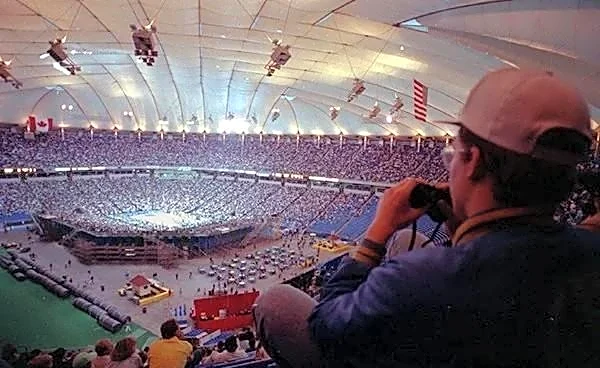
The Timberwolves made a deal to play their inaugural season at the Hubert H. Humphrey Metrodome. 10-year-old me thought this was the most magical place in the entire world (I didn’t get out much back then). This was a smart choice for many reasons.
First, the dome was awesome. I remember the first time I went to the dome to see a Minnesota Vikings game against the Cincinnati Bengals. The atmosphere was electric; the Vikings won, Boomer Esiason got booed, and when we left, I got expelled from the building by a huge gust of wind that always happened when exiting the Metrodome (Factor in that I was maybe 50 pounds at the time… I flew).
No matter if you were prepared for the wind or not, it always took you by surprise.

The dome was huge as well. Somehow, the Timberwolves set an NBA record for single-season attendance in their first year. 1,072,572 people attended Wolves games that year. The only negative of holding games at the dome was the men’s bathroom trough. If you don’t know what that is, basically a giant urinal that a bunch of guys use at the same time.
Think of what a horse drinks water from. Now, instead of horses, imagine dudes expelling all the beer that they drank while cheering on their favorite team. Even worse, now picture me standing maybe at 3 feet tall, and where my eye line would have been while trying to go to the bathroom. Get rid of those troughs, and we are good to go.
I read once that those troughs were auctioned off. One of the troughs was sold for $375! What are you going to do with that thing?

Former University of Minnesota Coach Bill Musselman was named the first Head Coach for the Timberwolves. Musselman may have seemed to some as a hometown discount type of pick, but he had some recent success that made him a decent candidate. He left the University of Minnesota with a .683 winning percentage, including a Big Ten Championship in 1972.
The 1972 team included future NBA players Jim Brewer and Ron Behagen, and, most bafflingly, Baseball Hall of Famer Dave Winfield, who averaged 7.0 points and 5.4 rebounds per game.
Before being named Head Coach of the Timberwolves, Musselman won four straight titles in the Continental Basketball Association (Tampa Bay Thrillers twice, Rapid City Thrillers, and the Albany Patroons).
The Wolves’ new coach shared personnel decisions with Director of Player Personnel Bill McKinney and CEO Bob Stein.
So, it is no coincidence that several of the Albany Patroons players, including Tony Campbell, Sidney Lowe, Tod Murphy, and Scott Brooks, played for the early Timberwolves teams. We’ll keep them in place, why not?
The First Drafts and Free Agency
Because the Timberwolves were/are an expansion team, they have zero players at this point in time. The Wolves and the Orlando Magic, being the other expansion team in 1989, would take turns selecting up to 12 players from an existing pool of NBA players.
Only one player could be selected from an existing team, and each team had several players that were “protected” and could not be selected.
So, no Michael Jordan on the Wolves.
There was a coin toss to see which team would select first in the expansion draft or have the higher pick in the regular NBA Draft. The Magic won the coin toss and elected to have the first pick in the Expansion Draft, allowing the Timberwolves to have the higher draft pick in the NBA Draft (#10 overall).
Orlando chose power forward Sidney Green from the New York Knicks. The Timberwolves, with their first selection, made their first front office blunder.
The Wolves drafted power forward Rick Mahorn from the Detroit Pistons. Great pick, right? Mahorn was a quality role player with trade value and on-court strengths. Wrong! Mahorn refused to go to the Timberwolves.

There are no take-backs in the draft, so the Wolves end up trading Mahorn to the Philadelphia 76ers for a first-round draft pick (Don’t get excited. The pick was used on Gerald Glass.) and two second-round picks. A whole lot of nothing. The rest of the draft wasn’t much better. Here are the Timberwolves selections:
- Rick Mahorn PF Detroit Pistons
- Tyrone Corbin SF Phoenix Suns
- Steve Johnson C Portland Trailblazers
- Brad Lohaus PF/C Sacramento Kings
- David Rivers PG LA Lakers
- Mark Davis SF Milwaukee Bucks
- Scott Roth SF San Antonio Spurs
- Shelton Jones PF Philadelphia 76ers
- Eric White SF LA Clippers
- Maurice Martin SG Denver Nuggets
- Gunther Behnke C Cleveland Cavaliers
Any names ring a bell? Maybe three? Yeah, it’s not good. Mahorn refused to play for an expansion team. Mark Davis was selected only because the Bucks gave the Wolves a second-round pick to take him off their books. Only four of the players selected played for the Wolves that first year, and only Ty Corbin played for more than one season for the team. Hell, Gunther Behnke never even played for one second in the NBA!
There were a bunch of players who were left unprotected who could have been drafted. Now I know that contract/salary concerns may have kept these players from being selected, but these are the picks I would have made for the “What If” Wolves:
- Tyrone Corbin SF Phoenix Suns
- Terry Catledge PF Washington Bullets
- Scott Skiles PG Indiana Pacers
- Tony Campbell SG/SF LA Lakers
- Jerome Lane PF Denver Nuggets
- Brad Lohaus PF/C Sacramento Kings
- Larry Krystkowiak PF/C Milwaukee Bucks
- Dennis Johnson PG Boston Celtics
- Vinnie Johnson SG/PG Detroit Pistons
- David Wingate SF/SG Philadelphia 76ers
- Caldwell Jones C/PF Portland Trailblazers
- No pick. This guy wasn’t going to play anyways.
So here is my thinking: try to at least draft players that may want to play for the team (thanks for nothing, Mahorn), milk as much talent out of the older players as possible, and draft players that can maybe play a bit.

The toughest decision was drafting Tyrone Corbin instead of Spud Webb. Spud Webb was my favorite player growing up because I was always the shortest kid in my class. I thought that if Spud could dunk at his height (5’7”), I should be able to as well when I grew up (5’8”).
I did manage to dunk (Twice!), but I had to catch the ball off the bounce and kind of smoosh it into the hoop. It wasn’t pretty, but I say it counts. Expansion draft complete! We have 80% of our roster set.
For the NBA Draft, the Timberwolves started a long tradition of messing up royally with their first pick at 10th overall.
Minnesota also had two picks in the second round, the 34th and 38th overall picks. When this draft took place, I was 12 years old. Not really the basketball nerd that I would become. But even in my early fandom, I knew who I wanted the Timberwolves to draft: Tim Hardaway.
The only reason why I wanted them to draft Hardaway was due to a short clip that discussed his signature move, the “UTEP Two-Step”. The UTEPTS (acronyms were long back then) was a simple but very effective crossover move that allowed Hardaway easy access to the bucket. That was the only reason I wanted the Wolves to draft him.
Seriously, the only reason.
When Minnesota instead selected Pooh Richardson out of UCLA, this 12-year-old GM was ticked. How could the Timberwolves betray me already? At the time, it really wasn’t that big of a deal, but I do remember a local paper headline that read “Who is Pooh?” or something along those lines.
Tim Hardaway even thought that he would go to the Wolves at 10. Hardaway started to fall a bit and was eventually selected by the Golden State Warriors. But why the slip in the draft? Well, Golden State Head Coach Don Nelson was telling the other teams ahead of the Warriors that Hardaway had bum knees and would most likely be out of the league in four years.
Sneaky coach.
Tim Hardaway would go on to be a multiple-time NBA All-Star, Olympic medalist, and a member of the Naismith Memorial Basketball Hall of Fame. I should have been named the GM at 12.
After Pooh Richardson at 10, the Wolves drafted center Gary Leonard from Missouri at pick 34 and wing Doug West from Villanova at pick 38. Leonard would only play a total of 31 games in the NBA. However, Doug West was one of the fan-favorite players on the early Timberwolves teams. He played 12 seasons in the NBA, nine of them with the Wolves.
West was a hard worker, a decent dunker, and didn’t have much of a jump shot. Fun guy to watch. I hope this won’t sound like slander.
So, who did the Timberwolves miss out on? Well, All-Stars like Shawn Kemp, Mookie Blaylock, Dana Barros, Cliff Robinson (RIP), B.J. Armstrong, and Vlade Divac were all selected later on.
The “What if” Wolves should have drafted Tim Hardaway at #10. Easy choice for me. The second round is where we get a bit tricky. I would try to package picks 34 and 38 to try to move up for pick 26 from the Lakers. I think that would have been good enough value for the Los Angeles to accept that trade.
Besides, they stole our team back in 1960; they owe us.
With the 26th pick, I would take Vlade Divac, same as what the Lakers did. The real reason to draft Divac is to trade him down the line to the Charlotte Hornets for the first-round draft pick that became Kobe Bryant, but he’ll be a decent center in the meantime.
The rest of the roster was filled out by adding some key players through free agency. The Wolves were able to agree to contracts with forwards Sam Mitchell, Tony Campbell, Tod Murphy, and Donald Royal, with point guard Sidney Lowe.
Here was the first roster for the Minnesota T-IF-berwolves:

Tony Campbell led the team by scoring 23.2 points per game. Forward Tyrone Corbin led in rebounds at 7.4 per game, and the rookie Pooh Richardson led the team with 6.8 assists per game.
Overall, the team finished dead last in points per game with 95.2, second worst defense in the league, giving up 99.4 points per game. Not exactly world beaters. A decent start? Maybe, but most likely not.
Based on my alternate timeline, the Timberwolves would have drafted a future Hall of Fame player and a solid piece we can trade later. Plus, the fans would have been able to watch Vinnie Johnson cook off the bench, watch the last games of Dennis Johnson’s great career, and witness the team miss a lot of threes (The real Wolves shot 73 for 294 on 3-point shots, 24.8%!).
The actual Timberwolves finished with a record of 22-60. My “What If” Wolves could have been 40-42, at least I think so.
Maybe it’s ridiculous to use my one pass to go back in time to fix the least consequential era in Wolves history, but that’s not important. Everyone has something they want to change in this franchise’s history, from the Steph Curry draft in 2009, to the idiotic abandonment of Chauncey Billups in 2002.
Me? I just think this whole expansion business was a missed opportunity.