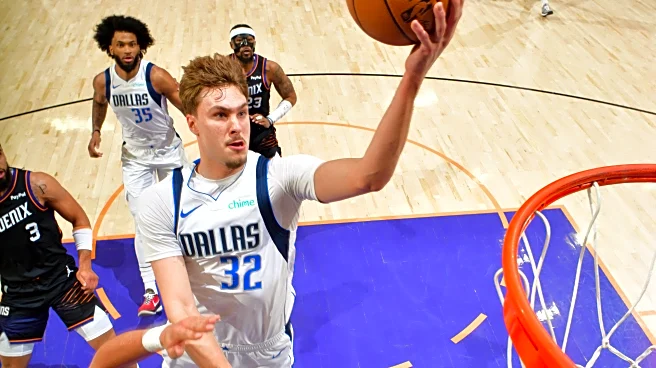




The Mavericks lost a long, dreadful game in Phoenix tonight to their old rival, the Suns. Naji Marshall led the way for Dallas with 31 points, with rookie Cooper Flagg tagging along with 27 to try to push the Mavs back from an early 31-point deficit. Newly acquired Khris Middleton also put in 13 points off the bench in his season debut for the Mavericks. For Phoenix, Dillon Brooks had 23, while Devin Booker had 19. The Suns finished with 7 players in double figures.
Dallas opened completely ice cold,
going 0-for-8 from three in the first quarter and scoring just 16 points, with the Mavericks not making a shot outside five feet for most of the half. They were just 6-for-13 from two early, missed three free throws, and didn’t hit their first three until P.J. Washington connected at the 7:00 mark of the second quarter, helping explain why Phoenix controlled the game while also out-rebounding Dallas by 16. The halftime shooting gap told the story: Dallas 1-for-10 from three, Phoenix 10-for-28. The only reason the game stayed within reach was Dallas’ late surge, as the Mavericks ripped off an 18–4 run over the last 4:15, cutting a 31-point deficit to 14, while Phoenix made just one field goal in the final five minutes. Cooper Flagg (15 points) and Naji Marshall (12) carried the offense into halftime.
Dallas entered the second half needing to sustain the late first-half momentum, but Phoenix quickly stabilized behind its shot-making and rebounding advantage. The Mavericks were far more effective offensively than in the first quarter. Still, the early hole created by a perimeter drought and rebounding deficit forced them to play from behind all night. Flagg and Marshall continued to generate offense through drives, free throws, and transition scoring, but Phoenix consistently answered with half-court execution and second-chance opportunities. Even when Dallas generated small runs, the Suns’ ability to control the glass and maintain shot volume prevented the Mavericks from ever fully flipping the game, leading to the eventual 120–111 win for Phoenix.
5: Mavs 3-pointers made
Dallas’ three-point shooting, or lack of it, fundamentally shaped how this game was played from the opening tip. The Mavericks finished just 5-for-22 from three (22.7%), but the game was essentially tilted in the first 12 minutes when Dallas went 0-for-8 from deep and scored only 16 first-quarter points, allowing Phoenix to pack the paint and sit on every drive immediately. For most of the first half, Dallas did not make a shot from outside five feet, which effectively shrank the floor and allowed Phoenix to play the game on its terms defensively. When a defense knows you can’t punish them from outside, help comes earlier, rotations get shorter, and suddenly even good looks at the rim become contested. The contrast with Phoenix made the early struggles even more damaging. The Suns finished with 16 made threes on 50 attempts (32%) and shot 48% overall, consistently creating spacing and shot-value advantages throughout the night. Dallas, meanwhile, was forced into a grind-it-out scoring profile built on free throws and interior finishes, which made every scoring drought feel heavier. Falling behind while missing every perimeter shot didn’t just cost Dallas points; it let Phoenix control defensive matchups, rebounding position, and transition tempo. By the time the Mavericks finally generated offense late in the half, the Suns were already comfortable, already spaced, and already playing from ahead exactly where a jump-shooting offense wants to live.
9: Suns Free Throws
One of the clearest signs of how this game tilted toward Phoenix was that the Suns held a double-digit lead for most of the night, even though they attempted fewer free throws than the Mavericks missed. That flipped what should have been Dallas’s easiest scoring outlet into empty possessions, keeping momentum permanently on Phoenix’s side. While the Suns built their lead through shot-making and spacing, Dallas couldn’t rely on free throws to stabilize cold stretches, which made every scoring drought feel longer and every run harder to sustain. In a game already shaped by early shooting struggles, missed free throws removed the one safety net Dallas had, allowing Phoenix to stay comfortable and in control virtually the entire night.
5: Naji Marshall Misses
Naji Marshall was flat-out excellent tonight, finishing 12-for-17 from the field, 2-for-4 from three, and pouring in 31 points while being one of the only Mavericks consistently producing efficient offense. While the team struggled to generate spacing and wasted possessions elsewhere, Marshall repeatedly attacked downhill, finished through contact, and took advantage of the shots the defense was willing to concede. On a night where Dallas desperately needed someone to steady possessions, Marshall was the one player who consistently turned touches into points instead of empty trips. When the offense stalled or broke down, Marshall was often the only Maverick able to create something clean and reliable.