




The story of Clint Capela returning to the Rockets begins, as most tragic stories do, with Steven Adams. Steven Adams over the past four regular seasons has played in 138 of 328 possible games. His last fully healthy season was 2022-23 with the Memphis Grizzlies. While Adams has been undeniably effective in the ways he’s always been effective, grabbing tons of rebounds, especially offensive rebounds, controlling the paint, and setting crushing screens, he’s also spent his most recent years not doing
that, sidelined with serious injury. So it proved this season, as Steven Adams played in 32 games before going out for the season with an ankle injury requiring surgery.
Obviously knowing this history, during the off season of 2025, the Rockets signed Clint Capela as a free agent, as his time with the Atlanta Hawks had clearly come to an end. It appeared the Hawks weren’t happy with Capela, and Capela wasn’t especially happy with the Hawks.
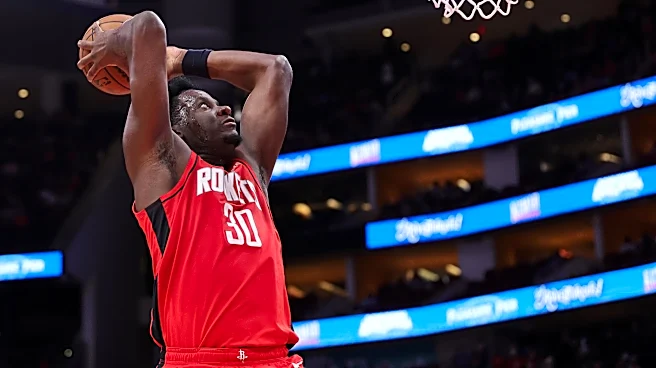
For the Rockets purposes, though, Capela might have appeared to be an ideal third center. Capela’s athleticism had diminished considerably from his Baby Deer heyday with the Rockets and James Harden, where he seemed to smash down at least five lobs per game, averaging just under 20pts per game, while grabbing a baker’s dozen rebounds and blocking a couple of shots every game. At the time I thought he was one of the more underrated centers in the NBA.
Even in decline, though, Clint’s rate stats have held up pretty well. His per36 in his last healthy season in Atlanta saw him at 16pts/15rbs/2blk with a staggering 18.7% offensive rebounding percentage. (For bench players with lower, and sometimes sporadic minutes, I think per36 gives a better idea of what they’ve done.) Given Capela’s salary, the Rockets evident plan of trying to boost their offensive output via offensive rebounding, and Steven Adams’ typically fragile health, the signing seemed a sensible one. A third center who approached Adams in rebounding skills, particularly on the offensive glass might be handy.
On a per36 basis last season, Capela did the business. He averaged 11pts/13.4rbs/2.4blks. His shot attempts were down to about 8.5 from 12, so there’s a fairly easy explanation for the drop in points. His offensive rebounding rate was the highest of his career at 19.4%, a number that would have lead the NBA in many seasons. Capela has always been good at that, in fact he’s 5th all time, in NBA history, in offensive rebounding rate.
This all would have been fine, and demonstrative of good planning, except for two things. The first is, Capela hardly played, even after Adams was lost for the season after 32 games. The second was that signing Capela hard capped the Rockets, making acquisitions and further signings difficult to achieve. Perhaps so difficult that none, in fact, occurred.
Initially it was easy to see why Capela wasn’t playing much. Adams was playing as well as he ever had, and Capela came into the season looking out of shape, and far less mobile that even in his recent past. But Capela began to find his way back. He looked lighter, more mobile, especially by late winter to early spring. The springiness that characterized his early career was gone, but seemed to be replaced with a real savvy about positioning for blocks, and grabbing boards. He was moving far better than early on, and it would seem the Rockets could use that.
Use it they did not.
It’s hard to say it was because Capela was ineffective when he played, especially later in the season. Although his early minutes were not encouraging, he improved under the care of the Rockets training staff, it would seem. But still he didn’t play. It was as if the Rockets bought a spare car, that very much like their unreliable main car, but when the main car broke once again, they refused to drive the back up car more than around the block twice a week. Ime Udoka’s idiosyncratic approach to the Rockets roster, rotations, substitutions, really, almost anything you care to name, lead to Clint Capela, with the Rockets primary backup center lost for the season, averaging 12 minutes per game, about the least he could play, given typical NBA center minutes for Sengun. This would be the lowest average of his career since he was a 20 year old 25th pick back in 2014.
Even in a playoff series where Alperen Sengun struggled with a re-engaged Deandre Ayton, Capela barely played. The Rockets often struggled to rebound, and were sometimes beaten on the offensive glass, an area where, again, Capela still excels. He didn’t play a single minute after game three.
The cost in roster options was even higher, of course. The Rockets desperately needed another guard or two after Fred VanVleet went out for the season. They wouldn’t get one, and the deal for Capela and subsequent lack of guards, proved to be the key enabler of Udoka’s preferred All Forwards, One Center, attack. An approach that made the Rockets 2025-26 offense so very distinctive.
Given the opportunity cost, and Udoka’s unwillingness to play him, Capela turned out to be a bad signing, through no real fault of his own.