

WASHINGTON, D.C. – For decades, the Coastal Athletic Association tournament was largely chalky, and aside from some occasional surprises, devoid of a single day that sent shockwaves throughout the conference.
That trend had been changing in recent years and as of Sunday’s occurrences at CareFirst Arena in Washington, D.C., that day has arrived.
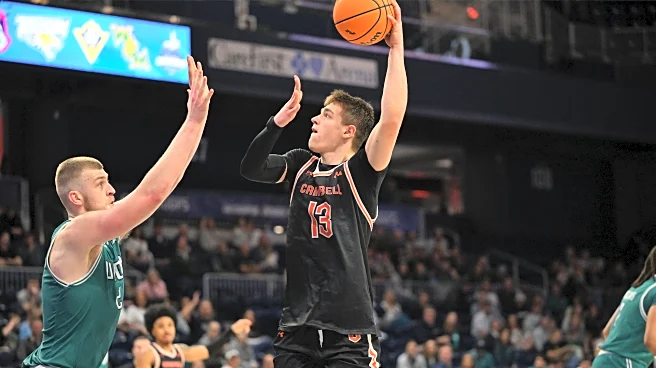
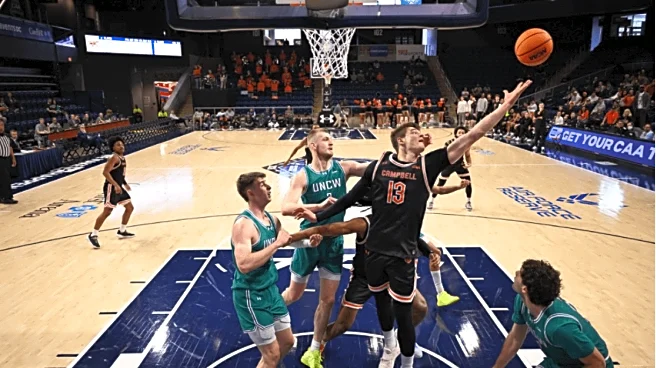
For the first time in CAA tournament history, the top two seeds will not play in the CAA semifinals after the No. 9-seed Campbell Fighting Camels shocked the top-seeded
North Carolina-Wilmington Seahawks, 85-70, to open the 2026 CAA quarterfinals. Two games later, on the same floor, the seventh-seeded Towson Tigers blitzed the second-seeded Charleston Cougars, 81-56.
While Campbell is the first No. 9 seed to reach the CAA semifinals, it’s only the third time in the tournament’s 44 years that the top seed failed to do the same. The other two times (when No. 8 seeds replaced top seeds), No. 2 seeds still got to the semifinals.
But not this year, thanks to Campbell (16-17, 8-10 CAA) and Towson (19-14, 9-9 CAA).
Perhaps even more stunning than the Camels and Tigers both winning in the quarterfinals was the way they each did it.
In each case, it was definitely no fluke. Read on to see how each of the final four got here.
Campbell Surge Finished at the Free Throw Line
After failing to have an answer for All-CAA First Team junior center Patrick Wessler (21 points) and trailing, 21-10, nine minutes in, Campbell tied the game, 31-31, before Wessler beat the first half buzzer with a fadeaway jumper for a two-point UNCW halftime lead.
So, the top-seeded Seahawks (26-6, 15-3 CAA) were still in control, right?
Well, not at all.
All CAA First-Team Graduate guard D.J. Smith (team-high 20 points, 4-for-8 from 3-point range) caught fire and with the Camels trailing by one, Campbell scored 16 straight points to lead, 56-41, as part of a much larger 56-26 surge spanning both halves, to take a game-high 66-47 lead with 6:41 remaining.
“We started off hot and they responded like a good team does,” head coach Takayo Siddle said in defeat. “Probably for about 25, 28 minutes, they were the tougher, more physical team and we could never get our footing… it was their [day]. They played really good and deserved that win.”
The Cinderella Camels, who ousted eighth-seeded Stony Brook, 96-89, in the second-round on Saturday, felt no pressure as UNCW (which swept Campbell by a total of just eight points in two regular season meetings) desperately tried to get its way back into the game and rally (the way the Seahawks had done many times this season) by fouling and forcing Campbell to make free throws.
No problem there either, as the Camels, who didn’t attempt a first-half free throw, sank 26 of 31 second-half foul shots, led by All-CAA Third Team sophomore guard Jeremiah Johnson (10-for-10 at the line) and Smith (8-for-10 at the stripe).
“We’ve been through a lot as a team,” head coach John Andrzejek said. “We’ve had a lot of different injuries, a lot of adversity off the court, and to find a way to keep chipping away, through losing games, by one point, by three points, these guys just keep coming back. They’re determined to make something of this year and have their little moment in the sun, and this is a great win for us. I think it’s a landmark win for our program.”
Towson Took It To Charleston From The Start
What Towson did to Charleston (21-11, 14-4 CAA) was perhaps less surprising than Campbell’s feat, given that the Tigers led the Cougars at halftime, 34-17, and won, 61-52, at home, in the teams’ only prior meeting this season on Jan. 15.
Still, as with the Camels, what the Tigers are doing now underscores what we see each year in college basketball, that March often gives teams new life.
Last year’s regular season CAA champions were picked to add another regular season crown this year, but were the league’s most disappointing regular season team.
Towson suddenly looks a lot different now. After taking a 30-17 halftime lead on tenth-seeded Hampton in the second-round, and winning, 64-58, the Tigers immediately jumped on the Cougars, 9-2, built a 14-point lead, and led by 11 at halftime. Using their staple of crashing the offensive boards (8-1 in the first half), they dominated Charleston, 19-2 in first-half, second-chance points.
Blowing the game wide open, Towson scored the first 13 points of the second half, to lead, 56-32, and never looked back, leading by as much as 29.
That team, led by Third Team All-CAA junior guard Tyler Tejajda (who scored 30 points against the Cougars on 11-of-11-shooting after dropping 35 points on 12-of-21 shooting the day before), rather than the one that finished as the seventh seed, is the one people expected to see this season.
But the ease with which Towson dispatched of Charleston, particularly on the same day UNCW lost by a big margin, was mind-numbing.
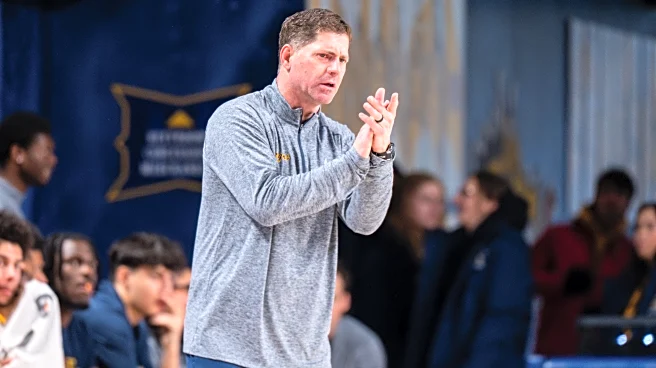
“We’ve talked a lot this week that we have an opportunity to either prove people right or prove them wrong,” head coach Pat Skerry said.
Senior forward Jack Doumbia Jr. added, “As a group, we know how good we can be. To start the season, people thought we were going to be No. 1, but obviously a lot of guys on the team got a chip on their shoulders… and felt like we didn’t achieve what we wanted. We see people kind of writing us off, so that’s definitely something that motivates us.”
Monmouth Advances With Defense
Yet another departure from the past will be the first semifinal matchup on Monday evening, featuring a pair of teams that will each be making their first CAA semifinal appearances , when Campbell meets the fourth-seeded Monmouth Hawks (18-14, 11-7 CAA), who like Campbell, overcame an 11-point first-half deficit to win. Monmouth did it with defense. After trailing 29-18 about 11 minutes in, the Hawks allowed 28 points over the final roughly 29 minutes, to beat the fifth-seeded Drexel Dragons, 65-57.
Following Monmouth’s 11-point hole, Drexel missed eight straight shots.
Leading 48-43 in the second half, the Dragons missed nine consecutive shots as the Hawks scored 11 straight points to lead by six, with under five minutes left.
“I just felt like we were stuck on 29 in the first half and we were stuck on 48,” head coach Zack Spiker said.
Hofstra Makes a Statement
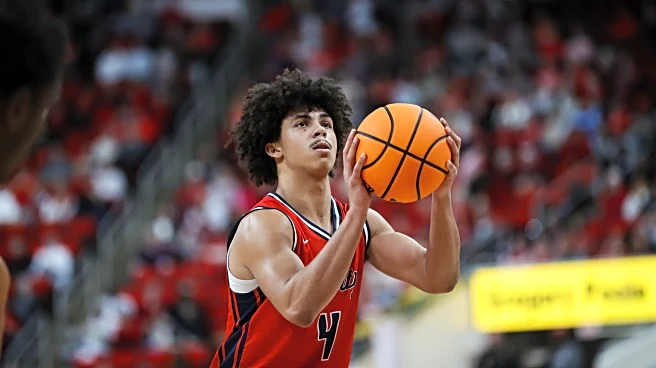
Restoring some order after the day’s earlier upheaval, the third-seeded Hofstra Pride (22-10, 12-6 CAA) avenged an 89-82 road loss, on Jan. 24, at the William & Mary Tribe (20-12, 10-8 CAA), with a 92-61 dismantling of the sixth-seeded Tribe.
CAA Player of the Year, junior guard Cruz Davis (game-high 30 points on 9-of-15 shooting) and graduate guard German Plotnikov (17 points) each went 5-for-9 from 3-point range as the Pride scored the final ten points of the opening half to lead, 50-33, at halftime, before leading by as much as 36 points in the second half.
Hofstra didn’t need to because of its offensive output, but the Pride – which beat the Tribe at its own fast-paced, higher scoring game in the first half – held William & Mary down defensively while improving to 19-1 when allowing under 70 points and 14-0 when surrendering under 65 points this season.
Next up for Hofstra is Monday’s night’s semifinal game against Towson, which the Pride swept by 11 and 22 points, respectively this year, leading the second of those matchups by 26 at halftime, at home.
“We’re definitely not taking them lightly, head coach Craig “Speedy” Claxton said. “They’re the preseason No.1 team and they’re playing really good right now. They’re playing probably like they should’ve been playing all year.”
Predictable Before, the CAA Tournament Is Lately More of a Crapshoot
Monmouth and Hofstra being joined by Campbell and Towson breaks new ground in the CAA semifinals.
Not only will the semifinals lack the top two seeds for the first time, but with the Nos. 3, 4, 7, and 9 seeds left, the total seed number of 23 is the highest ever for a CAA semifinal round.
While a No. 4 seed has snuck into the CAA finals five times, a No. 5 seed twice, a No. 6 seed four times, a No. 7 seed twice, and No. 8 and No. 12 seeds once each, the CAA had featured a championship game with the top seed facing either a No. 2 seed or a No. 3 seed 29 times over the prior 43 years , including 16 times when the top two seeds met in the finals.
Some of the aforementioned anomalies have occurred more recently, indicating that the CAA, hasn’t been quite as predictable in recent years as in the past.
In 2020, No. 6 seed Northeastern reached the CAA finals before losing to top-seeded Hofstra after the Pride only needed to go through the Nos. 8, 5, and 6 seeds to win its only CAA tournament championship.
A year later, in a Covid-shortened season, sixth-seeded Drexel won its only CAA tournament title over eighth-seeded Elon.
The following season, Delaware became the only No. 5 seed to win the CAA tournament.
Two years ago, No. 7 seed Stony Brook came with a play or two of winning the tournament before falling to top-seeded Charleston in overtime.
And last year, 12th-seeded Delaware went on a remarkable run, losing by only four points to second-seeded UNCW in the title game.
“It certainly speaks to the parity [of the league] because we have athletic directors, coaches, presidents that have made a commitment to being competitive,” said Joe D’Antonio, who is in his tenth year as the CAA’s commissioner. “We are in a new era in the world of college athletics and we’ve been a conference that has not mandated minimums [or maximums]. We are allowing institutions to put a plan in place that they feel as though is going to be successful.”
That gives teams like Campbell confidence and a reason to dream in March.
Looking back at the recent history of other teams’ lower-seeded, near-misses in the CAA tournament, Andrzejek said his team was able to use that knowledge and have a ‘Why-not-us?’ mentality in this year’s tournament.
D’Antonio said, “I think what we’re seeing come to bear fruit is the fact that [schools’] commitments to being competitive, and everyone making that commitment, allows us to see a conference that from top to bottom, has teams that can beat each other on any given night.
“We talk about the Campbell win today being an upset. It’s an upset from where the seed lines lie, but when you look at how those teams played each other during the regular season, I don’t know if it’s necessarily an upset.”
Maybe so, but teams sometimes played each other close in the regular season with a different story in the CAA tournament (like Hofstra’s first game against William & Mary this year compared to the teams’ semifinal meeting).
The difference now, D’Antonio says, is that, “Teams are closer in talent than we’ve ever had before… both in the regular season and in the [conference] tournament.”
As he prepares now for a longer stay in the CAA tournament than many thought previously, Skerry said, “A lot of people are going to say the 1 seed got upset, I mean, if you really watched our league, Campbell, twice, against Wilmington, led [late] and lost.”
Already knowing what it’s like to win a CAA championship involving the most unlikely CAA final matchup yet (in 2021), Spiker said, “I think it’s as good as it’s been in my ten years at Drexel with the exception of maybe Year 1 or 2. It’s not just a one-bid league. It’s a one-bid league where maybe seven or eight teams can win that thing, and I think the game before us (Campbell beating UNCW) may have been a pretty good example of that. That’s the beauty of our league. That’s also the frustrating thing of our league, as well.” All of which means that perhaps maybe now more than ever in the CAA, expect the unexpected.