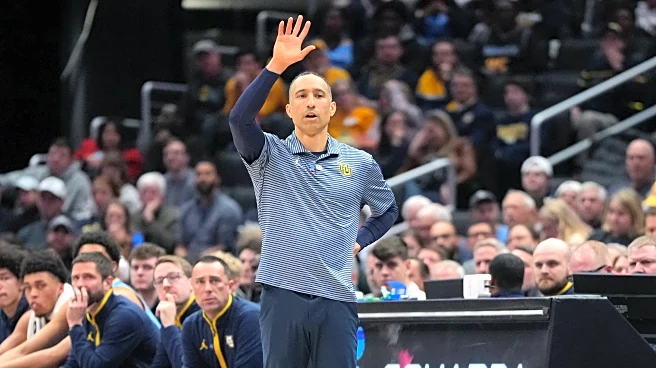




You might remember that back in mid-December, I penned an article on this website titled “Is Marquette Getting Worse?” That was published in the wake of Marquette men’s basketball losing 96-76 to Wisconsin on December 6th and just one day before the Golden Eagles took a 79-59 loss on the road against Purdue
.The ultimate conclusion was that with an absence of proof that Shaka Smart’s team was showing signs of improvement in any particular aspect 10 games into the season, it becomes very easy to point
to declines in several things as proof that the team was, in fact, getting worse. Nine days after I published that article, I cracked open a thread over on Bluesky to start something I had the idea of doing in the wake of the Getting Worse article. I started documenting, game by game, exactly where Marquette’s Game Scores were over on BartTorvik.com. Game Score is definitely not a perfect metric to measure a team’s improvement, but it is a compilation of quality of play with a dose of adjustment for opponent quality. Obviously: Losing to the #1 team in the country on the road by one point is a better performance than beating the #365 team in the country at home by one point.
The impetus for actually starting the thread? I started it on December 21st, one day after Marquette took an 84-63 loss at Creighton right before going on a nine day break for Christmas.
At the time, this is what the graph of Marquette’s Game Scores looked like:
Yeah, I’d say “that was the worst game of the year” was a good time to start tracking exactly how bad things were getting for Marquette.
And then a funny thing happened on the way to the forum: Marquette got better.
It’s not obvious in the record. After losing to Creighton, Marquette was 5-8 (.384 winning percentage) on the year and 0-2 in Big East play. Over the rest of the season, Marquette went 7-12 (.368) and 7-11 (.388) in Big East regular season contests. All games aren’t created equal, however, and if you count Dayton as a quality opponent because they are going to finish the year ahead of Marquette in whatever analytics you want to use, Marquette was 0-8 against quality opponents through the end of that Creighton game. Going from 0-8 to 7-12 is a drastic improvement in winning percentage even if it isn’t actually a winning record.
What do the analytics show us about where the Golden Eagles headed after the Creighton game? Let’s start with the Game Scores, since that was our jump off point:

Please note how I have helpfully marked the Creighton game on the graph, and when I say that I did it, I mean I clicked on it on BartTorvik.com before taking the screencap.
After seven Game Scores under 50 in the first 13 games of the season and hitting what would become a season low of 12 against Creighton, Marquette only dropped under 56 twice the rest of the year, and you remember both games very clearly. At Xavier, which was over early, and at home against DePaul, where Marquette barely got to 50 points. Even with those fall downs, the overall trend of the Game Scores — the two yellow lines — were going upwards as the season went on.
What about the offensive efficiency?

From the Creighton game forward, that thick gold line — which is updating season average as the season goes along — pretty much just keeps going up all season long. It’s heavily boosted by the run of games that caused that giant spike in the dotted black line, which is the rolling five game average. After the home win against Xavier — that’s the green square down by the Creighton loss — Marquette only had one more game with an adjusted efficiency under 1.05 points per possession after putting up seven of them in the first 16 games of the season.
How about the adjusted defensive efficiency?

This one is a bit more all over the place, as you can see the up and down spikes in that five game rolling average dotted black line. However, as you can see from the green squares and the red squares mostly ending up on one side of the averages or the other after the loss at Creighton, if Marquette figured out how to stop you, they won. If not, they didn’t. Overall, the thin gold line, which is showing you the trend of the entire season, is tilted towards improvement as the season goes along.
One more: What happened to Marquette’s T-Rank, the Torvik system’s overall rankings as the season went along?

Yeah, things continued to get a little bit worse for Marquette right after that Creighton game, that’s what happens when you lose that Seton Hall home game the way they lost it. But after falling at UConn for the absolute T-Rank low point of the year, things went back up. Not back to where Marquette was to start the season, where they were projected to be at the start of the year. Part of that might be the drop below #140 dragging the numbers backwards because ultimately, T-Rank is a measurement of your entire season. To a certain extent the ranking shooting back upwards almost as hard as it went downwards is a sign of how much things had turned around for the Golden Eagles.
Taking all of this in, we’re left with what appears to be a pretty undeniable truth: Marquette head coach Shaka Smart did a heck of a job coaching Marquette men’s basketball in 2026.
I phrased that incredibly carefully, by the way. I don’t mean “in the season that ended in 2026,” I mean “in the calendar year 2026.” The process and results we saw from Marquette after the calendar turned to 2026 were wildly different from what we saw up until New Year’s Eve. Credit where credit is due: Smart took the pieces he had on the roster that were working and turned the season around. Given where things were at the start of January, it’s tremendously impressive as to what Smart squeezed out of this roster over the last 10 weeks of the season.
This is where I acknowledge the fact that you’re currently screaming at your screen. Yeah, it’s real bad for the long term future of Marquette men’s basketball that the Shaka Smart that was fixing how bad things got was the same Shaka Smart that set the roster up for November and December 2025 and the same Shaka Smart that coached the roster in those months and produced the results that we saw as well. Same guy! It’s a real conundrum!
The fact that Marquette was not a completely different team, merely a much better team since the first of the year does help even that out. It’s easy to say that if January/February/March Marquette played the entire 31 game schedule, that could be an NCAA tournament team. You can see the vision there if all of the close call losses had gone the other way. However, 2026 Marquette is also the same team that completely clonked that home game against DePaul. Even with everything that Smart had done to fix what direction the season was going, his repair job was not perfect, partially because the team was still limited by several of the same flaws that the roster had all the way back on November 1st, tactical improvements or not.
Going forward, the big questions to be asked of Shaka Smart are 1) why did he go with the tactical options he did to start the year, 2) why did he change things, and 3) why did it take eight weeks of the season to make those changes when things were getting increasingly worse? If he has the introspection to answer those honestly, then perhaps the turnaround we saw in January and February is a good sign for the 2026-27 season.
Follow Anonymous Eagle on social media
Facebook: AnonymousEagle
Instagram: AnonymousEagleSBN
Bluesky: AnonymousEagle