
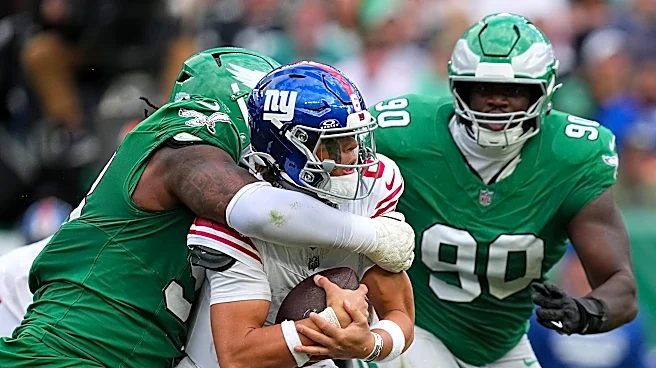


The New York Giants offensive coaching staff, and offense as a whole, is going to be one of the big storylines of the Giants’ 2026 training camp and preseason.
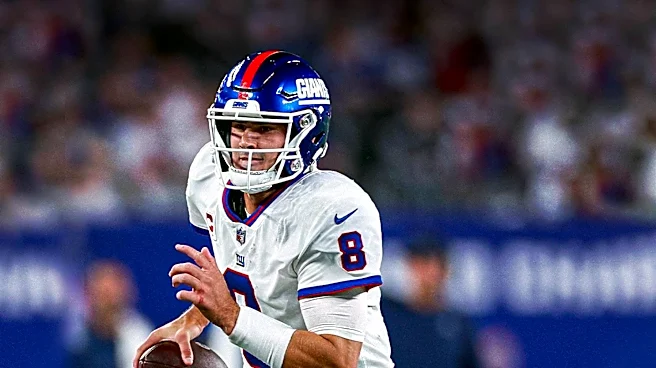
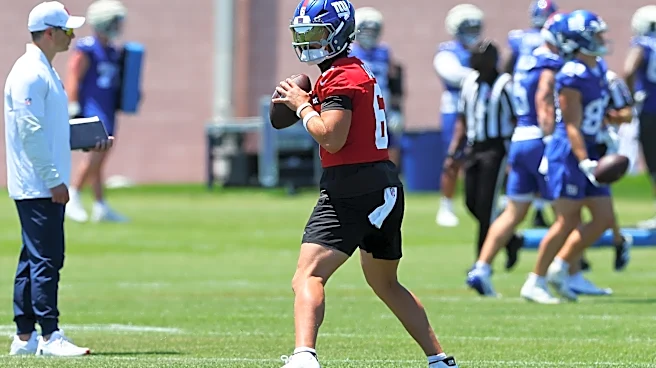
Not only will we be talking about the development of quarterback Jaxson Dart and how the offense copes with the (potential) absence of Malik Nabers, the offensive coaching staff itself will be a storyline.
The decision to hire Matt Nagy has been characterized as a joke or an act of charity on the part of Harbaugh for his old friend Andy Reid.
Under Nagy are former 49ers, Bills, Ravens, and Chargers OC Greg Roman and former Titans HC and Bengals OC Brian Callahan. Not only are they about as different as two coaches can be, they both failed rather spectacularly in their most recent stops.
So again, the hirings were met with reactions that range from skepticism to derision. Personally, I wouldn’t go anywhere near that far, but the arrangement is certainly confusing on the face of it.
Here’s what I said in the beginning of July when NFL.com gave the Giants’ offseason the only “A+” grade in the NFC.
The decision to create the Matt Nagy/Brian Callahan/Greg Roman triumvirate is confusing. I suspect that the plan is for Callahan and Roman to cover each other’s blind spots in play design, while Nagy balances the offense as a whole, but we’ll have to wait and see how that plays out.
I don’t believe that Harbaugh is just throwing spaghetti at the wall with his coaching hires. I believe there is a definite vision, though we aren’t privy as to what that may be
With training camp approaching, and with it our first real looks into the Giants’ schemes, I wanted to go back and dig a bit more into that triumvirate.
Greg Roman (Senior Offensive Assistant)
Greg Roman has been an offensive coordinator in the NFL for most of the last 15 years (save a two-year stretch as a “Senior Assistant” with the Baltimore Ravens in 2017-2018). He is widely known for his affinity for running the ball and is, frankly, catnip for power run game enjoyers.
Roman has consistently produced elite rushing attacks that are designed to pound opposing teams into submission.
Or, as he said after being hired by the Chargers in 2024,
“I think in this league, you can really, really help dictate the defenses if you have a strong running attack,” Roman said. “If you really talk to most defensive coordinators in this league and got ’em off to the side when they’re playing a really good running team, they’re sweating a little bit. They’re sleeping a little less that week.”
Like I said: Catnip. And that likely explains why the Harbaugh brothers simply love him.
Just look at what John Harbaugh recently told Domonique Foxworth about Jaxson Dart.
He can live in a power-running game, obviously, and a power-running game protects the quarterback because you can hand the ball off and make people defend that and keep them honest. Then, it opens up your play-action passing game. … That stuff, we’re gonna be in those worlds.
The two men speak the same language.
Roman loves downhill, man-gap based power run schemes, so much so that I’ve seen his offenses have been called “caveman football”. I wouldn’t go that far, as he helped to usher in the “Dual Threat” revolution with Lamar Jackson and incorporated far more motion with the Chargers. He can be legitimately innovative when it comes to creating numbers advantages with pulling linemen and putting defenses in bad positions to defend the run.
But it also isn’t completely inaccurate.
We’ll see plenty of Andrew Thomas, John Michael Schmitz, and Sisi Mauigoa using their athleticism to pull and hit defenders. Likewise, Patrick Ricard will have a definite role and should be a regular feature in the rushing attack. Likewise, we’ll probably see plenty of pre-snap motion between the 20’s to manipulate defenders or create play-action opportunities.
We’ll also likely see the return of the quarterback run game.
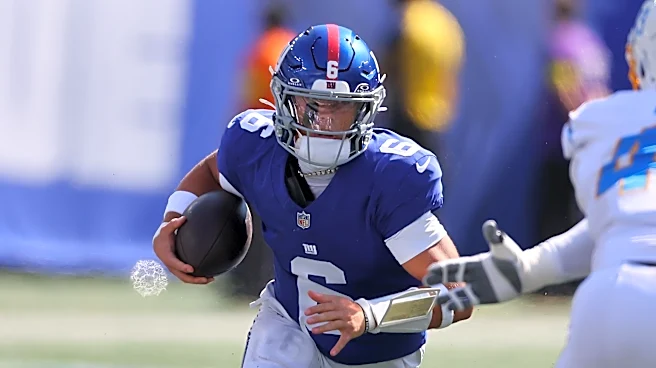
Nobody will go so far as to say that Dart is Lamar Jackson’s equal as a runner. However, Dart is an undeniably skilled runner with good vision and short-area quickness. It’s true that he needs to practice better judgement about sliding or getting out of bounds when the game isn’t on the line, but that doesn’t make his legs any less of a weapon.
Roman took full advantage of Lamar’s rare traits as a runner, and we’ll likely see him do the same with Dart — albeit in a different way given their different athletic traits.
Brian Callahan (Passing Game Cordinator / Quarterbacks Coach)
Callahan is a descendent of the McVay coaching tree, via Bengals head coach Zac Taylor.
And in many ways, he’s the antithesis of Roman. Where Roman bases his run schemes on downhill man-gap blocking, the Shanahan-McVay tree is built on wide-zone (outside zone) runs to stress the defense horizontally. Likewise, where Roman favors heavy personnel and lower passing rates, Callahan’s lineage has historically preferred spread seats, 11-personnel, and more passing.
That isn’t to say that he’s “pass happy”, and in fact much of what that offensive school does is to enable the run through manipulating defensive personnel. However, Callahan does believe in throwing at a much higher rate than Roman.
Rather than using the passing game as an extension of the run game, Callahan’s New West Coast philosophy seeks to use timing and route running in route concepts to attack multiple levels of the defense at once. They try to structure their route concepts to put defenders in conflict and force defenders to make impossible decisions. Be that by forcing zone defenders to decide between covering two receivers or creating traffic to disrupt man coverage.
The New West Coast philosophy has also proven adaptable in structure, weaponizing spacing and alignment to put defenders in bad positions. We’ve seen the Rams go from extremely wide 11-personnel spread formations to condensed formations with 13-personnel — but with similar intentions from both extremes.
In that vein, Harbaugh also told Foxworth that the Giants intend to be very multiple in their offensive structure and won’t simply live in a static “Pro Style” formation.
“But now we can also get in the gun or we can get in the pistol, and we can run RPOs, we can run quarterback-driven runs with Jaxson Dart, a lot of the stuff that we hand in Baltimore with Lamar, as well.
…
“So, that all kind of goes together on first and second down to create problems for the defense, and I just feel like it all starts with the quarterback. Jaxson is a guy that does give you a chance to live in all those different worlds. So, if he can do it, then we’re gonna do it, and that’s what we’re planning on doing.”
Matt Nagy (Offensive Coordinator)
As mentioned above, I suspect that part of the vision for the offense is for Nagy to balance and blend the areas of the game at which Roman and Callahan each excel. In other words, Nagy is the head chef who assembles the meal from components prepared by his assistant chefs.
In addition to the overarching game planning aspect of the offensive coordinator, part of Nagy’s role may be to meld Callahan’s passing concepts with Roman’s run concepts within his (Nagy’s) larger offensive scheme. Part of what we’ll be looking for over training camp and preseason is how Nagy’s offensive philosophy has shifted since he last ran his offense, as opposed to trying to parse his contributions from Andy Reid’s offense in Kansas City.
Nagy’s offense in Chicago heavily incorporated RPO (run-pass option) plays, as well as Air Raid passing concepts, in addition to the classic West Coast principles he learned from Andy Reid.
The question is whether Roman will be designing the run game while Callahan designs the passing game, or if they’ll be tasked with simply implementing Nagy’s scheming. If the former, how Nagy marries his philosophy with Callahan’s McVay-adjacent passing concepts and Roman’s downhill man-gap play designs will be fascinating to see.
The former does play into Nagy’s reputation as a “Culture Builder”, a trait he seems to share with John Harbaugh. Part of Nagy’s interpersonal philosophy is “Be You”, which suggests that he wants Roman and Callahan to add their own unique flavors to the offense’s gumbo, as opposed to simply following his recipe.
“I just always try to go back to that because I don’t want to be that guy that did try to change because things weren’t going the right way,” Nagy said. “When I say that, that’s the ‘me’ part, the person. The coach, there are some things that you can do different. That’s different. You’re always adapting and trying to see what solutions you could come up with.
“But the person part, that’s the part to me is the biggest thing in this ‘Be you’ and don’t ever change, is that there is a lot of egos and it’s very easy to get a big ego and very easy to change in this profession — and that’ll never happen with me. Never as long as I’m here in this league, that will never happen.”
There’s a chance that this experiment could fail. We don’t see coaching staffs assembled in this way often, and “too many cooks in the kitchen” is a real danger. It’s possible that when the Browns hired Todd Monken out from under John Harbaugh, he decided to try and build his own “Frankenstein’s Monken” out of Nagy, Roman, and Callahan.
Or maybe this coaching Voltron will work out and Nagy’s collaborative culture will successfully balance Callahan’s modern New West Coast passing attack with Roman’s Caveman Football.