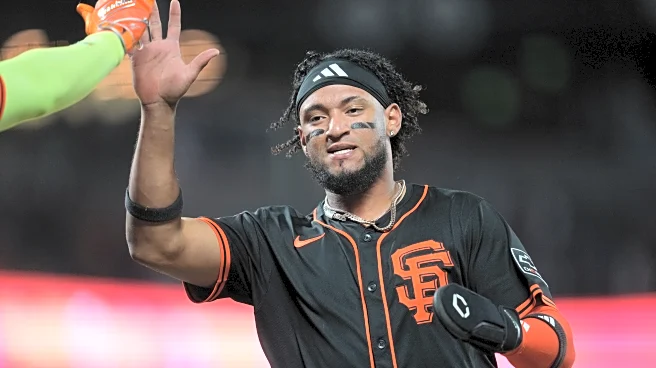

2025 stats: 57 G, 184 PA, .221/ .268/ . 424, .203 ISO, 6% BB%, 14.7% K%, 91 wRC+, -0.2 fWAR
It’s time, Luis.
As a humble representative of the San Francisco Giants community, I’m officially giving the supportive
but firm metaphorical tap on the rear. We’re ready for ya, kid. Take off, champ Do the thing you’ve teased at doing. Right field, Luis, it’s open for ya…now take it.
And why not him? Do we think some big money signing like Kyle Tucker is going to skip the line and dig their cleats into that grass instead? Do you expect Posey to engineer another swap for established talent? Probably not. Meanwhile Matos has recorded more than 150 plate appearances in three straight Major Leagues seasons, and logged nearly 1,300 innings in the outfield over that stretch. He’s proved, at least briefly, that he can hang with the big boys. He flashed, like an atmosphere-searing comet, across the sky of our collective consciousness in 2024, before flaming out suddenly, spectacularly, an echo reverberating in our ears: Remember me.
We remember, Luis. Some of us still sort-of believe. This present is a gift. As a humble representative of the San Francisco Giants community, I whisper in your ear the sentiment of thousands: Luis, now is the time. The runway has been cleared. The rock of Mike Yastrzemski, exemplar of veteran steadiness, has been rolled on to soft pastures in Atlanta to wait out his waning years. The once pebble strewn field of prospects has also been cleared with a couple sweeping transactional kicks. Marco Luciano, booted. Wade Meckler, booted. Joey Weimer — haha — booted. Few obstacles remain. Considering the physical grief right field caused Jerar Encarnacion in 2025, an everyday defensive position is not in the cards. Drew Gilbert and Grant McCray are better defenders but have looked like temperamental lefties at the plate, overmatched by MLB pitching during their brief stints. Do you really want to surrender playing time in a lukewarm platoon to them? Matos is younger, with more than twice as much Major League experience, than the lot of them.
It’s time, Luis. Take what’s yours.
Easier said than done, of course. And many realists will dig in their heels in protest and harumph with good reason. They have data to back up their discontent. He broke camp with the Giants last March and didn’t hit well enough to insert himself into starting consideration. By early June he was back in Sacramento. Similarly, with a full season’s worth of Major League plate appearances to his name, Matos hasn’t done much to force the manager’s hand. His low average isn’t supported by a high walk rate or boosted by power. Defensively, he’s robbed homers and crashed into walls from foul line to foul line but has consistently graded as well below average in terms of range. Based on his past inconsistent play, Matos deepens the outfield’s many defensive woes rather than solves them.
No, you can’t argue with those real-world results — but there are optimistic caveats to be thrown on. Try youth! We’ve been saying this for years now, but he’s still young! Matos turns 24 in January. Sure, he’s been kicking around for a while, but one should still factor in potential and growth. The Giants did just that last year, figuring it was best for Matos to get consistent playing time in Sacramento than sit on a bench in San Francisco. He hit well in AAA too: batting .293 with an .837 OPS in 159 PA. Considering the unique difficulties that a part-time role brings to a younger player, we could at least humor the possibility that the brief flashes of brilliance Matos showed us — as he did in late August / early September — were peeks into the future rather than unsustainable swings of fortune. At the very least, more consistent innings, more consistent plate appearances can certainly help raise a low floor.
Matos brings other qualities to the diamond as well. As the youths say, he’s got tools. First and foremost, he has the hard-part down with regards to batting. The hammer don’t miss the nail much when Matos is swinging it. His contact rate has always been excellent, and he’s made steady improvements in turning any ol’ contact into the right kind of contact.
The club mandate for Matos was to become more dynamic at the plate, and more of a threat by developing his power. He has bulked up physically since his debut in 2023 and progressively met the ball further out in front of the plate to exploit his pull side. He’s also made vast improvement in his ideal attack angle rate (defined by Baseball Savant as an angle of 5 to 20 degrees), which basically measures a hitter’s timing and what their bat is doing at the point of contact. Matos’s ideal attack angle rate in 2023 was 37.7%. In 2025, it was measured at 57.3% (MLB avg. 50.9%).
These metrics have produced some recent tangible results. His .424 slugging and .203 ISO last year were his highest marks in the Majors and solid improvements from his .342 SLG and .092 ISO postings in 2023. His home run to fly ball rate swelled 10 percentage points from 2.7 HR/FB to 12.7%. Obviously these are not punch-the-lights-out numbers (nor should we expect him to ever boast that much power), but things are moving in the right direction for Matos in terms of his swing mechanics.
But I’ve written all of this before:
Time is still very much on Matos’s side to tinker and find the balance in his approach between discipline and aggressiveness, and the sweet spot in his swing between contact and drive.
This is the worry — that Matos’s best asset is just time. Sure, he’s young and he’s improving, but how high is his ceiling? It’s dangerous to look so far down the road that you don’t see the thing right in front of you.
Look at his performance this past year: Even with all the positive developments in his bat tracking metrics, it still wasn’t enough to really tip the scale. He still doesn’t hit the ball very hard, and his expected numbers hardly suggest he got “robbed” in terms of his on-field results. There’s the question of discipline too. The best way to undermine great bat-to-ball skills is by chasing after pitches. Matos’s chase rate was an atrocious 37% in 2025, slightly less atrocious than 40% in 2024, and a far cry from 25% in 2023. His chase contact rate was 11 percentage points higher than the league average. That’s a bad combination. Cool, you didn’t strike out on a slider down-and-away — you just rolled into a routine double play. Contact can be exploited — this has been the recurring lesson of Matos’s career.
With no more options, Matos will neither have the safety net of Sacramento, nor be trapped in its unique purgatorial fog. The path forward has become far more clear and far more specific. Time, while still an asset, has started to feel more precious. This could be exactly what Matos needs. All of the clarity that these pressures bring might help him, in the words of Mike Krukow, “mature into the game.” As of right now, the Giants appear to have given Matos their blessing to take over right field— but how long will that good will last?
My professional opinion, Luis? Don’t goof around to find out. It really is time.