



As it turns out, 2026 has been a surprisingly strong year for the Colorado Rockies bullpen.
Through August 29th, Rockies relievers have been worth 3.0 fWAR, which is 15th in MLB. Their 4.81 ERA is not terrific, but it comes in 26th in baseball. (Given that their xERA was 4.80, the bullpen has performed about as expected.)
And it’s not like this has been an easy season for the bullpen, which has logged 549.2 IP this season, the sixth-most in the league.
But they have performed better than expected.
In
spring training, bullpen coach Matt Buschmann laid out his approach. As the Rockies near the end of their season, here’s what he’s seeing.
Pitching at elevation
The first thing he’s learned is that pitching at elevation is not unlike David Foster Wallace’s explanation of water in “This is water.”
It’s just the environment in which this team lives.
“I think once you’re in it a lot, it kind of goes away,” Buschmann said.
“There’s definitely some things about it, but it’s not as big a deal. From the pitcher’s perspective and what you can control, I think it’s very controllable. I think pitching at altitude becomes more (about) ‘What are you solving for?’ because a ball in play at altitude and with our field being so big, is a bit more of a penalty than a ball in play most other places.”
That imbalance requires more preparation on the part of Rockies pitchers.

“It’s just thinking through, ‘How do I attack hitters, knowing that a ball in play maybe costs a little more?” he said.
Buschmann is quick to complement the work of the Rockies bullpen staff and the way they’ve adjusted to playing at Coors and on the road.
“These guys handle it really well,” Buschmann said. “They understand how to pitch there. We’ve actually pitched at home compared on the road, pretty similarly. We get more two-strike swing-and-miss at home. So it’s not that guys don’t understand how to pitch at Coors. I think it’s just thinking through what is our attack plan, and how does that change? Because I think pitchers are going to execute fairly well in both places.”
For the record, Rockies relievers have a collective 5.91 ERA at Coors (29th worst) and a 5.14 road ERA (28th worst).
He’s also very aware of bullpen management.
“(With) relievers, you’re always managing workload,” Buschmann said. “There’s certainly injury risk in everything we do, but I think it’s more just output and ability and feeling good enough to execute and do these things, and so the fatigue more shows up in that. How good is this guy going to be? How good does he feel to go out and be his best? So managing that has been an interesting challenge.”
New technology
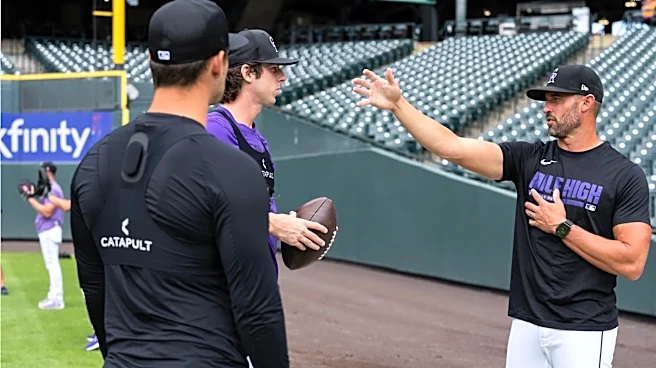
As one change brought in by the new front office, the Rockies are using technology to learn more about players and improve their performance — most notably, Catapult — and for that, Buschmann has worked with Brandon Stone, the Rockies manager of performance science and someone Buschmann knew from his time with the Toronto Blue Jays.

“Ultimately, we know everything that’s happening in a game,” Buschmann said. “We can measure every single thing in a game.”
The Rockies are in the process of learning how best to use that information.
“Now we’re trying to really measure ‘What do we do in between games?’ because we’re doing so much in between games, too. And when you get that total picture, you can you can basically understand ‘Here’s what’s expected of you from a workload perspective in the game.’ And if I know that, I know how to manage your workload in between games, and make sure the games don’t crush you, or they don’t fatigue you as much. And so the way to do that is to make sure your workload is high enough so that a game isn’t a big deal.”
The Catapult technology is helping the Rockies make better decisions.
“That’s helping us measure the throws and catch. It’s helping us measure not only their workload, but it’s helping us measure their strategy and how they’re going about workload. When we measure the strategy, little differences in strategy maybe tell us some underlying things that are going on. Maybe they’re tight in their lower half or upper half, and that just gets us ahead of things and makes sure we keep guys in their norm. And those things help measure when they’re outside their norm. And when they’re outside their norm in baseball, when you play every day, that can lead to kind of these small things over time end up to a big thing.”
Bullpen management
The changes aren’t limited to technology. Earlier in the season, the Rockies experimented with using bulk relievers, but they seem to have gone to a more-traditional bullpen strategy. However, Buschmann attributes that to improved length from the Rockies starters.
“Really, it’s just been a credit to our starters who, I think, have made adjustments,” Buschmann said, “and a lot of them have gotten more consistent and put together a good stretch here of our starters being being really good and getting deeper into games. And when you do that, you see the difference in how you can manage a bullpen, and maybe it lets you keep an extra leverage reliever instead of constantly worrying about length. Now you have extra leverage relievers, so each guy down there that can pitch in leverage isn’t necessarily always needing to be up.”
In addition to managing what’s happening with the Rockies, Buschmann has dealt with the bullpen churn that is part of an MLB season as relievers join the Rockies from Triple-A Albuquerque. For him, that goes back to veteran leadership.
“I think the biggest thing there is just the staples, the consistent guys, and Brennan Bernardino and Jimmy Herget and the veteran guys. It’s really fortunate for me that those guys have been there. They care about helping younger players, bringing them up, and they’re really good resources. They’ve both been in each situation you can think of, and so they were a really good resource for the younger guys to understand. ‘Here’s the expectation of you.‘ ‘Here’s you know how you need to prepare every day and to be your best.’ And so for me, it’s been leaning on those guys to make sure that they’re helping the younger guys come up.”
Another example is Rockies closer Jordan Romano, someone else Buschmann knew from Toronto.
“So it’s I knew it would be really, I think, hopefully impactful on some of the younger guys to see him prepare every day.”
Closing thoughts
It’s been a learning season for the new Rockies coaching staff, but Buschmann identified one lesson in particular he has stuck out to him.
“You can talk about pitching at elevation, you can have ideas, but then watching it day to day, there’s so much context there that now you’re truly informed through experience,” Buschmann said.
“I think what I’m most excited about is taking that experience and now building things and iterating our philosophy, building tools that are now informed by a year of experience and seeing it and seeing things work and not work. And so I’m really excited for that and just time — like a full offseason —with this group and what we’ve experienced. (Then we can) start to go and build the things we want to build, and hit the ground running in spring instead of hit the ground like, ‘Let’s learn, everybody.‘ I think that’s the most exciting place.”
This week on the internet
Okay, I thought this was funny.
MLB report cards for every team with 1 month to go | Bleacher Report
This seems to me a very reasonable grade for the 2026 Colorado Rockies.
Running the bases with Colorado Rockies Jake McCarthy | Mile High Sports
Speaking of Jake McCarthy, Drew Creasman spoke with the Rockies outfielder about how he approaches running the bases.
Join the conversation!
Sign up for a user account and get:
- Fewer ads
- Create community posts
- Comment on articles, community posts
- Rec comments, community posts
- New, improved notifications system!
Please keep in mind ourPurple Row Community Guidelines when you’re commenting. Thanks!