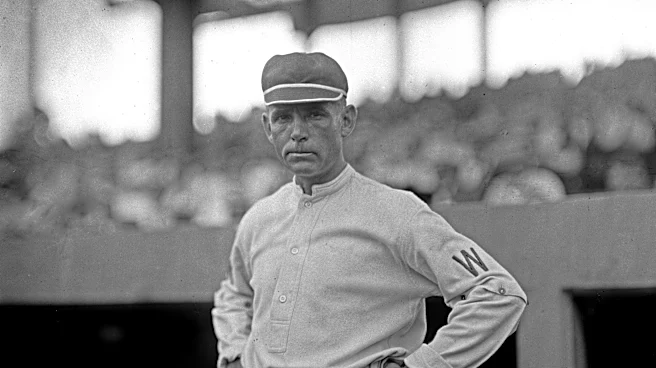


Though Clark Griffith is the first man to manage the New York baseball team we now call the Yankees, his time in New York is merely one chapter in a story of one of the giants of baseball’s early history. That’s no shot at Griffith’s time in New York and his importance to the franchise. It’s just he had such an amazing life and career.
He was already an accomplished hurler when he came to New York and became the player-manager of the club, in its first season in The Big Apple. And long after he hung
up his cleats, he remained an integral part of baseball in the first half of the 20th century.
Clark Calvin Griffith
Born: November 20, 1869 (Clear Creek, MO)
Died: October 27, 1955 (Washington, DC)
Yankees Tenure: 1903-07 (player/manager), 1908 (manager)
Clark Griffith was already a grizzled veteran when American League President Ban Johnson named him manager of the New York Highlanders (often called the Americans in the press) prior to the 1903 season. It was the inaugural campaign for the club, which relocated from Baltimore after the Orioles folded following two seasons.
The diminutive Griffith (listed at 5-foot-6) was a right-handed pitcher, and a good one, at that. Between 1894 and 1901, he won at least 20 games in a season seven times. His first season in New York was also his last one as a starting pitcher, and he tossed more than 200 innings while managing the club to a disappointing fourth-place finish.

Griffith’s pitching days were not over, however. He transitioned to the bullpen and continued to pitch at a high level while trying to steer the Highlanders to a pennant. In 1904 and 1906, he came close, with the club finishing in second place each season, mere games from wining the American League.
Modern Yankee fans are used to skipper Aaron Boone getting himself tossed from games, though he was shockingly well-behaved in 2026. He’s far from the first Yankee manager to get the hook, of course. Griffith, by virtue of being the first manager, gets that honor. Like his modern successor, Griffith also got himself suspended for his conduct toward umpires.
On Monday, August 27th, 1906, Griffith took umbrage with a safe call at first base while playing St. Louis. As a result, the umpires ordered Griffith off the field. The Highlanders’ skipper took his sweet time about it. Unfortunately for him, AL President Johnson was in the crowd, and the next day he suspended Griffith indefinitely. Yeesh. “Savages in the Box,” this was not. Seems a little harsh. But wait — there’s more. The indefinite suspension might have something to do with Griffith fighting umpire Tim Hurst earlier in the season, which also got him suspended. For that round of fisticuffs, Griffith received a five-day suspension. His ban in August lasted a week.
The Highlanders bottomed out on Griffith’s watch in 1908, and in June he decided it was time for him to move on. Owner Frank J. Farrell tried to dissuade the disheartened Griffith, but to no avail.
“It was fighting against fate,” Griffith told The New York Times, “And I knew when I had enough. I do not know who my successor will be, but I understand [Kid] Elberfeld is mentioned for the place. If that is so, I wish him the best of luck, and I hope my successor will pull the team out of the rut and place them where they belong.”
Griffith’s warm feelings for the club definitely did not last forever. At his death, the Times noted, “Mr. Griffith had two pet dislikes in his lifetime. One was John McGraw and the other was the New York Yankees.”
Griffith’s time in baseball was by no means done when he left New York. Most famously, he eventually found himself in Washington, where he leveraged his assets to obtain a 10 percent stake in the notoriously bad Senators. “First in war; first in peace, and last in the American League,” the old saying went.
Griffith won five pennants in nine years before again relying on his assets to buy a majority share in the franchise. By 1920, he’d transitioned out of the dugout and into the owner’s box, ending a 20-year managerial career where he won 1,491 games (26th most all-time). In 1924, his Senators finally won the World Series, upsetting the New York Giants. They would win further pennants in 1925 and 1933 as well.
Clark Griffith is almost certainly the most important person in the history of Washington baseball, with all due respect to Walter Johnson. He’s also the answer to an obscure yet important bit of trivia. Who was responsible for the tradition of US presidents throwing out the first pitch? It was Griffith, who in 1910 asked President William Howard Taft to toss out the first ball. Taft obliged and the rest is history.
Griffith was also key to baseball’s relationship with the U.S. government and military during both world wars. In World War I, he organized an initiative to get baseball equipment for every American soldier overseas. He even got President Woodrow Wilson to chip in. During World War II, he was one of the people who helped convince President Franklin Roosevelt to keep baseball playing.
He’s the only man in baseball history to have played, managed, and owned a team for at least 20 years each. Clark Griffith was elected to the Major League Baseball Hall of Fame in 1946. His Senators would eventually pass to his son, Calvin, who would move them to Minnesota in 1961 to become the Twins (and become rather infamous in his own right).
Clark Griffith died on October 27, 1955, in Washington, D.C. In its obituary for the legend, The New York Times noted what former president Harry S. Truman had said about Griffith in 1946 when he had thrown out a presidential first pitch, the tradition Griffith started decades earlier.
“Mr. Griffith is a shining example of what this great country of ours can produce.”
Happy birthday to the Yankees’ first skipper.
See more of the “Yankees Birthday of the Day” series here.