


NBA history spans 80 seasons, and as CelticsBlog readers well know, the Boston Celtics have won a league-high 18 championships. This month, we are recapping each of those title years.
The regular season
When the 1958-59 season began, Bill Russell was in an unfamiliar position: he was not a reigning champion.
From his junior year in college through his rookie year with Boston, Russell’s teams won two NCAA titles, an Olympics gold medal, and the NBA championship. In his second season as a pro, the Celtics
again made the NBA Finals but lost a rematch with the St. Louis Hawks – largely because Russell badly sprained his ankle in Game 3, missed Games 4 and 5, and gave it a try in Game 6 but was too injured to continue.
The Hawks took their four wins by the point margins of two, three, two and one. In the closeout game, St. Louis superstar forward Bob Pettit took full advantage of Russell’s predicament, scoring 50 points on 19 of 34 from the field and 12 of 15 free throws, while also grabbing 19 rebounds. All for the Hawks to win by one point.

So, when the next regular season began, it was clear the Celtics were on a mission. Little did they know, they were taking the first step toward making history and beginning a stretch where they would not be beaten for a long, long time.
In December, they ripped off 11 straight wins, and in January they tacked on an eight-game streak. They were the highest-scoring team in the league, including smashing league records with a 173-139 onslaught of the Minneapolis Lakers. Tommy Heinsohn scored 43 points, and Bob Cousy set a new league record with 28 assists.
The Celtics finished with 52 wins and 20 losses, the NBA’s best one-season record to date. Red Auerbach had built a loaded roster, as represented by the backcourt: starters Cousy and Bill Sharman, backed up by Sam Jones and rookie K.C. Jones. All four are now in the Hall of Fame. Boston even had a two-sport star you may not have heard of (see sidebar below).
Eastern playoffs
Even with all that talent, the Celtics needed seven games to beat the Syracuse Nationals (now the Philadelphia 76ers), who had their own go-to guys in Dolph Schayes, one of the top players in the fledgling years of the league, and George Yardley, All-NBA and one season removed from being the league’s scoring leader.
Through six games, the series was tied as each team won all its home games. In Game 7 in Boston, Schayes and Yardley combined for 67 points, but the Celtics prevailed with seven men in double figures. Sixth man Frank Ramsey was Boston’s high scorer with 28. In addition, the Celtics outrebounded the Nats, 89-62 (Russell grabbed 32), leading to 20 more field goal attempts in a game Boston won, 130-125.

NBA Finals
The Celtics expected a rematch with St. Louis, which led the Western Division at 49-23, but the Hawks were stunned in six games by the Minneapolis Lakers. Thus, the first-ever installment of the Celtics vs. Lakers rivalry was set.
The Lakers were led by sensational rookie Elgin Baylor, a 6-foot-5 forward who was a gifted scorer. Baylor was a deft finisher around the rim, and his herky-jerky dribble moves consistently got him to the basket or to the free throw line. He won Rookie of the Year, was first-team All-NBA, placed third in MVP voting, and averaged 28.3 points per game during Minneapolis’ upset of St. Louis.
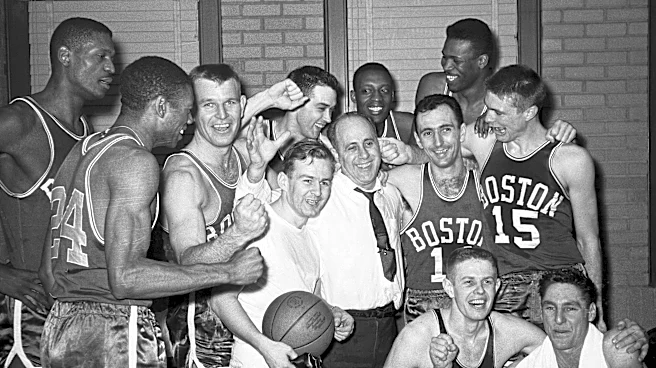
However, Baylor couldn’t carry the Lakers to victory against the more talented, motivated Celtics. Boston’s defense, backstopped by Russell, held the rookie to 33.3% shooting from the field and the Celtics swept the Lakers, 4-0.
It was over when…
The series truly might have been over before it began. As author George Sullivan noted in his book, “The Picture History of the Boston Celtics,” Minneapolis came into the series having lost to Boston 22 consecutive times over the previous two years.
Despite that, the Lakers gave it their best shot in Game 1. Baylor dropped 34 points, but the Celtics prevailed at home, 118-115. Minneapolis had no answer for Ramsey, who notched 28 points.
Turning point
If the Lakers still had a chance, it vanished in Games 2 and 3, when Baylor was held to 13 and 14 points, respectively. The Celtics won both by double digits to take a 3-0 series lead.
The heroes we needed
In Game 4, Heinsohn, Ramsey and Sharman combined for 76 points on 33 of 67 shooting for a 118-113 closeout.
Notable facts and stats
- The Celtics and Lakers franchises have gone on to meet for the championship 12 times. Boston leads the rivalry, 9-3.
- It wouldn’t be true in all those meetings, but in this series, it was the Celtics who had an advantage at the free throw line. Boston made 111 of 158, while Minneapolis made 86 of 117.
- This championship began Boston’s eight-peat — eight consecutive titles from 1959 through 1966. No other NBA franchise has won more than three straight.
Gene Conley: The two-sport star who made history with Boston
You’ve probably heard of Bo Jackson and Deion Sanders, who were major stars in both professional baseball and football. You may also know that Celtics legend Danny Ainge played three seasons with the Toronto Blue Jays before going to basketball full time.

But do you know the name Gene Conley? He was a two-sport star who arguably topped them all.
Conley was a 6-8 forward selected by the Celtics in the 1952 NBA Draft. As a rookie, he came off the bench for 12 minutes per game, averaging 2.3 points and 4.4 rebounds. However, also in 1952, Conley won 11 games as a pitcher in the Boston Braves minor league system and made his Major League Baseball debut by pitching in four games for the Braves.
That modest start led to bigger things. For the next five seasons, Conley stepped away from the Celtics to pitch full-time for the Braves, who had relocated to Milwaukee. The highlight of that stretch was winning the 1957 World Series in seven games over the New York Yankees. His most notable teammate was Hank Aaron, who went on to hit 755 home runs, breaking Babe Ruth’s career record. Conley pitched 11 seasons in the majors (including three with the Boston Red Sox), finishing with a 91-95 won-lost record and four all-star game appearances.
Conley returned to play for the Celtics in 1958 and was a member of the 1959 championship team led by Bill Russell. Conley also won titles with the Celtics in 1960 and 1961, all while simultaneously continuing his pitching career, since at that time the baseball and basketball seasons did not overlap. His NBA career totals were 5.9 points and 6.3 rebounds per game over six seasons.
To sum up, Conley won four pro sports championships and remains the only athlete to win titles in both MLB and the NBA. He beat the Yankees in the World Series and the Lakers in the Finals. Moreover, he was a teammate of arguably the greatest home-run hitter of all time and the basketball star who won more championships (11) than any other individual in the four major U.S. sports. That resume has never been matched by any other two-sport athlete, and it never will be.
Banner Years continues tomorrow with a review of the 1959-60 season and the road to winning Banner #3.