



Welcome to the 2026 edition of Ranking the Rockies, where we take a look back at every player to log playing time for the Rockies in 2026. The purpose of this list is to provide a snapshot of the player in context. The “Ranking” is an organizing principle that’s drawn from Baseball Reference’s WAR (rWAR). It’s not something the staff debated. We’ll begin with the player with the lowest rWAR and end up with the player with the highest.
No. 40, Tanner Gordon (-0.2 rWAR)
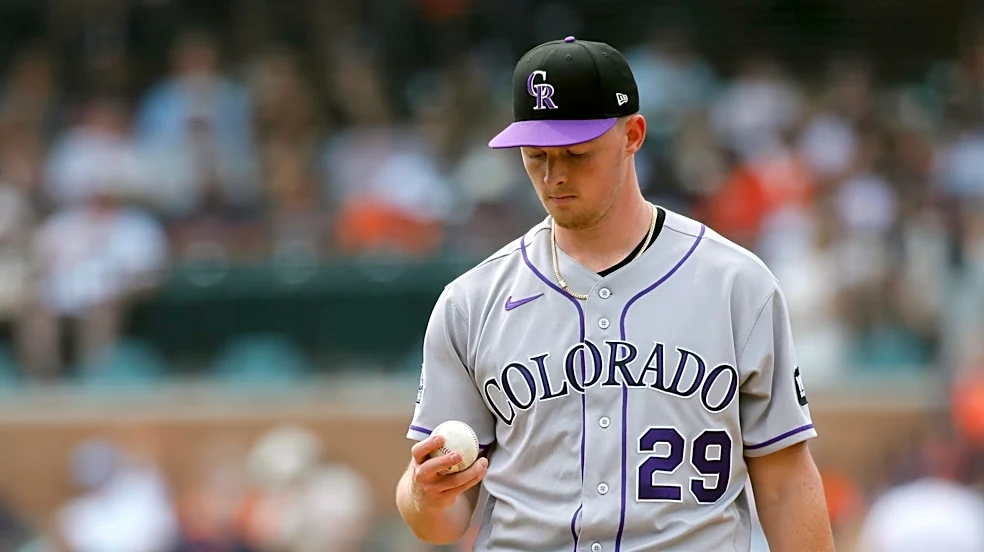
Tanner Gordon appeared in 24 games for the Colorado Rockies in 2026,
making 12 starts and finishing with a 1-6 record, 6.68 ERA, and 1.66 WHIP across 103.2 innings. His season was worth -0.2 rWAR.
For the second consecutive season, Gordon struggled to find consistent success at the major-league level. In fact, his 2026 numbers looked remarkably similar to those from 2025.
Despite the similar results, Gordon did make some adjustments.
Gordon reduced his four-seam usage from 52.8% to 43.1%, incorporated his curveball more frequently, and added 2.6 mph to his slider. His chase rate climbed from 27.1% to 31.3%, while his whiff rate improved from 18.0% to 21.7%. His expected ERA also dropped from 5.88 to 5.16.
Those numbers moved in the right direction, but the improvements weren’t enough to substantially change Gordon’s overall effectiveness. Gordon continued to struggle with strikeouts, hard contact, and keeping the ball on the ground. Despite the adjustments, his actual ERA increased.
One thing that hadn’t changed was Gordon’s ability to avoid walks. Unfortunately, getting the baseball into the strike zone and keeping hitters from doing damage against it proved to be two very different things.
A season of changing roles
Gordon opened the season in long relief.
His April 15 debut against Houston was encouraging: four scoreless innings, two hits, one walk, and four strikeouts.
Five days later, against the Dodgers, Gordon surrendered six earned runs over four innings, including three home runs. He also committed a fielding error, threw a wild pitch, and walked three hitters in a 12-3 loss.
On May 19 against Texas, Gordon replaced starter Sammy Peralta with two outs and the bases loaded in the first inning. With help from Willi Castro’s defense, he escaped the jam without allowing another run.
That reprieve didn’t last long. Texas scored three runs against Gordon in the second inning, all with two outs, as Brandon Nimmo, Ezequiel Duran, and Jake Burger delivered RBI singles. Nimmo added a two-run homer in the fourth, and Gordon eventually worked 6.1 innings, allowing seven earned runs on 12 hits while walking just one batter.
Six days later, Gordon joined the rotation, making his first start of the year against the Dodgers. He allowed just one run over five innings, although it wasn’t exactly smooth sailing.
The Dodgers put their leadoff hitter aboard in four of Gordon’s five innings. In the third, he allowed the first three hitters to reach, including an RBI double by Kiké Hernández and a walk to Shohei Ohtani.
With runners at first and second, nobody out, and Mookie Betts and Freddie Freeman coming to the plate, Gordon was in serious trouble.
Instead, he retired Betts on a flyout and induced an inning-ending double play from Freeman.
Gordon escaped another jam in the fourth and retired the final five hitters he faced. The Rockies eventually lost 5-3, but Gordon had given them a chance to win.
He remained in the rotation until a right hip impingement interrupted his season in early June. Gordon returned June 30 and continued starting through July 10.
His July 5 outing against San Francisco was particularly ugly. Gordon allowed four home runs and five earned runs in five innings despite striking out seven hitters. Rafael Devers accounted for two of those home runs, both against Gordon’s four-seamer, including a 463-foot blast.
Five days later, Gordon faced the Giants again, this time in San Francisco. Devers homered off him for the third time in less than a week, but Gordon escaped with just one run allowed over five innings despite surrendering eight hits.
Gordon then returned to long relief, providing 5.2 innings of one-run baseball against Cincinnati on July 19. After a rougher appearance against Tampa Bay on August 3, he tossed four scoreless innings against San Francisco on August 15.
The Rockies returned him to the rotation on August 21, but his first outing back wasn’t encouraging. Cleveland collected nine hits and five earned runs over 5.1 innings, with Gordon issuing two walks.
Five days later, Gordon delivered his best start of the season against Washington. Dylan Crews tripled with two outs in the first, but Gordon retired Daylen Lile to strand him. Andrés Chaparro led off the second with a solo homer, and the Nationals threatened again in the fourth.
With runners at second and third and two outs, Gordon got Harry Ford to ground out, escaping without another run.
He settled in from there, retiring 10 of his final 12 hitters and completing seven innings with six hits, one earned run, five strikeouts, and no walks.
Gordon followed that performance with another strong outing, holding Baltimore to one run over five innings on August 31.
He finished August with a 3.82 ERA and 1.17 WHIP across 30.2 innings, walking just three batters. It was his most productive month, although his struggles against Tampa Bay and Cleveland showed that the improvement wasn’t entirely consistent.
September was a different story. Gordon allowed 26 earned runs on 40 hits in just 15.0 innings, producing a 15.60 ERA and 3.20 WHIP. His final two starts were particularly brutal, beginning with seven earned runs on 10 hits over three innings against San Diego on September 17.
A week later, Arizona opened the game with seven consecutive baserunners, scoring six runs before Gordon recorded an out. Gabriel Moreno launched a three-run homer, Geraldo Perdomo tripled, and Nolan Arenado capped the barrage with a two-run shot.
Arizona added two runs in the second and two more charged to Gordon in the fourth. He finished with 10 earned runs on 12 hits and four walks in just 3.1 innings.
After allowing two earned runs over 12 innings in his final two August starts, Gordon surrendered 17 in 6.1 innings to close the season.
Command is more than avoiding walks
Gordon was exceptionally good at one thing in 2026: avoiding walks. His 5.1% walk rate ranked in the 96th percentile among MLB pitchers.
When the walks did come, however, so did the damage.
He issued multiple walks in just five of his 24 appearances. Every one of those outings resulted in at least five earned runs, and together they accounted for 33 of his 77 earned runs, nearly 43% of his season total.
Limiting walks didn’t guarantee a good outing. Gordon was knocked around several times while issuing one or fewer free passes, including May 19 against Texas.
Of course, command involves more than avoiding walks. Getting the baseball into the strike zone is one thing. Consistently locating pitches where hitters have difficulty doing damage is another.
Gordon’s results illustrate that distinction. His 18.0% strikeout rate ranked in the 18th percentile, while his 21.7% whiff rate placed him in the 22nd. His 43.1% hard-hit rate ranked in the 14th percentile, and his 11.0% barrel rate fell in the fourth.
Opponents hit .368 and slugged .637 against his four-seamer, which accounted for 10 of the 21 home runs he allowed. His Baseball Savant zone chart shows where hitters were particularly productive.

Opponents produced a .600 wOBA against pitches in the middle-middle portion of the strike zone and .546 against those in the upper-middle portion.
Gordon’s September 24 start against Arizona showed just how quickly poor fastball location could become a problem.
Facing Arenado in the first inning, Gordon opened with a 90.2 mph four-seamer that missed above the strike zone.
His second four-seamer missed even higher, putting Gordon behind 2-0 without challenging Arenado in the strike zone.
Now behind in the count, Gordon threw a third consecutive four-seamer, this one at 93.7 mph in the upper half of the zone. Arenado turned on it for a 419-foot, two-run home run.
Compare that sequence with Gordon’s August 26 start against Washington, when he faced Jacob Young in the third inning. Once again, Gordon threw three consecutive four-seam fastballs. This time, however, he consistently located them down and toward the edges of the strike zone.
His first fastball, at 90.9 mph, caught the lower portion of the zone for strike one.
The second was even lower, a 91.0 mph four-seamer featuring 19.2 inches of induced vertical break that put Gordon ahead 0-2.
Gordon finished with a 93.4 mph four-seamer toward the outer edge. Initially called a ball, the pitch became strike three after catcher Hunter Goodman successfully challenged the ruling.
All three fastballs against Young featured greater induced vertical break and horizontal movement than Gordon’s season averages. But the most noticeable difference between the two sequences was location.
Against Arenado, Gordon missed the zone with his first two fastballs, fell behind, and watched his third leave the ballpark. Against Young, he established the strike zone immediately, stayed around its edges, and recorded a three-pitch strikeout without the batter taking a swing.
These are just two plate appearances, but they highlight a larger issue that followed Gordon throughout the season.
Gordon could throw strikes. Too often, he threw strikes hitters could punish.
A better fit in the bullpen?
Gordon’s results varied considerably depending on his role.
He was more effective in relief, although his 5.21 ERA was hardly outstanding.
Gordon also wasn’t working as a conventional one-inning reliever. He averaged roughly four innings per relief appearance, and his average start wasn’t much longer.
The relief appearances came under different circumstances, often with Colorado already trailing, so the split doesn’t establish that he would succeed in a permanent bullpen role. It does, however, suggest that bulk relief may be a more practical role than a regular rotation assignment.
His performance also differed dramatically by ballpark.
Gordon posted a 9.25 ERA at Coors Field, allowing 17 home runs in 59.1 innings. On the road, his ERA fell to 3.25, with four home runs allowed in 44.1 innings.
Even away from Colorado, however, opponents hit .302 against him.
Final thoughts
Gordon enters his age-29 season in 2027 with three years of major-league experience and many of the same limitations that have defined his career.
His ability to limit walks and cover multiple innings provides some utility, but his results have remained largely unchanged despite adjustments to his repertoire. His performance in relief was better than as a starter, although neither role produced particularly encouraging results.
At No. 40 in our rankings, Gordon sits on the fringes of two areas the Rockies desperately need to improve: their starting rotation and bullpen.
How many innings Gordon pitches in 2027, and in which role, might ultimately say as much about Colorado’s progress in addressing those weaknesses as it does about Gordon himself.
Join the conversation!
Sign up for a user account and get:
- Fewer ads
- Create community posts
- Comment on articles, community posts
- Rec comments, community posts
- New, improved notifications system!
Download the SB Nation app on iOS or Android.
Please keep in mind ourPurple Row Community Guidelines when you’re commenting. Thanks!