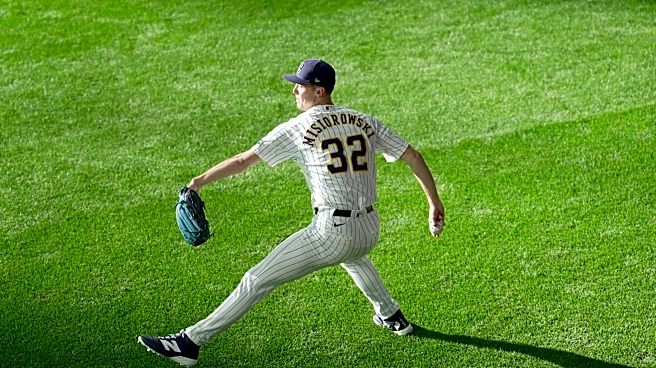








I’m not breaking news by telling you that Jacob Misiorowski is having a good season. He has made 14 starts (a little less than half of a full season), and here are his numbers, with bolds indicating he leads the NL and bold plus italic indicating he leads the majors:
- 8-2, 1.34 ERA, 307 ERA+, 1.68 FIP, 0.736 WHIP, 4.3 H/9, 0.4 HR/9, 131 K, 13.6 K/9, 5.95 K/BB
I want to look a bit deeper into those numbers, and contextualize them within the long history of baseball.
ERA and ERA+
18 qualified starters (meaning they threw at least one inning per team game) have finished a season with an ERA better than 1.34
in AL/NL history. 16 of those happened in the era we know as “Deadball,” between 1900 and 1919. Of the remaining two, one was in 1880 and shouldn’t count: Tim Keefe of the Troy Trojans technically qualified for the ERA title with just 105 innings pitched, in which he had a 0.86 ERA… but Keefe’s teammate, Mickey Welch, threw 574 innings that season, so you understand why I don’t think 105 innings should count as “qualifying.” Both Keefe and Welch are in the Hall of Fame, by the way.
The one pitcher remaining is, as you know if you’re at all a baseball history buff, Bob Gibson in 1968, when he had a 1.12 ERA.
Of course, Gibson’s 1.12 ERA in 1968 was not the same as a 1.12 (or 1.34) ERA in 2026. Let’s take the same parameters—qualified AL/NL pitchers—and sort by ERA+, which includes adjustments for league-wide offense of the era and the ballpark. When we do that, most of the Deadball guys drop out—the top 19, instead of including 16 Deadballers, includes only four.
Gibson is still on the list, at number 10. Keefe is there too, but we discussed him. Guess who jumps to number one in this set? Yes, that would be Misiorowski in 2026. His 307 ERA+ would be the best by any qualified starting pitcher… ever.
The season that should be considered the all-time record for ERA+ by a starter is one that many of you witnessed: Pedro Martínez in 2000. Martínez had a 1.74 ERA in 2000, which ranks “just” 104th all time. But since offense was so jacked up during the Steroid Era, Martínez comes in with a 291 ERA+, the highest single-season mark ever for a qualified pitcher who threw more than 105 innings.
Also near the top is another incredible Steroid-Era accomplishment. Greg Maddux doesn’t just hold the number seven spot on this list, but he holds the number eight spot, too—in back-to-back years. Maddux had a 271 ERA+ in 202 innings in 1994 and a 260 ERA+ in 209 innings in 1995.
Misiorowski, right now, has a better ERA+ than all of them.
FIP and FIP-
Misiorowski’s 1.68 FIP would rank 15th all time, but again let’s get rid of those pesky Deadball pitchers. Do that, and only two pitchers rank ahead of where Misiorowski is right now: Martínez, again, but this time in 1999, and one you’ll enjoy: Corbin Burnes, with a 1.63 FIP in his Cy Young campaign in 2021.
FIP- is FanGraphs’ answer to ERA+ but for FIP and in reverse (lower is better). I’m going to filter out the 1800s because things are weird there, so the record for FIP- after 1900 belongs to Martínez in 1999 at 30. Next is Burnes in 2021 at 38. Third would be Misiorowski, whose FIP- this season is 40.
WHIP, H/9, and HR/9
Misiorowski’s 0.736 WHIP would be the best ever for a qualified starter, a fraction ahead of Martínez in 2000 (0.737). The next-lowest in a post-Deadball, non-2020 season is Justin Verlander at 0.803 in 2019.
Likewise, Misiorowski’s 4.3 hits allowed per nine innings would be a record by far. The lowest total in a non-2020 season is Nolan Ryan’s mark of 5.3 in 1972, which is percentage points ahead of Luis Tiant in 1968, Martínez in 2000, Ed Reulbach in 1906, and… Ryan in 1991. (That Ryan has two of the top five, 19 years apart, is wild.)
For homers allowed per nine, it is important to note that we live in a high-home-run era, so this isn’t approaching any history. But to give a little more context, Misiorowski’s mark of 0.4/9 would be beaten only by Burnes in 2021 and Sonny Gray in 2023 among seasons since 2020.
Strikeouts
Misiorowski probably isn’t going to threaten any strikeout records—Ryan can feel safe that his 383 strikeouts in 1973 will continue to stand as the post-1900 record. (A quick shout to Old Hoss Radbourn and his 441 strikeouts in 1884, the AL/NL record. Of course, he did that in 678 2/3 innings, so his 5.8 K/9 that season are slightly worse than what Jose Quintana had as a Brewer in 2025.)
However, Misiorowski has an outside chance at becoming the first pitcher since Gerrit Cole in 2019 to strike out 300 batters, something that’s happened only nine times this century (Verlander in 2019, Max Scherzer in 2018, Clayton Kershaw in 2015, Chris Sale in 2017, Curt Schilling in 2002, Cole in 2019, and Randy Johnson each year from 2000-02).
But those guys all threw way more innings than Misiorowski will throw this year. Cole’s 212 1/3 innings pitched in ’19 are the least ever for a player who struck out 300 batters. If we sort by strikeouts per nine, Cole jumps to the top (again ignoring 2020) at 13.8 per nine innings, a remarkable number. After Cole, it’s another pitcher this season, Dylan Cease, who is tied with (technically slightly ahead of) Misiorowski at 13.6. Only three other qualified starters have ever finished a season with 13 or more strikeouts per nine: Martínez in 1999, Johnson in 2001, and Spencer Strider in 2023.
Since Misiorowski is merely “good” rather than “historic” at preventing walks, his 5.95 strikeout-to-walk ratio will have to live with being merely excellent; that would rank 80th all time among qualified starters.
But those are whole seasons. What about 14-game spans?
It would be fair to point out that Misiorowski is unlikely to keep this pace all season. So how good, really, are these 14 games, if they’re only 14 games?
There are 42 instances in baseball history of a player striking out 131 batters with an ERA of 1.34 or lower over 14 starts, but many of those are tied up in the same streak; for example, when sorted by strikeouts, eight of the top nine on this list of 42 14-game stretches are all between August 3rd, 1999 and May 17th, 2000 by Martínez, all within the same span.
There are essentially 11 different pitching runs that can match up with Misiorowski’s:
- Jacob deGrom in 19 starts from 9/16/2020 to 8/8/2022 (this wraps around a season-ending injury in 2021)
- Martínez in 23 starts from 8/3/99 to 6/8/2000
- Martínez again, partially overlapping the other: 14 starts from 4/30/2000 to 7/28/2000
- Kershaw in 19 starts from 6/6/2015 to 9/19/2015
- Kershaw again in 14 starts from 6/18/2014 to 9/2/2014
- J.R. Richard in 20 starts from 7/25/1979 to 4/30/1980
- Dwight Gooden in 16 starts from 8/11/1984 to 5/10/1985 (the end of his rookie season into his sophomore season)
- Ryan in 15 starts from 8/18/1972 to 4/18/1973
- Bob Gibson in two overlapping 14-game stretches from 7/21/1968 to 9/22/1968 and 8/9/1968 to 4/19/69
- Finally, Rube Waddell in 14 starts from 7/9/1904 to 8/29/1904
A lot of these occur over more than one season, which could allow pitchers to benefit from pitching to batters from non-contending teams who’ve checked out down the stretch.
With that in mind, I want to talk about the season that reminds me most of Misiorowski’s 2026 season thus far, and it is the year in which I have been in the most awe during my fandom: deGrom’s 2021 season.
deGrom didn’t finish 2021 healthy, and I’m going to knock on all the wood right now to ensure that part of his 2021 season does not align with Misiorowski’s 2026. When 2021 started, deGrom was considered the most dominant pitcher in the majors; over the previous two seasons, he’d collected 58 of 60 first-place NL Cy Young votes, and his 2018 season in particular was one of the best of this century. He was third in Cy Young voting in the shortened 2020 season, but he struck out 13.8 batters per nine innings that year, which matches Cole’s record for strikeouts per nine in a full season.
But in 2021, deGrom hit a different level. In 15 starts and 92 innings, he had a 1.08 ERA, which translated to an unbelievable 373 ERA+. He struck out 146 batters, or 14.3 per nine innings. Almost more remarkably, he walked only 11 batters. His 13.27 K/BB wouldn’t just be a record—it would blow away the previous record. Under modern walk rules, no starting pitcher has finished with more than 11.63 K/BB in a season.* Heck, only seven relievers have ever finished a season with a K/BB ratio that high.**
*This is a great trivia question: the record holder for K/BB by a starter is…Phil Hughes, pitching for the Twins in 2014.
**One other all-timer actually bettered deGrom’s 13.27 K/BB in another injury-shortened season: Kershaw, in 149 innings in 2016, had 172 strikeouts to 11 walks.
deGrom had a 1.08 ERA, 1.24 FIP, 0.554 WHIP, and a microscopic 3.9 hits allowed per nine innings in those 15 games in 2021. I’d never seen anything like it. He was essentially pitching like the league’s best high-leverage reliever, except he was a starting pitcher. Unfortunately, that took a physical toll, and he managed only 20 starts over the next three years.
I don’t mean to be speculating on Misiorowski’s future health at all, so don’t read into that. The point is, deGrom’s 15-start 2021 season is the closest comparison that I can come up with for what Misiorowski has done in these 14 games, and when deGrom was pitching in 2021, I thought I was watching the most dominant starting pitcher in the history of the game.
What does it all mean?
We have no idea what the future holds for Misiorowski. Maybe he’ll pitch 20 years. Maybe he’ll get hurt. We have no idea.
But right now—not next year, not three years from now, but right now—Misiorowski is pitching like one of the best pitchers ever. And 14 games is a long time; I brought up those nine different pitchers who have had 14-game runs as good as Misiorowski for a reason. Martínez, Ryan, Waddell, and Gibson are in the Hall of Fame. Kershaw will be a near-unanimous selection. deGrom could yet make it, even if his status as a late bloomer and injury issues will make it a complicated case from an innings-pitched perspective. Only Gooden and Richard aren’t major Hall candidates, but there are extenuating circumstances in both cases. Richard’s career was cut short by a stroke suffered during his prime, mere weeks after his aforementioned streak ended. Gooden was considered one of the most talented players ever, but his career was derailed by substance abuse problems. (I could still make a Hall of Fame case, too.)
Misiorowski is a Hall-of-Fame talent. He is pitching at a Hall-of-Fame level, and the only players in the history of the game who’ve been as effective as him over a span this long are all either Hall of Famers or guys who make people say “you should’ve seen ______.”
We have no way of knowing how long this will last, but right now, we are not living in a hypothetical world where Jacob Misiorowski could pitch like Randy Johnson someday. Right now, the only difference between Miz and Johnson is that Johnson pitched for 20 years.
No matter how long it lasts, we should all revel in this, because someday we will say: “you should’ve seen Miz.”