






The Commissioner’s Cup results in some weird scheduling quirks for WNBA teams.
Because Cup play features a concentrated stretch of in-conference matchups, its conclusion brings the opposite, with the schedule immediately populated with inter-conference contests. Presumably to reduce travel demands, the WNBA favors back-to-back sets between Eastern and Western Conference teams.
This week’s schedule has been stuffed with two-game sets between out-of-conference opponents, with some producing fun back-and-forth
contests and others demonstrating the discontent that can come with too much immediate familiarity between opponents.
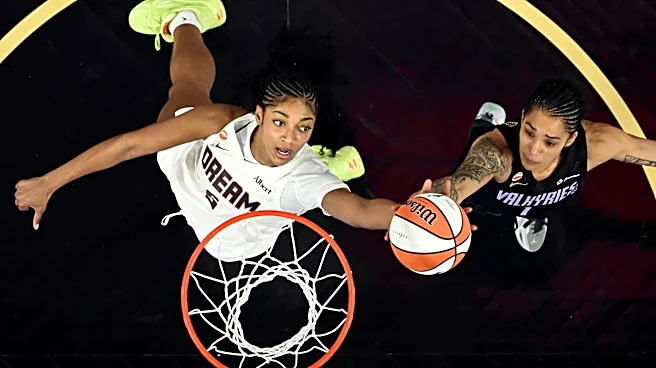
Let’s hope Friday night’s double dips trend toward the former when the Portland Fire meet the Chicago Sky for the second-straight, and third and final time ,this season (7:30 p.m. ET, ION) and the Atlanta Dream extend their visit with the Golden State Valkyries to a second-straight game (10 p.m. ET, ION).
So, can the Fire and Dream get revenge, or will the Sky and Valkyries take two in a row?
Here’s how I assess what it will take from Atlanta and Portland to prevail in the rematches. Please share your prognostications in the comments.
Will the Fire light it up or get lit up in the Windy City?

As Beckett Harrison emphasized, single-game wins aren’t the priority in Portland. The Fire are about building a sustainable culture, and they’ll be more than fine if it that approach results in a top pick in the 2027 WNBA Draft.
However, it can be challenging to build sustainable success without any success.
Even if wins, including a revenge win over the Sky, aren’t of the utmost importance for Portland, victories are validating for the franchise, keeping players invested in the innovative systems and strategies being installed by head coach Alex Sarama.
And if Portland aspires to be the ultimate culture team, they should hope to avoid a season sweep at the hands of a team with one of the shakiest cultures in the W.
That mission begins on the defensive end, something Eric Nemchock recently analyzed. Defensive slippage is at the root of the Fire’s recent downturn. Yet, as Eric highlighted, personnel makes addressing Portland’s defensive issues difficult. Their lack of size, in particular, has resulted in struggles ending possessions with defensive boards. The undersized Fire also are foul prone.
On Wednesday, Chicago secured 12 offensive boards which helped them earned 22 second-chance points. The Sky also went to the line 29 times, making 23 free throws.
So, maybe the Fire should just try to outscore the Sky, even though Chicago has been better defensively than offensively for much of the season?
That Portland shot 40 percent from 3 on Wednesday and still lost by 27 points is not encouraging. The Fire themselves also earned 20 trips to the line, their sixth-most this season.
It feels like that elusive expansion team magic that the Fire enjoyed earlier in the season—where Bridget Carleton is bombing 3s, Carla Leite is bebopping to the basket, Sarah Ashlee Barker is coming through in the clutch and Emily Englster is everywhere on defense—is Portland’s best path to a win.
Can they light that Fire in the Windy City? Or will Chicago, expected to welcome back Courtney Vandersloot for her 2026 season debut, win two games in a row for the first time since the first two games of the season?
Is the 3-ball the key to the Dream getting a win in the Bay?

When the Valkyries played the Las Vegas Aces last Saturday, they made just five of their 30 3-point attempts, good for under 17 percent. Against the Dream on Tuesday, the Valkyries were 15-for-32, or almost 47 percent, from downtown.
The Dream, in contrast, were 4-for-18, or 22.2 percent, from 3 on Wednesday.
Although 3-point variance might be a too simplistic explanation for Golden State’s victory on Wednesday, it’s not necessarily the wrong explanation. And if the 3-point luck reserves, the Dream might cruise to a revenge win.
The Dream weren’t just off from deep. Overall, they shot less than 40 percent from the field, and they missed 10 free throws.
After the game, Dream head coach Karl Smesko was asked about how his team would prepare for Friday’s rematch. He expressed a commitment to the team’s process.
If Atlanta spaces the floor, moves the ball and doesn’t force things, the offense, which had ticked up to league-leading levels during their four-straight wins that preceded Wednesday’s loss, should return to form.
But, more important than favorable variance or superior execution is available personnel, and that’s a slight question for Atlanta. Allisha Gray exited Wednesday’s game early and did not return, suffering an upper-body injury as she attempted to get around a screen. She is not listed on Atlanta’s initial injury report.
If Gray, a 3-point bomber and relentless driver who is the Dream’s leading scorer, as well as a top-10 scorer in the league, can’t go, the ability of the Atlanta offense to recover enough for the revenge win becomes a shakier proposition.
If that’s the case, and if the Valkyries again prioritize neutralizing Angel Reese, something Valkyries head coach Natalie Nakase indicated about her team’s approach before Wednesday’s game, that puts the onus on Rhyne Howard to play to her superstar potential.
As Zack Ward wrote earlier this week, that’s something Rhyne’s been doing this season.
Or, it’s something she’s been doing in Atlanta. All Howard’s numbers are lower away from the ATL. That her 3-point percentage has dipped to below 30 percent on the road, in contrast to a scalding 45.3 percent at home, has prevented her from turning in superstar-esque away games, as it is Howard’s high-volume and versatile 3-point shooting that unlocks the most dangerous offensive version of herself.
So again, we’re back at 3-point shooting as the simple, yet essential, key to this matchup.
Will a wave of 3-pointers again churn up in San Francisco Bay and, this time around, crest through the Dream? Or, will the home team again be the beneficiaries of favorable shooting splits?