




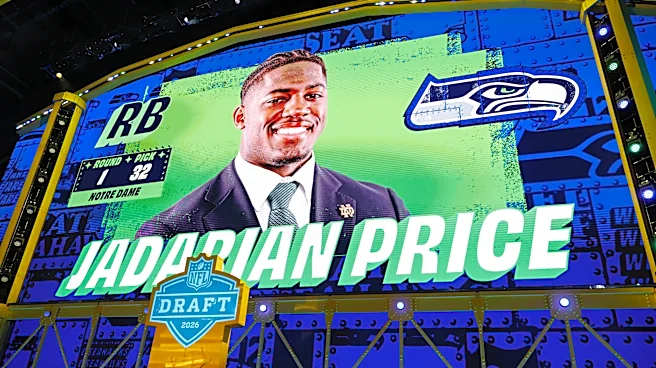
The selection of Jadarian Price at No. 32 in the 2026 NFL Draft raised eyebrows for more than one reason. It wasn’t just about the player profile — it was the context. The Seattle Seahawks were coming off a championship run with limited draft capital, yet still chose to invest in a running back, a position that continues to divide opinion in today’s NFL.
A first-round pick is always the defining piece of any draft class. In recent years, Seattle has been among the league’s most efficient drafting
teams (2022–2025), consistently landing immediate impact players. Price doesn’t arrive with that same level of “plug-and-play certainty,” but it’s important to frame this correctly: this is the 32nd pick, not a top-10 investment. That nuance matters.
Let’s break down the process, the tape, and what it all means.
Draft value vs. Draft reality
Even if you loved Price as a prospect, it’s hard to argue he was a consensus top-32 player. Across most big boards, his range landed somewhere between 45–55, with some evaluators even lower due to concerns we’ll address later.
Still, Seattle did its homework.
They brought in multiple running backs for visits — including Jonah Coleman, Mike Washington, and Emmett Johnson — all widely considered among the top backs in the class alongside Jeremiyah Love. The conclusion internally seemed clear: either none of them projected as a true RB1, or there was a meaningful gap between Price and the rest.
Here’s where things can be a little complicated…
Price may not have been “worth” No. 32 — but he also likely wouldn’t have been available at No. 64. With only four total picks, Seattle didn’t have the flexibility to trade up from the second round. That essentially forced a binary decision: take Price early or pivot to a tier of players they didn’t fully trust.
After Day 2, GM John Schneider publicly thanked the Pittsburgh Steelers for honoring a trade agreement, hinting at how chaotic the end of Round 1 became. Reports suggested a potential trade-down with the New York Giants or Tennessee Titans fell apart late. In another timeline, Seattle moves back, still lands Price, and this conversation looks very different.
As reported, their preferred target was Chris Johnson (selected at No. 27). Once that option — and the trade-down — disappeared, Price became the pick.
Background: Who is Jadarian Price?
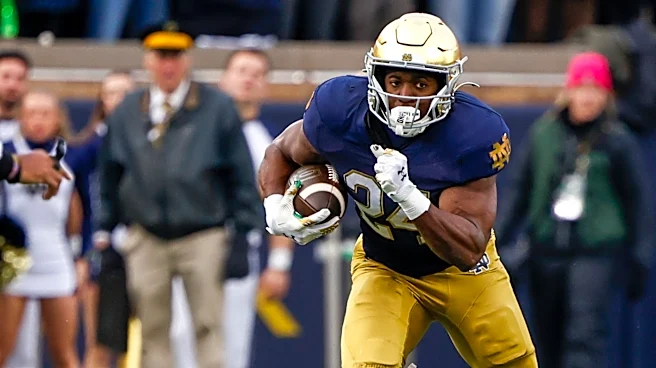
Price, a Texas native, was raised by a single mother who overcame breast cancer — a detail that speaks to his resilience and upbringing. A four-star recruit, he committed to Notre Dame Fighting Irish football and stayed loyal even after Brian Kelly left the program.
His college career got off to a brutal start: after standing out in spring practices, he tore his Achilles before the 2022 season. He missed the entire year. Despite transfer offers during recovery, Price stayed at Notre Dame and carved out a rotational role behind Jeremiyah Love. He never became the full-time starter, but efficiency was his calling card — averaging 6.2 yards per carry in 2025 and flashing explosive ability as a kickoff returner, including multiple long touchdowns.
Fit in Seattle’s Offense
Price is a natural fit in a wide/outside zone structure, which is expected to be the foundation of Seattle’s run game. He’s not the same stylistic runner as Kenneth Walker III, and trying to force that comparison misses the evaluation. What Price brings instead is burst and edge acceleration — traits that allow him to stress defenses horizontally before turning runs vertical.
On this rep, the left side of the offensive line collapses almost immediately, forcing the back to win to the perimeter. This is the type of situation where Zach Charbonnet can struggle — he needs cleaner blocking angles to consistently attack the edge. Price, by contrast, shows the urgency: he presses the landmark, recognizes the breakdown, and accelerates outside fast enough to beat the force defender to the corner.
That burst shows up again on a separate play where the crease isn’t initially obvious. Price stays patient through the mesh point, but the moment the gap flashes open, he hits it instantly. His acceleration over the first two steps is what creates the play — linebackers are still reading when he’s already through the line.
His 4.49 forty doesn’t suggest elite long speed, and the tape mostly confirms that, but it also shows why it doesn’t matter as much. Price consistently manipulates pursuit angles because of his vision and processing. Defenders take false steps or misjudge leverage, which allows him to generate explosive gains without needing true breakaway speed.
You see this most clearly in how he wins at the first and second levels. Price’s burst allows him to clear traffic quickly and get into space, where he can stack yardage in that 10–20 yard window. That’s an area where he could complement — and at times replicate — the impact of Kenneth Walker III. Once the play extends beyond that into the open field, however, the difference in top-end speed becomes more apparent.
Even without being a power runner, Price consistently finishes runs falling forward. On contact, he maintains balance through arm tackles and glancing hits, squeezing out hidden yardage. He’s not going to run through defenders, but he rarely gives them clean shots to end the play early.
This rep highlights what might be his best trait: vision. Notre Dame calls Midzone to the right side, and Price initially tracks the play as if he’ll bounce it outside — which aligns with both the design and his tendencies. But as the play develops, he identifies a better crease forming between the offensive tackle and tight end. He subtly redirects, presses that gap, and times his entry to maximize the leverage of his blockers. It’s not improvisational in a flashy sense; it’s disciplined, efficient decision-making.
Processing speed shows up again on a crack toss concept. The design is blown up almost immediately by a corner blitz from CB Julian Neal (Seahawks third round pick), which eliminates the intended running lane. Instead of committing to a dead play, Price recalibrates on the fly — he plants, redirects inside, and salvages positive yardage. That ability to adjust post-snap is what separates functional vision from high-level processing.
As a returner, the production jumps off the stat sheet — three touchdowns and a 36.1-yard average across 22 kickoff returns (794 yards total). It’s a small sample size, so projecting that role to the NFL comes with caution, but the traits translate. Even if he doesn’t handle primary return duties, it reinforces the same themes seen on offense: vision, acceleration, and the ability to exploit space quickly.
Areas of concern
This is where the evaluation gets complicated.
Price is an outlier historically: no running back drafted in Rounds 1 or 2 has ever failed to reach 125 touches in a single college season. Across three healthy years, he logged just 295 offensive touches — an extremely low workload. He never had a game with more than 15 carries.
Ball security is a legitimate concern. Despite limited usage, he recorded four fumbles — the third-worst rate in the class — including three in the red zone.
Pass protection is another issue. He graded near the bottom of the class, largely due to inexperience and limited reps.
The willingness is there, and physically he can improve, but the tape shows inconsistency in recognition and anchor.
As a receiver, his profile is underdeveloped. He saw targets on just 9.9% of his routes — one of the lowest rates among draft-eligible backs — finishing his career with only 15 receptions on 18 targets.
Most of his usage came on screens and flat routes. The lack of volume makes it difficult to project his ceiling in more complex passing concepts/routes.
Technically, he still needs refinement — he tends to body-catch at times — but once the ball is in his hands, his returner instincts take over and he becomes dangerous in space.
Final Thoughts
Price forced missed tackles on 26.9% of his attempts — the best rate in the class. He averaged 6.0 yards per carry across three seasons and added elite kickoff return production. The efficiency is undeniable.
The question is scale.
Can he maintain anything close to that level with a full NFL workload?
This marks the first time since Rashaad Penny that Seattle has invested this heavily at running back. Unlike Penny, however, Price arrives without a history of lead-back usage or high-volume games. That makes this one of the more unique RB evaluations in recent draft history.
Every draft pick carries risk, but Price’s lack of experience amplifies it. Especially if the expectation is for him to quickly develop into RB1 drafted in the first round.
The talent is real. The explosiveness, vision, and processing all can be translated to the NFL.
But make no mistake: this is a bet.
A bet on projection over production.
A bet on traits over résumé.
And a bet that Seattle can unlock something we’ve only seen in flashes.