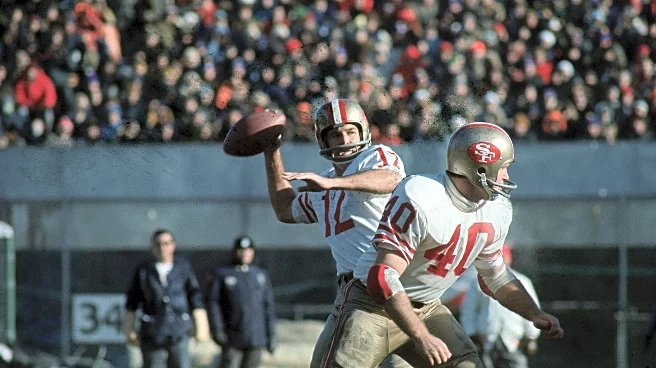




Legendary 49ers QB, Bay Area native John Brodie dies at 90, team announces
“Brodie played his entire 17-year NFL career with the 49ers after being the No. 3 overall pick in the 1957 NFL Draft out of Stanford.
He played in 201 games with the 49ers, second-most in franchise history behind only Jerry Rice. Brodie ranks No. 2 in all-time franchise passing yards (31,548) behind only Joe Montana (35,124).
Brodie (214), Montana (244) and Steve Young (221) are the only quarterbacks in 49ers history with 200
or more passing touchdowns.
He was known for having a strong throwing arm but also great touch on his passes to connect on throws at every level, including intermediate passes that had to be layered over a linebacker and in front of a safety.
The 49ers retired Brodie’s No. 12 in 1973 after leading the NFL in touchdown passes three times in his career. He was a two-time Pro Bowl player and led the 49ers to consecutive playoff appearances in 1970, ’71 and ’72…..The late Bill Walsh said Brodie would often stop by the Stanford football offices when Walsh was head coach there before he became coach of the 49ers in 1979.
“He would take time to sit and talk football with me,” Walsh said of Brodie. “I learned a lot of the mechanics, the footwork and techniques of the quarterback position from John.
“Later, we were able to transfer those to many other quarterbacks. But I didn’t have a clue about the position until I talked to John over a period of time.”
After his football was over, Brodie earned a spot in the Senior PGA Tour and recorded 12 top-10 finishes with one victory in 14 years.“
Former 49ers QB John Brodie, second-leading passer in team history, dies at 90 (paywall)
“Much like illustrious predecessors Frankie Albert and Y.A. Tittle, Brodie couldn’t find a way to win a championship. And because of his propensity to throw interceptions, he may have been the most maligned quarterback in 49ers history.
He averaged 17½ interceptions during one eight-year stretch from 1964 through ’71 (and finished with a franchise-record 224 for his career), which didn’t sit well with rowdy fans at Kezar Stadium. They repeatedly booed him, and sometimes worse.
Brodie had to wear his helmet after games, as he ducked into the tunnel that led from the field to the Kezar locker rooms, because of the bottles and other objects spectators tossed at him.
“If we lost, you knew not to walk off the field with Brodie,” teammate Dave Wilcox once said. “One year, one of the officials was walking off the field with John, and someone threw a bottle. It missed John, but it hit the official and knocked him out. So they built a barrier.’’
The protective screen didn’t stop the beer, but it did keep out the cans and bottles. Brodie persevered, enduring a stint as one of three quarterbacks (Bill Kilmer and Bobby Waters were the others) in Red Hickey’s then-revolutionary “shotgun” attack in the early 1960s.
Brodie went on to build Hall of Fame-type statistics even though he wasn’t recognized in Canton, Ohio, a point of contention over the years. He ranked third in NFL history in career passing yards when he retired, behind only Hall of Famers Johnny Unitas and Fran Tarkenton.“
Barrows: 49ers mailbag: Which assistants could Robert Saleh take with him to Tennessee? (paywall)
“I know Upton Stout had a good rookie year, but it feels like the team has struggled to get value out of third- and fourth-round picks. Why is that? — Efrim D.
The third round has always intrigued me because it feels like there are more misses there — Danny Gray, Cameron Latu, Ty Davis-Price … it’s a loooong freakin’ list — than other rounds. I think it has to do with expectations. In Round 3, teams are still swinging for the fences. They’re still looking for contributors and eventual starters, and they persuade themselves that a prospect’s traits and measurables — through coaching and time — will make them starter-caliber players. That is, they allow their projection (because he’s got great speed like Gray or is powerful like Latu) to override the player’s actual ability.
By the fifth round, all the elite-trait guys are gone, and the picks are more production-based. You’re not expected to find a starter in the fifth or sixth round, so you forgive a bad 40-yard dash time (Talanoa Hufanga) or lack of ideal size (Dre Greenlaw) or height (Deommodore Lenoir) and base it on what you see on tape. Instead of taking mighty swings, you start hitting singles.
That said, maybe the 49ers have started to pick up on this. Stout, after all, doesn’t have great measurables — he’s the shortest guy on the team — but was consistent and productive in college.“
For some 49ers, EMF injuries theory no joke: ‘I might pull up with a meter one day’ (paywall)
“Center Jake Brendel acknowledged at least one of his teammates is convinced EMF waves have played a role in the 49ers’ injuries.
“There’s no reason to deny the fact that someone on the team thinks the substation probably is doing something to you,” Brendel said. “And, I mean, there is a reason why people don’t usually live by those. It might just be because they’re unsightly and they make noise. Or it might be other reasons.”
Linebacker Luke Gifford added: “To me, it would make more sense if it was exposure over a long period of time. So, who knows?”
Brendel and Gifford are among those in the who-knows camp. That group also includes wide receiver Trent Taylor, 31, who spent last season on injured reserve with a career-threatening back injury. Taylor is aware EMF waves, at high intensities, can create health risks. But what about far lower levels of exposure?
“All I know is that there’s truth to the science that’s presented,” Taylor said. “The question is: Is it actually strong enough to where we’re feeling it, on the practice field or in the weight room, to where it really has an effect?”
What if the effect is nearly negligible? Even that could make it an issue in a unique work environment where health is of paramount importance when it comes to securing a next contract.
Kittle and fullback Kyle Juszczyk travel to Panama twice each offseason to get stem-cell treatments. Running back Christian McCaffrey uses an altitude training chamber known as the “Stratosphere” as part of his rigorous training routine. In July, McCaffrey sounded like a scientist as he discussed “hypoxic training,” “SpO2 numbers” and a “stem-cell flush.”
“There’s so many different things,” McCaffrey said. “We just try to take every little ounce. If you can find an advantage or an edge, we’ll do it.”
On Monday, about five months after McCaffrey detailed his body-maintenance program, Brendel explained why a theory many are quick to dismiss isn’t so easily waved off in an NFL locker room.
“Let’s say it affects you 1%, or even a fraction of a percent?” Brendel said. “When it comes to professional athletes, we’re always trying to optimize everything about our lives.”
49ers RB Christian McCaffrey wins PFWA’s Comeback Player of the Year award
“San Francisco running back Christian McCaffrey, who led the NFL in receiving yards by a running back and had the second-most yards from scrimmage in the league in 2025 after missing 13 games of 2024 with several injuries, is the 2025 NFL Comeback Player of the Year, chosen in voting by the Professional Football Writers of America (PFWA).”
The point-guard mentality didn’t just make Sam Darnold better. It’s a useful mental trick (paywall)
“Listed at a generous 6 feet 1 and athletically nondescript, Purdy was perpetually overlooked and consistently successful, and at some point during the 2023 season, he shared a piece of advice that lodged itself in Darnold’s brain.
One secret to playing quarterback in the NFL was to think like a point guard, to put the ball in the hands of your playmakers and set up others to have success.
“Like, my job is just to play point and get the ball in their hands and let them go do great things with the rock,” Darnold told reporters in March, relaying the message. “When I changed my thought process as a quarterback to kind of just getting the ball in my guys’ hands, that’s really where it unlocked for me.”
It might sound like Purdy was arguing for a change in style. But rather he was outlining a shift in mindset, a mental trick to simplify the position, an idea that can be expanded beyond the sports realm — the power of the point-guard mentality.“