



It was a scenario right out of a teaching tape.
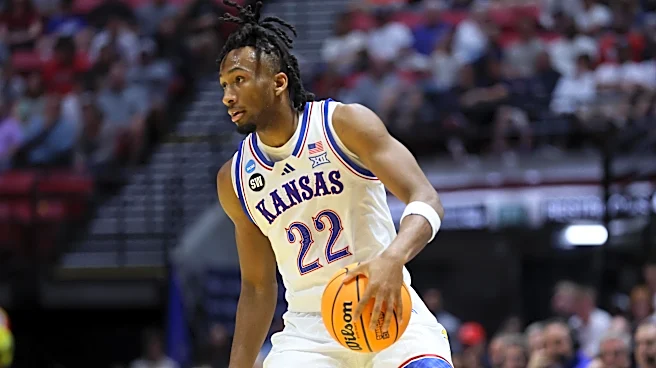
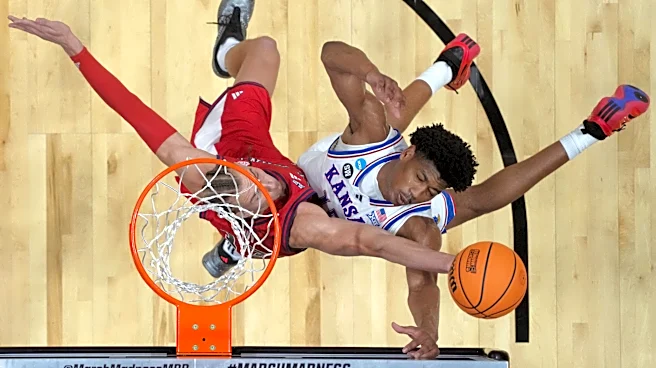
During the first possession of the second half against Princeton, Kansas freshman Bryson Tiller set a clean screen for Tre White at the top of the arc. To keep White from turning the corner, forward Malik Abdullahi played at the level. Almost instantly, Tiller slipped toward the rim, forcing guard Jackson Hicke into a switch.
Once White lofted a pass, it was easy to assume what would unfold: Tiller assaulting the rim while Hicke, who gave up six inches
and 40 pounds, futilely tried to slow the big man down. That’s not what happened. Instead, Tiller jump-stopped, pivoted, and lofted a gentle fadeaway jumper from the mid-post—and watched it kick off the heel of the rim.
And while it’s always risky to use a dozen seconds to encapsulate a player, the sequence underscores an obvious point: When we watch a point guard slice up a defense in the pick-and-roll, it’s easy to forget that they can’t do it alone. It doesn’t matter if a lead guard reads the coverage perfectly and drops a beautiful pass right on time and on target. If the guy catching it can’t finish the job, the play is dead.
Now’s the right time for a reminder given the impending arrival of Jason Crowe Jr. — and a prime example of trying to translate how raw talent might manifest when the ball is tipped.
We can spend ample time dissecting how his creative prowess might translate as a pick-and-roll passer, but he’s also at the mercy of the supporting cast Missouri coach Dennis Gates assembled. Because MU had a bustling spring in the portal, there’s the temptation to assume additions like Tiller and Jaylen Carey will plug in to juice a potent attack.
But a closer look raises reasonable questions about how seamlessly they might sync with Crowe. Dissecting film and data underscores one early but important observation: there’s room for improvement.
Visualizing their performance makes the point emphatically.
Parsing the data itself reveals that the Tigers added two frontcourt players who rank among the bottom 20th percentile for efficiency among high-major big men. In fact, there’s a compelling argument that Carey was the worst roll man among power conference programs last winter.
It’s not like we can trace those poor metrics back to spotty on-ball creation. Tiller and Carey each played alongside competent lead guards. And while point guards like Tennessee’s Ja’Kobi Gillespie and KU’s Melvin Council Jr. struggled to score out of ball screens, play-type data makes it clear that their efficiency as passers landed around the median for high-major players.
As you can plainly see, Gillespie and Tiller’s passing volume was pretty robust. So, while we might not confuse them with Braden Smith, Donovan Dent, Jeremy Fears Jr., Keaton Wagler or Kingston Flemings, they proved effective enough at keeping their teams on the road.
In Carey’s case, there’s a reasonable argument to be had about how much sway the Volunteers’ offensive approach had over his performance. The Vols ranked 63rd nationally in their usage of rollers last season, but the value of those touches only checked in at 270th in Division I. Instead, UT relied more on traditional post-ups, and it was more successful on a per-possession basis when playing through the low blocks.
Any thorough vetting ($) of Carey makes it clear he embodied that approach on Rocky Top.
The brawny forward’s game clustered around three tasks: early post-ups, dump-offs in the dunker spot and crashing the glass. He was not spacing the floor. He did not attack off the bounce. And even on post-ups, the Vols didn’t rely on him as a hub.

Optimizing Carey also meant using a specific formula. For example, Carey averaged 1.46 points per possession when he could duck into the lane. Sometimes, those touches arose from structured high-low looks. More often, though, they were the byproduct of Carey ducking in as the ball reversed around the perimeter, pushing his defender up the lane and creating a large passing window.
Yet post touches that unfolded deeper in a possession produced markedly different results. Carey was just 24 of 65 from the floor when posting up on the right or left block. If his first power dribble didn’t dislodge a defender, an opposing big would re-anchor and trust the principle of verticality. And as SEC play rolled along, opponents wised up and started sending late help to disrupt Carey after he put the ball on the floor.
It also puts his struggles as a roller into more context.
When Carey set ball screens, foes defaulted to drop coverage, hemming Gillespie in. To the guard’s credit, he excelled at creating separation – opening a narrow window – and threading early pocket passes. That’s absolutely the right read. However, any success hinged on Carey catching, using at least one dribble and finishing at the cup.
The film shows how that presented several issues. While Carey’s footwork is nimble for his size, he’s not the swiftest guy on the floor. Notice how Carey, especially in side ball screens, has not slipped behind his defender. That makes his rolls into a de facto straight-line drive against a fellow big who simply needs to stay attached to Carey’s hip and wall up.
Because Carey played the four alongside Felix Okpara, it also meant that Carey might not pull a rim protector out of the lane. That posed an issue on some rolls into the middle gap, because even if Carey shed his man, there was still another big lingering at the restricted area to provide rim protection.
That low help also proved problematic when Tennessee had Carey screen in the middle of the floor. Even with a clean catch and some runway, Carey’s vertical pop doesn’t give him adequate altitude to overcome a back-line anchor (again) trusting their length.
Theoretically, Gillespie pushing the ball deeper on drives might help, because Carey’s rolls might take him into the paint. But even in those instances, a defense might be content, because Carey was slightly prone to attempting floaters or mid-range jumpers rather than initiate a confrontation at the rim. Those were looks they’d willingly concede.
What’s also interesting are the tactics you don’t see.
One way to overcome drop coverage is have your big set a Gortat screen, essentially using the big man as a lead blocker in the lane before sealing off their defender. That carves out a path for a smaller driver like Gillespie and presents a chance to drop the ball off to Carey in an easier finishing spot. Or there’s the possibility to roll a big into a post-up for a high-low entry. That’s a touch Carey loves – and it also taps into his prowess as an interior passer to feed another big like Okpara.
Put it all together, though, and Carey’s presence rarely punished help or warped a defensive shell. If weak-side defenders know they don’t need to tag him, they aren’t helping off shooters. And as we’ve seen, a stationary low man wipes out drop-offs and deters cutters. In other words, it potentially winnows the list of easy passing reads for a young lead guard like Crowe.
In Knoxville, coach Rick Barnes never entirely abandoned Carey as a rotational piece, but he routinely talked about how the Vols needed more consistency from him. To a certain extent, though, the scout for Carey became straightforward: Sprint back and prevent early post-ups. Otherwise, stay in front and make him finish over length. Do that, and the use case for the hulking big gets slimmer.
Carey’s struggles, however, make some sense given his physical profile. It’s also what throws Tiller’s woes into sharp relief.

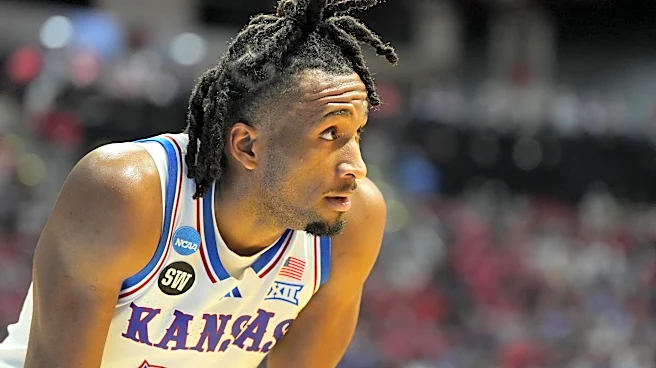
Unlike Carey, the KU transfer looks the part of a modern forward with a positional size, a nearly plus-5-inch wing span, fluidity in space and plenty of bounce to overwhelm defenders at the rim. Yet the data makes it plain that the former five-star talent, who reclassified and took a redshirt season, has ample room to improve after his debut campaign in Lawrence.
It’s also not an entirely new issue.
Throughout Tiller’s prep and grassroots career, evaluations noted a disconnect between his obvious physical tools and production. Scouts repeatedly pointed out that Tiller didn’t display the kind of aggression expected when attacking downhill or apply the kind of force required to play through contact.
Instead, Tiller had a habit of drifting toward the mid-post, where he was comfortable catching, facing, and tapping into touch to score over defenders. Now, that latent inside-out versatility is one reason he was tantalizing to KU coach Bill Self and now a staff in Columbia. However, it leaves Tiller prone to settling rather than imposing his will.
Those same themes resurfaced last season – and Self didn’t mince words pointing them out.
His best work came when the approach remained simple: clean up misses, finish dump-offs and forge a big-to-big partnership with Bidunga. When a Jayhawk bent the defense and created an opportunity for Tiller in the dunker spot, he showed promise. Unfortunately, it went missing when he played on the move.
While Tiller’s raw efficiency grades out ahead of Carey, that’s the byproduct of sporadic success from pick-and-pop jumpers. As rim finisher from rolls, Tiller averaged 0.654 points per possession, per Synergy. That’s only 6.7 percent better than Carey’s handiwork.
Looking at Tiller’s film shows us KU saw a slightly higher dosage of soft hedging when trying to run pick-and-rolls. That coverage asks a big man to play at the level of screen and take a slight step toward the ball handler – and presents the chance for a screener like Tiller to slip or roll cleanly into space.
Often, KU ran its PNRs on a vacated side of the floor, where the lack of a help defender meant it was impossible to tag a roller. Bidunga, who was one of the nation’s best rollers, feasted on those touches, usually on lobs for him to mash down. Tiller? Not so much.
By contrast, Tiller frequently caught the ball after an early pocket pass and – like Carey – needed to finish on the move. Instead of playing directly to the rim, Tiller attempted finessed finishes around the block. And, as you can see, rolls to the middle of the floor saw him default to his preferred touch finishes – floaters or jumpers – from the mid-range.
Against drop coverage, he ran into the same bottlenecks as Carey.
When Tiller tried to apply rim pressure — whether on soft lob, traditional pocket pass or out of a short roll – he rarely applied enough force to the loitering low man. That was true even if the help defender was a smaller wing rotating over.
Instead, Tiller might try an extension finish or an avenue around length. Or he might simply revert to his comfort zone. And in some instances, putting the ball on the floor invited off-ball defenders into the mix, creating more congestion and offering chances to rake the ball free.
It’s also easy to have some empathy for Tiller.
When the season tipped, KU didn’t envision star freshman Darryn Peterson missing long stretches as he battled a hamstring strain, cramps and multiple bouts with the flu. That instability forced Self to juggle his rotation, which included pairing Tiller with Bidunga. Tiller logged real minutes, but an 18.9 percent usage rate clearly signals he was a secondary option.
Sure, Tiller knitted everything together a handful of times, like a neutral court outing against Notre Dame and two home wins over BYU and Arizona. Yet it’s easy to forget the developmental curves for young bigs are rarely linear. Tiller, for example, logged more than 300 touches in the half-court, per Synergy. How heavy was that lift? It was a heavier volume than the ones for Joel Embiid, Perry Ellis, David McCormack and Udoka Azubuike in their respective freshman seasons.

In the world before the transfer portal and NIL, Self ran a tightly managed assembly line that carefully distilled reps. A young big like Tiller was coaxed along while a veteran sopped up most of the touches. Ideally, Bidunga would have inherited that job from Hunter Dickinson, while Tiller saw spot duty.
That’s not the world we live in now, and necessity pressed Tiller into hefty minutes. It also exposed facets of his game ($) that are still rough-cut. It’s up to Gates and his staff to shape them up — and get Tiller to impose his will more consistently.
Digging into how well big men function as rollers isn’t meant to be veiled condemnation of Tiller or Carey. Figuring out how skill sets complement each other — or need refinement — can be messy. Yet it’s completely within their power to improve, and the potential solutions at MU’s disposal aren’t complex.
With Carey, skill work might focus on trying some late-career polishing of his floater package and refining play calls to let him roll to his preferred duck-ins. As for Tiller, the chief task might be instilling a mentality shift. No matter how Tiller receives the ball, whether it’s an entry pass at the elbow, a clean pocket pass on an empty-side roll, or a lob from a middle ball screen, finishing with authority is the imperative.
Sorting through those issues goes beyond boosting Carey and Tiller’s output. Their competence would also let Gates add another wrinkle: Using Jamier Jones as a cutter.
At Providence, he flourished by cutting along the baseline when an opposing defense was put into rotation. One way to apply that strain was using a rolling big man to force a single help defender to tag while another rotated to the restricted area. That left Jones free to fetch lobs tossed from short rolls.
Both Carey and Tiller have been well-drilled on interior passing, including high-low style feeds to a cutting Jones. First, though, they have to pose enough of a threat to give him the chance to play fetch above the rim. Those kinds of feeds from short rolls also help lift some of the burden carried by Crowe, Aaron Rowe and Kennard Davis.
Again, we can spend a lot of time parsing how a headliner like Crowe might acclimate. We can fiddle with regression analysis looking at other highly rated freshmen in a bid to project his performance.
Studying recent history shows us the blueprint for a highly touted guard’s success ($) has fundamentally shifted in the transfer portal era. Between 2016 and 2021, handing a freshman the keys to the offense was a statistically proven recipe for production. Usage was king, and high-volume alphas — and their teams — thrived regardless of their supporting cast. Fast forward and raw usage rate has completely lost its predictive power. Heavy freshman ball-dominance against physically mature, portal-hardened defenses breeds inefficiency.
What actually drives success in today’s game is the ecosystem. Earning minutes remains the only true non-negotiable. You can’t impact the box score on the bench, and increasingly, a glitzy recruiting ranking won’t buy you grace once the ball is tipped. Now, top-tier freshmen succeed when they’re slotted into an efficient and proven infrastructure.
But even modeling current conditions only accounts for 40 percent of outcomes. The remaining 60 percent come down to human elements like coaching, scheme and teammate chemistry.
Suppose Crowe makes a brilliant read, but a big man blows a layup or a wing clanks a jumper. He gets zero statistical credit, and his efficiency takes a knock. It’s why the final verdict on Crowe and MU’s season won’t be found solely in numbers. It’s in the missed opportunities we saw on film.
When he threads a pocket pass this winter, he’ll be hoping to see blunt force applied to the rim. For his sake and Mizzou’s, Carey and Tiller need to deliver.